










Capital India Finance Limited Q2 Revenue Rises 8.7% to ₹75.80 Crore
Key highlights
- Capital India Finance reported Q2 FY27 standalone revenue of ₹75.80 crore, up 8.7% from ₹69.53 crore in Q1 FY27.
- H1 FY27 standalone revenue reached ₹146.32 crore, up 44.5% from ₹101.22 crore a year earlier.
- Capital India Finance's FY26 AUM rose 22% year-on-year to ₹1,227.37 crore, while disbursements increased 62% to ₹753.54 crore.
- Capital India Finance raised ₹100 crore through 27-month secured NCDs carrying a 10% annual coupon.
powered by IRIS
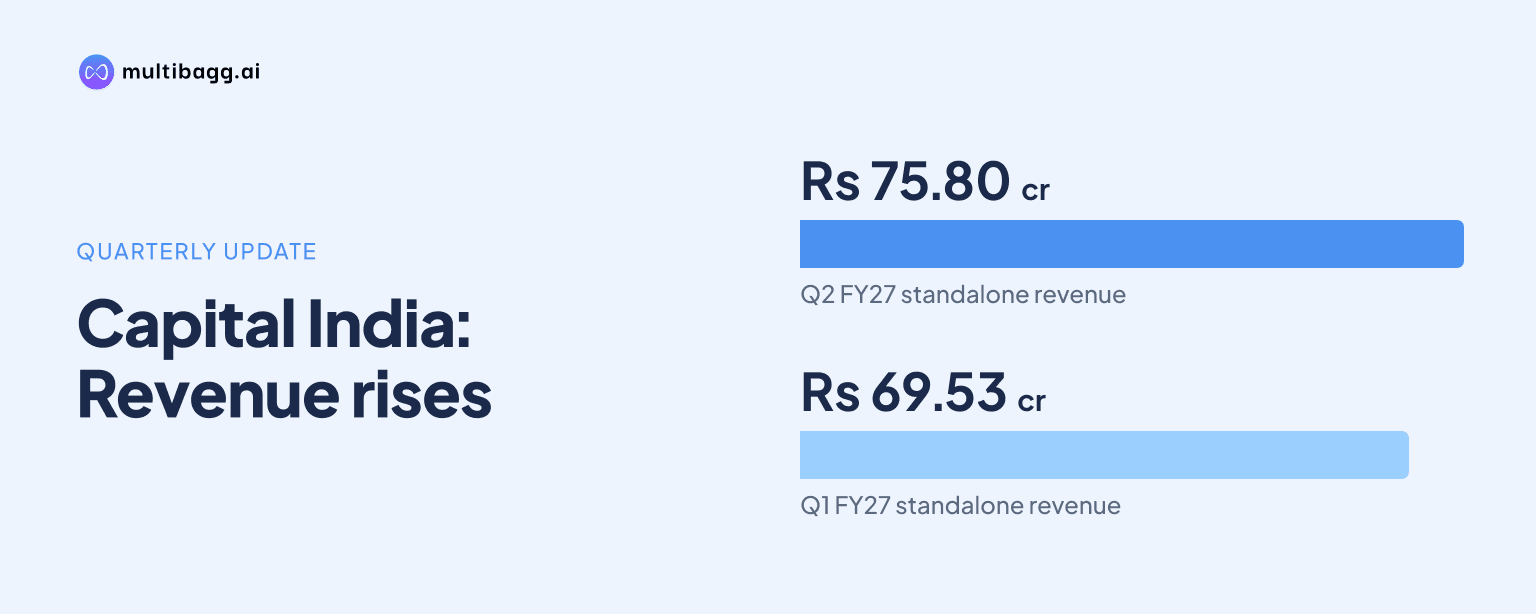
Capital India Finance Limited reported standalone revenue of ₹75.80 crore for the quarter ended September 30, 2026, up 8.7% from ₹69.53 crore in the preceding quarter. Its standalone revenue for the first half of FY27 reached ₹146.32 crore, a 44.5% increase from ₹101.22 crore a year earlier.
Know Capital India Finance inside out
Results, valuation, peers and who's buying, in one view.
What did Capital India Finance report for Q2 FY27?
Capital India Finance reported standalone revenue of ₹75.80 crore for Q2 FY27, compared with ₹69.53 crore in Q1 FY27. The sequential increase of ₹6.27 crore indicates higher reported revenue during the September quarter. The figures are based on the company's standalone financial data for the quarter ended September 30, 2026.
For the April-September period, standalone revenue was ₹146.32 crore, against ₹101.22 crore in the corresponding half-year period of the previous year. This represents growth of 44.5% year-on-year. The reported half-year figure combines the June-quarter revenue of ₹69.53 crore and the September-quarter revenue of ₹75.80 crore.
How did the September-quarter result unfold?
Capital India Finance had announced on October 31 that its board would meet on November 6, 2026, to consider unaudited financial results for Q2 and the half year ended September 30. The revenue update places the September quarter after a June quarter in which the company had reported standalone total income of ₹69.53 crore.
The company operates as a listed, non-deposit-taking non-banking financial company in the financial services sector. Its lending focus is on secured MSME and retail loans. Revenue growth is therefore relevant to investors assessing the scale of its lending and related financial operations, although the provided Q2 information does not specify the contribution from individual products or business lines.
Earlier disclosures said that Q1 FY27 standalone total income increased 32% year-on-year to ₹69.53 crore. Capital India Finance also reported that disbursements rose 36% year-on-year and assets under management increased 20% year-on-year during that quarter. These operating indicators provide context for the higher revenue reported in Q2, but the company has not provided corresponding Q2 disbursement or AUM figures in the available information.
What operating trends support the revenue growth?
Capital India Finance's FY26 operating metrics showed expansion in its lending business. Assets under management rose 22% year-on-year to ₹1,227.37 crore, while disbursements increased 62% to ₹753.54 crore. Total income for FY26 was ₹229.67 crore.
The company expanded its distribution network to 46 branches across nine states in FY26, compared with 29 branches in FY25. The larger branch network supports its secured MSME and retail lending operations. However, the available data does not quantify the revenue, loan book, or profitability generated by the additional branches.
Capital India Finance reported a capital adequacy ratio of 43.58% as of June 30, 2026. It also raised ₹100 crore through a private placement of listed, rated, senior secured non-convertible debentures in September 2026. The instruments carry a fixed annual coupon of 10%, payable quarterly, and have a tenure of 27 months.
Got a follow-up? Ask IRIS
Which financial figures are most important for investors?
The key reported figures are the 8.7% quarter-on-quarter revenue increase and the 44.5% first-half year-on-year increase. The September-quarter standalone revenue of ₹75.80 crore was ₹6.27 crore above the June-quarter level, while the first-half revenue was ₹45.10 crore higher than the prior-year comparable period.
The ₹100 crore NCD issuance adds a defined funding source for the business, while creating a fixed interest obligation at a 10% annual coupon. The company said the fundraise diversified its financing as lending activity and AUM continued to grow. Investors will need the detailed Q2 results to assess how funding costs, credit costs and operating expenses moved during the period.
How could the results affect Capital India Finance's business assessment?
The revenue growth follows a period of reported expansion in AUM, disbursements and physical distribution. For an NBFC focused on secured MSME and retail lending, loan growth, funding availability and capital strength are material operating factors. Capital India Finance's reported CAR of 43.58% indicates the capital position disclosed at the end of the June quarter.
The company has also moved through uneven profitability in earlier periods. Available data for Q1 FY27 showed standalone net profit of ₹3.76 crore, compared with ₹0.10 crore in the year-ago quarter, while another earlier report recorded a Q3 FY26 net loss of ₹0.42 crore. These figures underline why the detailed September-quarter profit and loss statement will be important alongside revenue growth.
For customers and local lending markets, the branch expansion and secured-loan focus may broaden access to the company's products in its operating states. For shareholders, the reported revenue figures provide evidence of top-line growth, but they do not independently establish earnings performance, asset quality or returns for Q2 FY27.
Conclusion
Capital India Finance reported a higher standalone revenue base in Q2 FY27, with quarterly revenue rising 8.7% to ₹75.80 crore and first-half revenue increasing 44.5% year-on-year to ₹146.32 crore. The result aligns with previously disclosed growth in AUM and disbursements, alongside a wider branch network and fresh debt funding.
The next point to watch is the detailed unaudited Q2 and half-year financial result considered by the board on November 6, 2026. Investors will look for disclosures on net profit, loan-book growth, disbursements, funding costs, asset quality and the effect of the ₹100 crore NCD issuance.