










Rolex Rings Limited Q2 Revenue Rises 43% to Rs 389 Crore
Key highlights
- Rolex Rings Limited reported Q2 FY27 revenue of Rs 389 crore, up 43.4% year on year.
- Q2 FY27 EBITDA was Rs 94 crore, up 72.0% year on year, with a 24.2% margin.
- About Rs 18 crore of Q2 FY27 revenue came from a one-time customs-duty refund.
- Rolex Rings expects initial defence and aerospace revenue within 12-18 months from Q2 FY27.
powered by IRIS
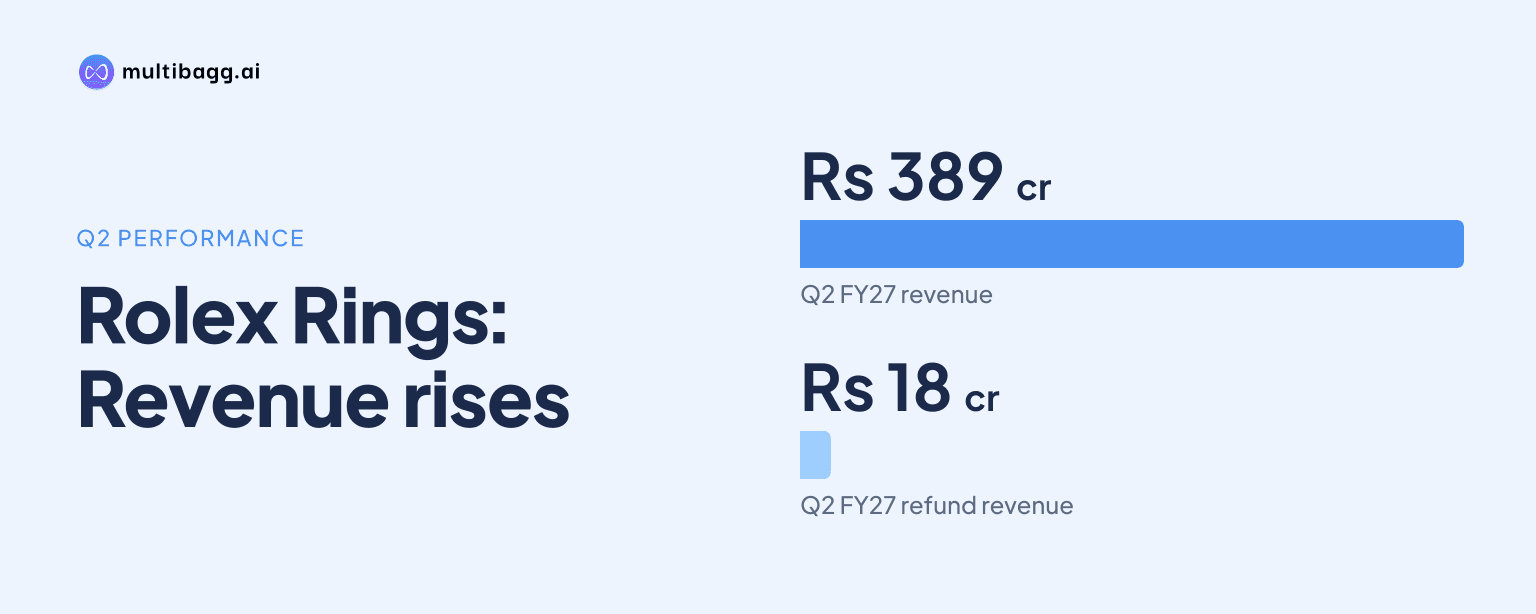
Rolex Rings Limited reported Q2 FY27 revenue from operations of Rs 389 crore, up 43% year on year and 28% sequentially, with about Rs 18 crore coming from a one-time customs-duty refund. The quarter also saw EBITDA rise 72% year on year to Rs 94 crore and profit after tax increase to Rs 74 crore.
Know Rolex Rings inside out
Results, valuation, peers and who's buying, in one view.
What did Rolex Rings Limited report for Q2 FY27?
Rolex Rings Limited reported revenue from operations of Rs 389 crore for the quarter ended September 2026, compared with Rs 271.38 crore in the corresponding quarter a year earlier. The company said revenue rose 43.4% year on year, while the quarter-on-quarter increase was 28%.
The company reported EBITDA of Rs 94 crore, up 72% year on year, and an EBITDA margin of 24.2%. Profit after tax stood at Rs 74 crore, rising about 67.5% year on year. The results were announced on November 4, 2026, ahead of the company’s Q2 and H1 FY27 earnings call on November 5.
What contributed to Rolex Rings' quarterly revenue growth?
Rolex Rings' reported revenue included about Rs 18 crore of one-time customs-duty refunds linked to higher US tariffs. This item contributed to the reported quarterly revenue figure and should be considered separately when assessing the underlying operating performance of the period.
Management also cited a strong order book and said it expected stronger performance in the second half of FY27. The available disclosures do not specify the composition of the order book, the customer mix, or the share of revenue attributable to individual end markets. The company’s investor presentation reported the quarterly figures, while a transcript of the Q2 call was not available in the material provided.
The sequential revenue increase of 28% indicates that the September-quarter performance was higher than the preceding June quarter. However, the company has not provided separate revenue figures in the supplied material for its automotive, industrial, export, or other operating categories.
When could Rolex Rings earn revenue from defence and aerospace?
Rolex Rings expects initial revenue from defence and aerospace within 12 to 18 months from Q2 FY27 after receiving registrations and initial approvals for relevant components. Management described the opportunity as being at a primary stage and said it was unlikely to make a significant contribution over the next 12 months.
The company said the products being assessed fit its existing forging and machining facilities. It did not disclose the specific component applications, customers, defence platforms, aerospace programmes, or prospective order values during the Q2 and H1 FY27 call.
This distinction is important because registrations and initial approvals can enable participation in a new supply chain but do not by themselves establish material revenue. The company’s stated timeline points to an early-stage business development effort rather than an immediate change in its reported financial mix.
Got a follow-up? Ask IRIS
How is Rolex Rings expanding its manufacturing capabilities?
Rolex Rings is exploring inorganic options in India to add value-added processes and has appointed a global agency to evaluate potential partners. The company did not identify potential acquisition targets, partnership candidates, investment amounts, or a timetable for completing a transaction.
The stated focus on value-added processes is consistent with the company’s existing role as a manufacturer of forged and machined components. Rolex Rings is described as one of India’s top five forging companies, and management said the potential defence and aerospace products can be produced using its current facilities.
Any inorganic transaction would require further company disclosures on the target, consideration, financing structure, approvals, and expected operating benefits. At present, the announced step is limited to evaluating potential partners through the appointed agency.
What do the Q2 FY27 results mean for investors?
Rolex Rings' Q2 FY27 results show higher reported revenue, EBITDA, and profit, but the Rs 18 crore customs-duty refund was a one-time item within revenue. Investors assessing recurring performance may therefore distinguish between the reported Rs 389 crore revenue figure and the contribution from this refund.
The 24.2% EBITDA margin and 72% year-on-year EBITDA growth indicate that profit growth exceeded revenue growth in the reported quarter. But the supplied information does not provide a detailed cost breakdown, volume data, product-level margins, or guidance that would explain the precise drivers of the margin movement.
The defence and aerospace opportunity could broaden the company’s end-market presence over time, although management has explicitly said it is not expected to be significant in the next 12 months. The near-term financial discussion therefore remains centred on the existing business, the order book referenced by management, and the company’s expected H2 FY27 performance.
Conclusion
Rolex Rings delivered Q2 FY27 revenue of Rs 389 crore, with reported growth supported in part by an approximately Rs 18 crore one-time customs-duty refund. EBITDA of Rs 94 crore and profit after tax of Rs 74 crore reflected faster year-on-year growth than revenue, while the company also outlined early progress in defence and aerospace registrations and approvals.
The next areas to watch are management’s expected H2 FY27 performance, further disclosure on the order book, and any update on inorganic partnerships for value-added processes. Investors will also look for evidence of defence and aerospace revenue as the company works toward its stated 12-18 month timeframe.