










Rolex Rings Targets Defence and Aerospace Revenue in 12-18 Months
Key highlights
- Rolex Rings expects initial defence and aerospace revenue within 12-18 months, with no significant contribution expected in the next 12 months.
- Rolex Rings reported Q2 FY27 revenue from operations of Rs 389 crore, including about Rs 18 crore of one-time customs-duty refunds.
- Auto-component revenue rose 68% year on year to Rs 177 crore in Q2 FY27, while bearing-ring revenue increased 6% to Rs 153 crore.
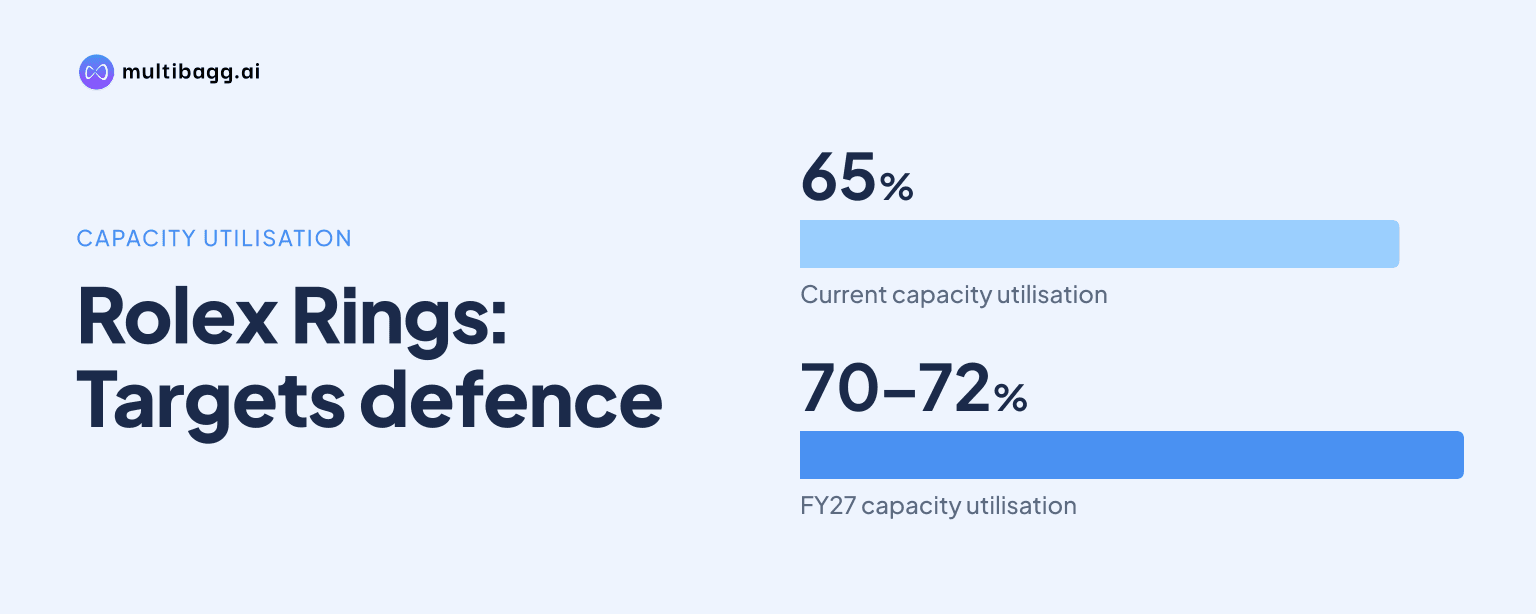
- Rolex Rings was operating at 65% capacity utilisation and targets 70%-72% by the end of FY27.
powered by IRIS
Rolex Rings Limited expects initial defence and aerospace revenue within 12-18 months from Q2 FY27, after receiving registrations and initial approvals for components suited to its existing facilities. Management said the opportunity remains at a primary stage and is unlikely to make a significant contribution during the next 12 months.
Know Rolex Rings inside out
Results, valuation, peers and who's buying, in one view.
What products is Rolex Rings pursuing for defence and aerospace?
Rolex Rings is pursuing round and hot-forged components for defence use, alongside certain engine and technical transmission parts for aerospace. Management said these products fit its current forging and machining facilities, but it did not disclose individual applications, customers or programmes during the Q2 and H1 FY27 call.
The company has received registrations and initial approvals in both sectors and is working with a senior consultant on the entry effort. These steps do not amount to a disclosed supply contract, order book or revenue target, and management said some application details could not be discussed publicly because of the nature of the sectors.
Rolex Rings currently uses its forging and machining base for bearing rings and automotive components. Management said the facilities are fungible between those existing businesses, allowing capacity to be directed towards programmes based on volume, tenure and margin, rather than requiring a separately announced defence or aerospace plant.
When will Rolex Rings begin earning defence and aerospace revenue?
Rolex Rings expects defence and aerospace revenue over the next 12-18 months, but management said a significant or considerable number should not be expected in the next 12 months. The timetable reflects an entry-stage process involving registrations, approvals, development and qualification rather than a confirmed production launch.
Management described defence and aerospace as a medium-term growth avenue while maintaining its FY28 outlook for revenue growth moving towards the high teens. It also said FY28 earnings before interest, tax, depreciation and amortisation, or EBITDA, margin could be 50-75 basis points above FY27 levels, without attributing that outlook to the new vertical.
The company cited a 15-18-month minimum validation period for new customers in its established industry. Rolex Rings did not say defence and aerospace follow the same validation cycle, but its 12-18-month revenue expectation is management's indication that the relevant approval and development work must advance before sales begin.
Can Rolex Rings use existing capacity for the new vertical?
Rolex Rings plans to use existing facilities for its initial defence and aerospace work while operating at 65% capacity utilisation in FY27. Management expects utilisation to move towards 70%-72% by the end of FY27 within planned annual capital expenditure of Rs 30 crore-Rs 40 crore.
That capacity will also support the existing order book, which management placed at Rs 120 crore-Rs 125 crore a month for H2 FY27. It said October 2026 had similar product-revenue traction, excluding scrap and export incentives, as automotive programmes started in FY26 move towards higher run rates.
Auto components accounted for 54% of Rolex Rings' sales in Q2 FY27, up from 42% in the comparable quarter of the prior fiscal year. This mix change was a stated contributor to higher profitability, while the proposed defence and aerospace products are intended to use the same hot-forging and precision-machining capabilities.
Got a follow-up? Ask IRIS
What existing business trends support Rolex Rings' pipeline?
Rolex Rings reported Q2 FY27 revenue from operations of Rs 389 crore, up 43% year on year and 28% quarter on quarter. The total included about Rs 18 crore of one-time United States customs-duty refunds, and management said revenue excluding that item grew about 32% year on year.
Auto-component revenue rose 68% year on year to Rs 177 crore in Q2 FY27, while bearing-ring revenue increased 6% to Rs 153 crore. Auto-component exports climbed 89% to Rs 129 crore, whereas bearing-ring exports were broadly flat at Rs 38 crore as management described European industrial demand as soft.
For H1 FY27, Rolex Rings remained debt-free after completing a Rs 180 crore buyback and held about Rs 260 crore in cash, bank balances and liquid investments. Operating cash flow was affected by a working-capital increase of about Rs 74 crore, as inventory and receivables rose with Q2 sales and longer export transit times.
Management said it expects part of the working-capital increase to unwind in H2 FY27 as freight links normalise. It also said ocean freight rates had begun declining from October 2026, after freight had run at nearly three times normal levels during Q2 FY27 and affected costs that are not covered by its raw-material and foreign-exchange pass-through mechanisms.
How do larger industrial components fit Rolex Rings' plans?
Rolex Rings is also receiving domestic inquiries for larger bearing rings used in wind and industrial equipment, which management said carry better margins than traditional rings. These opportunities require development and testing, and management did not include them in the near-term order-book outlook.
For FY28, management envisages the monthly Rs 125 crore order-book level increasing by at least 5%-7%, supported principally by automotive programme ramp-ups and potentially larger industrial components. This was management's outlook, not a confirmed sales forecast, and it remains separate from the early-stage defence and aerospace entry.
The company is exploring inorganic options to add value-added processes in India and has appointed a global agency to evaluate potential partners. Management said the exercise is at an early stage, with the aim of adding processes and original equipment manufacturer access, but it disclosed no transaction, investment amount or timetable.
Conclusion
Rolex Rings has established an entry pipeline for defence and aerospace by obtaining initial registrations and approvals for round and hot-forged parts that can be made in its present facilities. The opportunity sits alongside a Q2 FY27 business in which auto-component revenue rose 68% to Rs 177 crore, while the company continues to use shared capacity for automotive and bearing-ring programmes.
The next disclosed milestones are progress towards first revenue within the stated 12-18-month period and capacity utilisation of 70%-72% by the end of FY27. Management's planned annual capital expenditure of Rs 30 crore-Rs 40 crore, development of larger industrial bearing rings and evaluation of value-added-process partners will indicate how Rolex Rings expands its technical and production scope.