










Rolex Rings expects FY28 margin expansion as freight eases
Key highlights
- Rolex Rings expects FY28 EBITDA margin to be 50-75 basis points above FY27.
- Q2 FY27 EBITDA margin was 24.2%, or about 21% excluding the one-time Rs 18 crore customs-duty refund.
- Auto components reached 54% of Q2 FY27 sales, up from 42% a year earlier.
- Ocean freight was nearly three times normal levels in Q2 FY27 but began declining in October 2026.
powered by IRIS
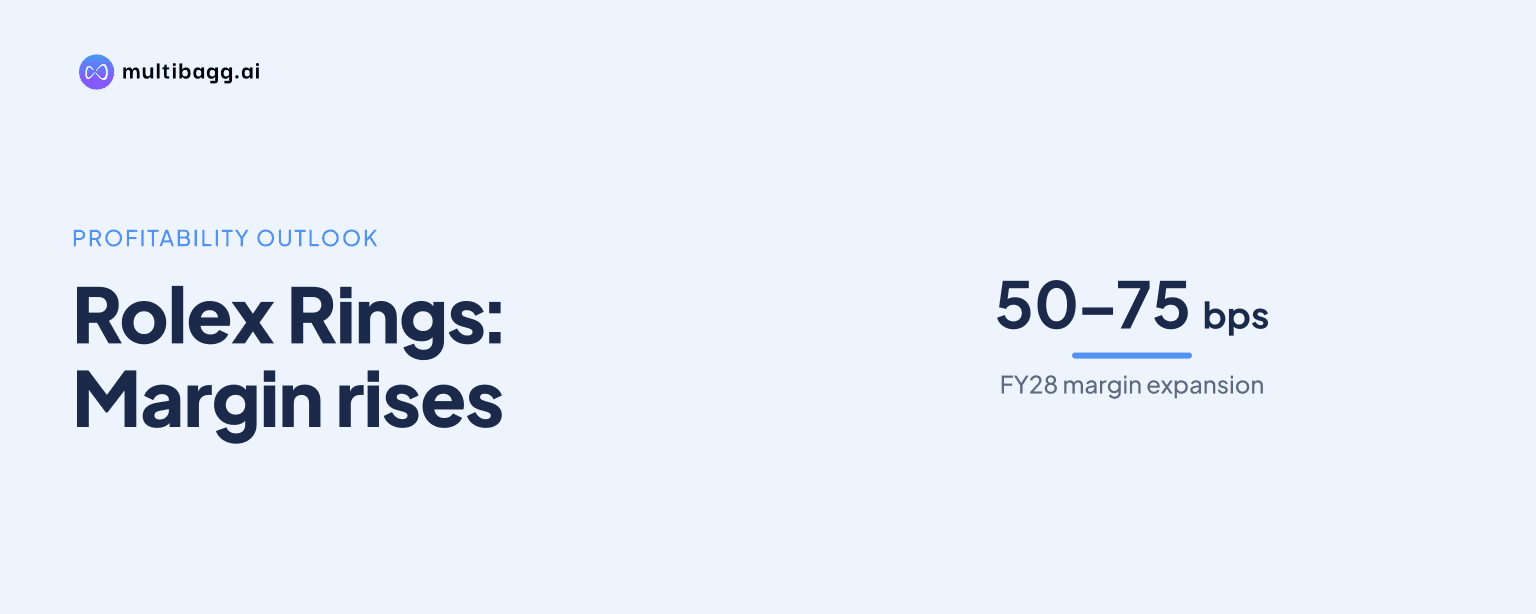
Rolex Rings Limited expects FY28 EBITDA margin to be 50-75 basis points above FY27 as ocean-freight rates ease and auto components account for a larger share of sales. In Q2 FY27, Rolex Rings reported a 24.2% EBITDA margin, although management said the margin was about 21% excluding a one-time Rs 18 crore customs-duty refund.
Know Rolex Rings inside out
Results, valuation, peers and who's buying, in one view.
Why does Rolex Rings expect FY28 EBITDA margin to expand?
Rolex Rings expects FY28 EBITDA margin to be around 50-75 basis points higher than FY27, supported by lower freight costs, a richer auto-component mix and greater capacity utilisation. Management gave this outlook on November 5, 2026, after Q2 FY27 EBITDA rose 72% year on year to Rs 94 crore and the reported margin increased by almost 400 basis points to 24.2%.
The Q2 result included Rs 18 crore of refunds for customs duties paid under an earlier United States tariff regime, which management recognised in revenue as a one-time item. Excluding that refund, management put Q2 EBITDA margin at about 21%, within its stated 21%-22% operating-margin range. The FY28 outlook therefore relies on operational factors rather than another tariff refund.
How are freight costs affecting Rolex Rings' margins?
Freight costs reduced Rolex Rings' underlying Q2 FY27 margin because ocean rates were nearly three times their normal level and customer contracts do not provide freight pass-through. Management also reported a 40% rise in fuel-gas prices and higher consumable costs following the escalation of the West Asia conflict, which raised other expenses during the quarter.
Rolex Rings passes commodity and foreign-exchange movements to customers, but initially absorbs shipping-cost changes. Management said it had absorbed most of the freight increase by Q2 FY27 and was discussing cost-sharing with customers, particularly in the United States. During an earlier Red Sea disruption, customers partly reimbursed costs and one customer changed delivery terms for that period.
Management said ocean-freight rates had begun declining in October 2026 and expects lower rates, alongside further auto-component growth, to return operating margins to the 21%-22% range. Longer export transit times also lifted working capital by about Rs 74 crore in H1 FY27, contributing to operating cash flow of Rs 68 crore. Management expects part of that working-capital increase to unwind in H2 FY27 as freight links normalise.
How is the auto-component mix changing at Rolex Rings?
Auto components accounted for 54% of Rolex Rings' overall Q2 FY27 sales, up from 42% in Q2 of the prior fiscal year, and management identified the mix shift as the main driver of its margin profile. Auto-component revenue rose 68% year on year to Rs 177 crore, while bearing-ring revenue grew 6% to Rs 153 crore.
Export growth was concentrated in auto components. Total component exports increased 55% year on year to Rs 167 crore, representing 51% of component sales, while auto-component exports rose 89% to Rs 129 crore. Domestic auto-component revenue increased 29% to Rs 48 crore, showing that the higher-value mix was advancing in both export and domestic markets.
Management said products with more value-added processes, including electric-vehicle and hybrid bearing rings and other critical rings, can generate economics similar to auto components. Bearing-ring exports, however, were broadly flat at Rs 38 crore because European industrial demand remained soft. Domestic bearing-ring revenue rose almost 10% to Rs 115 crore, while Rolex Rings pursues new ring customers in Europe and the United States.
Got a follow-up? Ask IRIS
What volume and capacity plans support Rolex Rings' FY28 outlook?
Rolex Rings expects FY28 revenue growth to move towards the high teens as previously won programmes reach fuller volumes. Management said FY27 auto-component revenue should exceed Rs 550 crore to Rs 575 crore, compared with about Rs 505 crore in FY26, and expects the auto-component segment to grow at least 20%-22% year on year thereafter.
The company reported an H2 FY27 order book of Rs 120 crore to Rs 125 crore per month. Management said one of two new customer plants would begin supplies in Q3 FY27 and the other in early Q4 FY27, while programmes started in the last quarter of FY26 were ramping through FY27. A couple of United States programmes remained on hold at the original equipment manufacturer level.
Rolex Rings was operating at 65% capacity utilisation and expects to reach 70%-72% by the end of FY27 within annual capital expenditure of Rs 30 crore to Rs 40 crore. Management said its forging and machining facilities can serve both bearing rings and auto components, allowing capacity to be allocated to programmes with the appropriate volume, tenure and margin.
What could change Rolex Rings' margin recovery?
Rolex Rings' margin recovery would be affected if ocean freight stays elevated, customer discussions do not result in cost sharing, or auto components do not continue gaining sales share. The contrast in Q2 FY27 illustrates the exposure: reported EBITDA margin was 24.2%, while management estimated margin at about 21% without the Rs 18 crore customs-duty refund.
European industrial demand is a specific consideration for bearing rings, as exports in that segment were flat at Rs 38 crore in Q2 FY27. Management said Europe represented about 23%-24% of overall business and that most new programmes won were European auto-component programmes. Its effort to add European bearing-ring customers remains under development rather than confirmed revenue.
Defence and aerospace are also early-stage opportunities. Rolex Rings said it had received registrations and initial approvals and expects segment revenue over the next 12-18 months, but management said significant revenue would be difficult within the next 12 months. Larger wind and industrial bearing-ring inquiries require development and testing before they can contribute to FY28 volumes.
Conclusion
Rolex Rings' FY28 margin outlook combines a stated 50-75-basis-point improvement with identifiable operating mechanisms. Freight rates had started declining in October 2026, auto components had reached 54% of Q2 FY27 sales, and utilisation was planned to increase from 65% towards 70%-72%. The Rs 18 crore tariff refund remains separate from the underlying operating-margin assessment.
The next disclosures to watch are H2 FY27 conversion of the Rs 120 crore to Rs 125 crore monthly order book, the planned supply starts at two customer plants in Q3 and early Q4 FY27, and any reduction in the Rs 74 crore working-capital increase. Management's FY28 high-teens growth and margin-expansion expectation depends on those programmes ramping and freight conditions continuing to normalise.