










Rolex Rings says US tariff disruption ended as sales double
Key highlights
- Rolex Rings reported US component revenue of Rs 92 crore in Q2 FY27, more than double year on year.
- Rolex Rings recognized about Rs 18 crore of one-time historic US customs-duty refunds in Q2 FY27.
- Q2 FY27 revenue from operations was Rs 389 crore, up 43% year on year, including the refund.
- Management said its H2 FY27 order book was Rs 120 crore to Rs 125 crore per month.
powered by IRIS
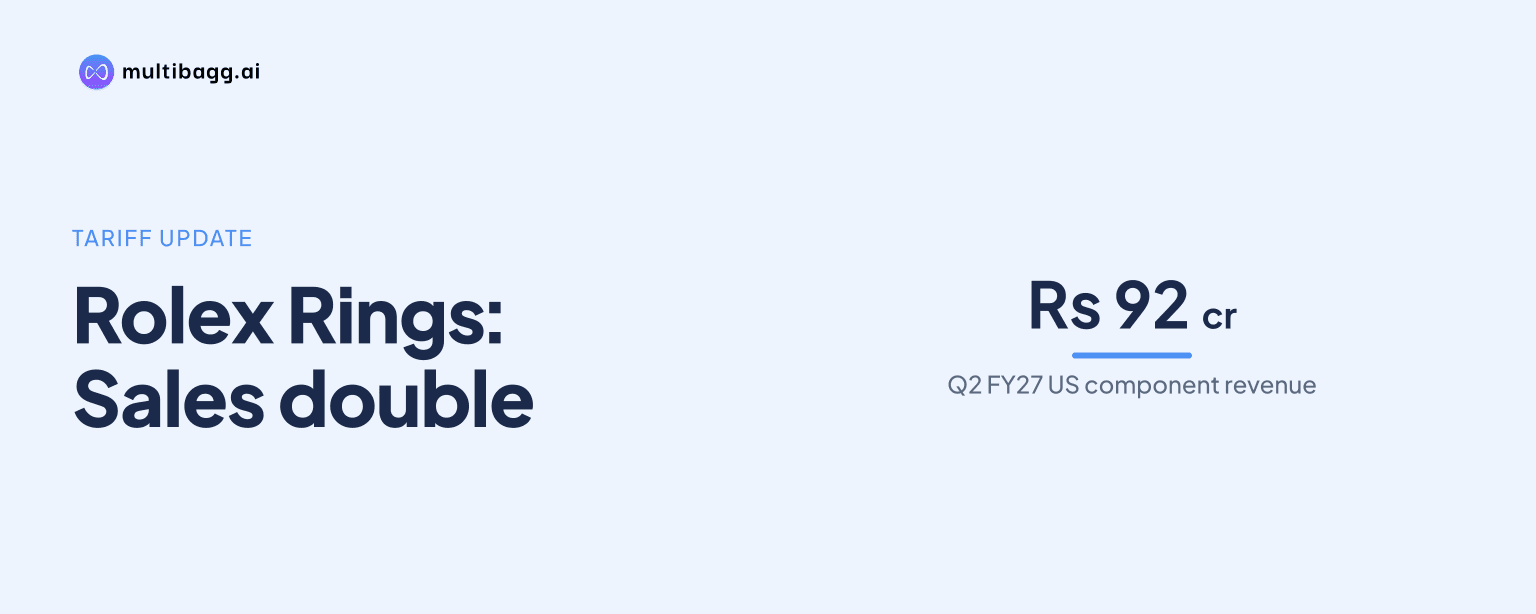
Rolex Rings Limited said the United States tariff disruption was no longer affecting business in the second quarter of fiscal 2027 (Q2 FY27), when US component revenue more than doubled year on year to Rs 92 crore and it recognized about Rs 18 crore of historic-duty refunds. Management said customers had accepted the current duty structure and order flows had normalized.
Know Rolex Rings inside out
Results, valuation, peers and who's buying, in one view.
Did Rolex Rings say customers reimburse a 25% US duty?
No. Rolex Rings said customers had accepted the current US duty structure, but its November 5, 2026 earnings call did not disclose a 25% tariff rate or say customers reimburse current duties. Management instead discussed refunds of duties paid under an earlier tariff regime and said it had registered the majority of those claims with US Customs.
The approximately Rs 18 crore refund was recognized in Q2 FY27 revenue from operations and described as a one-time item. In response to an analyst, Chief Financial Officer Hiren Doshi said the refund would be reported under other income in segment reporting, although it was included in the revenue-from-operations line presented for the quarter.
Management’s statement on current tariffs was operational, not a description of a customer pricing agreement. Rolex Rings separately said raw-material and foreign-exchange changes are passed through in customer contracts, whereas freight is initially borne by the group, which was facing ocean freight at nearly three times normal levels during Q2 FY27.
How did Rolex Rings’ US orders recover in Q2 FY27?
Rolex Rings’ US orders recovered as component revenue from the market more than doubled year on year to Rs 92 crore in Q2 FY27. Management said customers that had held back volumes during FY26 returned with meaningful orders after accepting the current duty structure, and that no customer was lost during the disruption.
A key customer whose volumes had fallen by 35% to 40% in FY26 had returned to its FY25 level, according to management. Rolex Rings also said US automotive revenue more than doubled in the quarter, though it did not disclose a separate automotive revenue figure for the United States.
Exports increased 55% year on year to Rs 167 crore and represented 51% of Q2 FY27 component sales. Auto-component exports rose 89% to Rs 129 crore, compared with 29% growth to Rs 48 crore in domestic auto-component revenue, showing that the stronger export performance was concentrated in that product category.
The bearing-ring trend differed from auto components. Domestic bearing-ring revenue rose nearly 10% to Rs 115 crore, but bearing-ring exports were broadly flat at Rs 38 crore because management said industrial demand in Europe remained soft; it is seeking additional bearing-ring customers in Europe and the US.
Got a follow-up? Ask IRIS
How much did the duty refund affect Rolex Rings’ Q2 results?
The approximately Rs 18 crore historic-duty refund increased reported Q2 FY27 revenue and profitability, while Rolex Rings said earnings before interest, tax, depreciation and amortisation (EBITDA) margin would have been around 21% without it. Reported EBITDA margin was 24.2%, 400 basis points above the year-earlier quarter.
Revenue from operations rose 43% year on year and 28% sequentially to Rs 389 crore, including the refund. Management said revenue excluding the one-time benefit grew about 32% year on year, while component sales, comprising bearing rings and auto components, also rose 32% to Rs 330 crore.
The sales mix changed materially from Q2 FY26, with auto components contributing 54% of overall sales, against 42% a year earlier. Management attributed gross-margin expansion of nearly 700 basis points to the richer auto-component mix, raw-material price pass-through and the duty refund.
Profit after tax (PAT) rose 68% year on year to Rs 74 crore and PAT margin increased 280 basis points to 19.1%. The quarter also included fuel-gas prices up 40% and higher consumable costs following the escalation of the West Asia conflict, alongside the elevated freight expense.
What does Rolex Rings expect for H2 FY27?
Rolex Rings expects the second half of FY27 to be stronger than the first half, supported by an order book of Rs 120 crore to Rs 125 crore per month, two customer-plant supply starts in Q3 and early Q4, and FY26 programme wins moving towards higher volumes. Management said the Q1 labour constraint had been fully normalized from the start of Q2.
For the first half of FY27 (H1 FY27), revenue from operations increased 23% year on year to Rs 694 crore. Auto-component revenue grew 28% to Rs 318 crore, bearing-ring revenue was flat at Rs 271 crore, exports rose 26% to Rs 296 crore, EBITDA increased 40% to Rs 163 crore and PAT rose 44% to Rs 134 crore.
Rolex Rings was operating at 65% capacity utilisation and management expects 70% to 72% by the end of FY27. It plans annual capital expenditure of Rs 30 crore to Rs 40 crore and said its forging and machining facilities can be allocated between bearing rings and auto components according to volume, tenure and margin requirements.
Management said ocean freight had begun declining in October 2026 and expects operating margin to move back into its 21% to 22% guided range as freight normalizes and auto components increase in the mix. It also said a couple of US programmes remain on hold with an original equipment manufacturer, while other previously announced programmes are returning and newer FY26 programmes have begun supplies.
Conclusion
Rolex Rings reported a clear Q2 FY27 recovery in US demand, with Rs 92 crore of component revenue from the market, while the approximately Rs 18 crore historic-duty refund added a one-time benefit to reported revenue and margin. The call supports management’s view that customers have accepted the current duty structure and orders have normalized, but it does not support a claim that customers reimburse a disclosed 25% current tariff.
The next disclosures to watch are the planned Q3 and early-Q4 supply starts at two customer plants, progress toward 70% to 72% capacity utilisation by FY27-end, and the effect of lower freight rates on the 21% to 22% EBITDA-margin range cited by management. The unresolved matter is the timing of the couple of US original-equipment-manufacturer programmes that remain on hold.