










Clean Max Enviro Energy Solutions Limited funds Rs 4,276 crore outlay
Key highlights
- Clean Max recorded Rs 4,276.015 crore of net investing cash outflow in the six months ended 30 September 2026.
- Clean Max reported negative operating cash flow of Rs 202.096 crore, against positive Rs 1,375.682 crore a year earlier.
- Financing activities generated Rs 4,164.657 crore, including Rs 4,811.606 crore of non-current borrowing proceeds.
- Total borrowings rose to Rs 17,226.927 crore at 30 September 2026 from Rs 12,410.764 crore at 31 March 2026.
powered by IRIS
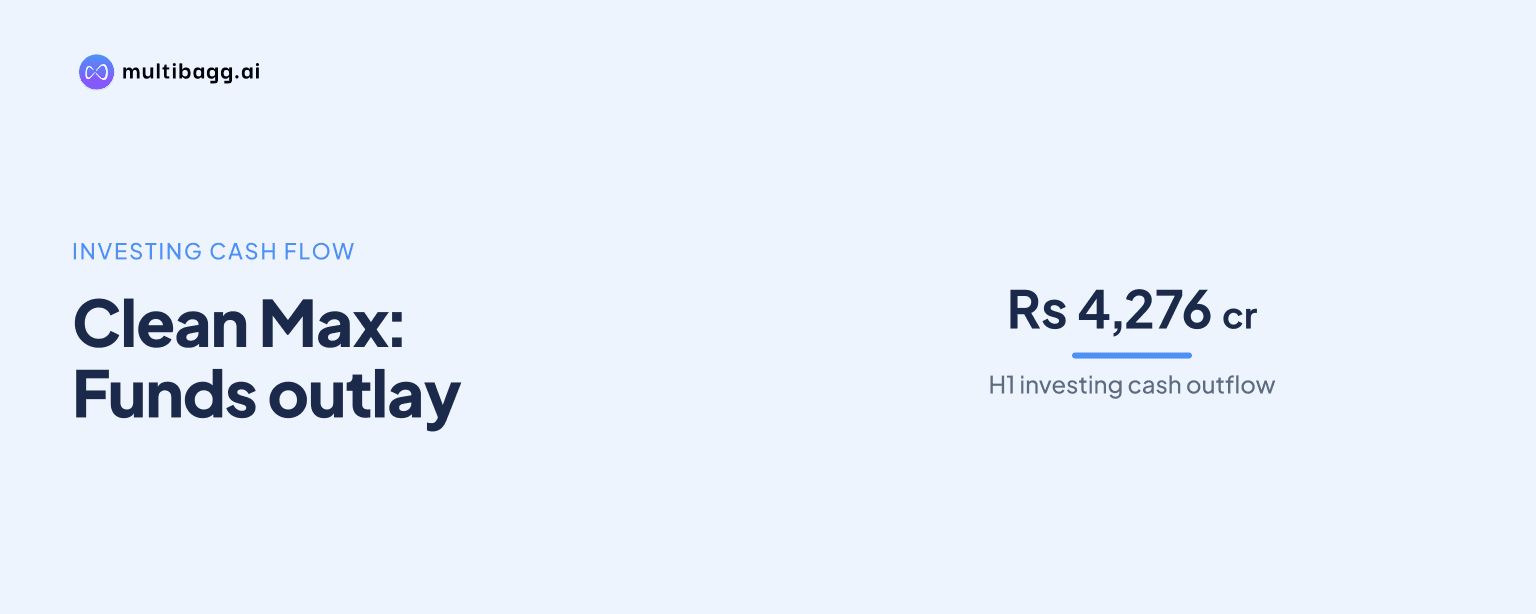
Clean Max Enviro Energy Solutions Limited funded a Rs 4,276.015 crore net investing cash outflow in the six months ended 30 September 2026 with Rs 4,164.657 crore of financing inflows, while operating activities used Rs 202.096 crore of cash. New non-current borrowings and non-convertible debentures were the principal financing sources.
Know Clean Max Enviro Energy Solutions inside out
Results, valuation, peers and who's buying, in one view.
Why did Clean Max’s operating cash flow turn negative?
Clean Max’s operating cash flow turned negative because working-capital movements and tax payments exceeded cash generated before those movements. Operating profit before working-capital changes increased to Rs 1,003.580 crore in the six months ended 30 September 2026 from Rs 632.421 crore a year earlier, but net operating cash flow moved to an outflow of Rs 202.096 crore from an inflow of Rs 1,375.682 crore.
The change was led by trade payables, which used Rs 899.346 crore of cash in the 2026 period after contributing Rs 920.406 crore in the comparable six months of 2025. Trade receivables absorbed Rs 320.449 crore, compared with Rs 29.120 crore a year earlier, while inventories used Rs 57.235 crore after releasing Rs 20.526 crore. Income taxes paid rose to Rs 168.764 crore from Rs 16.792 crore.
Reported earnings nevertheless increased during the period. Profit after tax rose to Rs 120.123 crore from Rs 19.004 crore, and earnings before interest, tax, depreciation, impairment and amortisation, or EBITDA, increased to Rs 1,010.589 crore from Rs 637.858 crore. Finance costs rose to Rs 544.007 crore from Rs 416.075 crore, illustrating that the higher earnings did not translate into positive operating cash flow in this six-month period.
How much did Clean Max invest in six months?
Clean Max used Rs 4,276.015 crore in net investing cash flows in the six months ended 30 September 2026, compared with Rs 3,238.201 crore in the prior-year period. Capital expenditure on property, plant and equipment, capital work-in-progress, intangible assets, assets under development and capital advances accounted for Rs 3,320.753 crore, marginally above Rs 3,260.264 crore a year earlier.
Other investment-related uses included Rs 766.882 crore of net movement in current investments, Rs 123.655 crore of restricted bank-balance use and Rs 80.994 crore of net investments in fixed deposits. Loans given to joint ventures used Rs 22.722 crore. Interest received on loans and deposits contributed Rs 34.504 crore and dividend income received was Rs 3.256 crore, but these receipts did not materially offset the wider investing outflow.
The balance sheet reflected the project-related deployment. Property, plant and equipment rose to Rs 13,770.535 crore at 30 September 2026 from Rs 11,744.512 crore at 31 March 2026, while capital work-in-progress increased to Rs 6,745.744 crore from Rs 5,339.212 crore. Renewable Energy Power Sales segment assets rose to Rs 23,233.730 crore from Rs 19,673.400 crore over the same period.
How did Clean Max finance its investment outlay?
Clean Max financed most of the Rs 4,276.015 crore investing outflow through Rs 4,164.657 crore of financing cash inflow rather than cash from operations. Gross proceeds from non-current borrowings were Rs 4,811.606 crore, while proceeds from the issue of non-convertible debentures, or NCDs, were Rs 2,501.577 crore. These two debt sources together exceeded the group’s capital expenditure of Rs 3,320.753 crore.
The inflow was reduced by Rs 1,455.728 crore of non-current borrowing repayments, Rs 599 crore of NCD redemption and Rs 509.846 crore of net short-term borrowing repayments. Clean Max also paid Rs 624.598 crore of finance costs, Rs 112.780 crore of other borrowing costs, Rs 82.023 crore of lease liabilities and Rs 27.383 crore of transaction costs related to borrowings.
Cash and cash equivalents declined by Rs 313.454 crore over the six months to Rs 892.253 crore at 30 September 2026, despite the financing inflow. In the prior-year six-month period, cash declined by Rs 112.263 crore to Rs 216.322 crore. The cash-flow statement was prepared under the indirect method set out in Indian Accounting Standard 7, or Ind AS 7.
Got a follow-up? Ask IRIS
What changed in Clean Max’s borrowings and debt measures?
Clean Max’s total borrowings increased to Rs 17,226.927 crore at 30 September 2026 from Rs 12,410.764 crore at 31 March 2026. Non-current borrowings increased by Rs 4,832.045 crore to Rs 16,144.467 crore, while current borrowings decreased to Rs 1,082.460 crore from Rs 1,098.342 crore. Total liabilities rose to Rs 21,593.063 crore from Rs 17,574.743 crore.
The debt-equity ratio was 2.89 at 30 September 2026, compared with 2.25 at 31 March 2026 and 3.80 a year earlier. Total debt to total assets was 0.63, up from 0.54 at the March year-end. The current ratio reached 1.00 from 0.66, with current assets of Rs 4,198.290 crore and current liabilities of Rs 4,183.943 crore.
Interest service coverage, defined by Clean Max as EBITDA divided by interest charged to profit and loss, was 2.36 for the six months ended 30 September 2026, compared with 1.87 a year earlier. Debt service coverage was 1.46 against 1.05. The disclosed calculations exclude loans repaid through initial public offering proceeds and loans refinanced with NCD proceeds.
What debt proceeds remain available to Clean Max?
Clean Max issued additional senior secured, rated, listed green NCDs with Rs 2,500 crore of principal during the quarter ended 30 September 2026. The stated uses include capital expenditure for projects, repayment or prepayment of long-term borrowings and general corporate purposes. Of the proceeds, Rs 1,692.252 crore had been utilised by 30 September 2026, leaving Rs 807.748 crore unutilised.
Of the unutilised NCD proceeds, Rs 716.920 crore was invested in debt mutual funds, a permitted investment under the debenture trust deed, and Rs 90.828 crore was held in escrow. Separately, Clean Max used Rs 1,122.674 crore of net initial public offering proceeds for prepayment of outstanding borrowings and Rs 26.572 crore for general corporate purposes. Fresh-issue expenses of Rs 5.150 crore remained in escrow.
Clean Max prepaid Rs 599 crore of 11.50% NCDs on 2 April 2026 using initial public offering proceeds, before their original 8 June 2027 repayment date. The amended NCD security package includes a subservient charge over cash flows and receivables, pledges over shares of identified project companies, interests in specified limited liability partnerships, designated-account deposits and specified subsidiary assets.
Conclusion
Clean Max’s six-month disclosures show that financing inflows of Rs 4,164.657 crore broadly supported a Rs 4,276.015 crore investing outflow as operating cash flow turned negative Rs 202.096 crore. The funding pattern coincided with Rs 4,832.045 crore growth in non-current borrowings and increased investment in property, plant and equipment and capital work-in-progress.
The next disclosed funding item is deployment of the Rs 807.748 crore of unutilised September 2026 NCD proceeds, including Rs 716.920 crore invested in debt mutual funds and Rs 90.828 crore in escrow. Clean Max also disclosed that the proposed amalgamation of four wholly owned subsidiaries, approved on 31 July 2026 and filed with the National Company Law Tribunal, Mumbai, on 17 October 2026, remains subject to regulatory approvals.