










Clean Science absorbs inflation as China blocks pass-through
Key highlights
- Clean Science's consolidated raw-material cost rose to 43.3% in Q2 FY27 from 39.7%.
- Clean Science said Chinese phenol prices were 10% to 15% lower than Indian prices.
- Clean Science reported Q2 FY27 consolidated revenue of Rs 295 crore, up 23% year on year.
- Clean Science said H1 FY27 HALS volume reached 67% of the previous full-year volume.
powered by IRIS
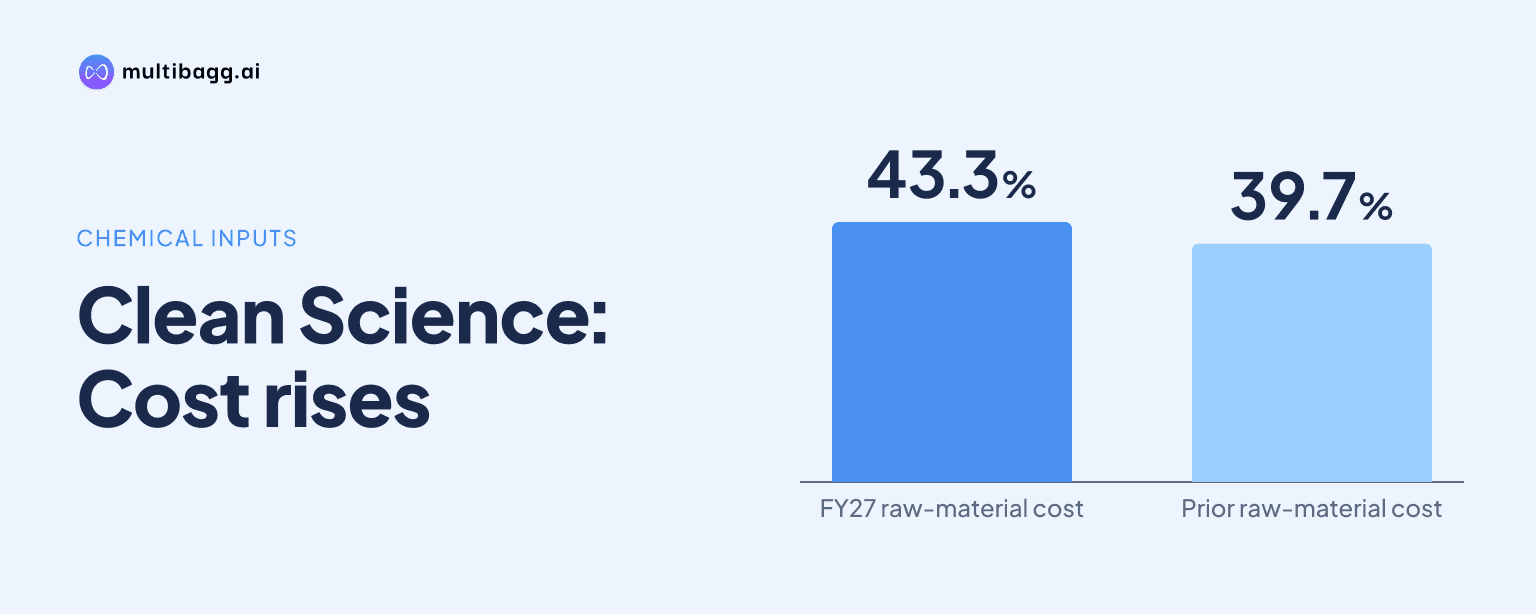
Clean Science and Technology Limited absorbed higher raw-material costs in Q2 FY27 because Chinese suppliers retained a 10% to 15% phenol-price advantage, limiting customer pass-through; consolidated raw-material cost rose to 43.3% of sales from 39.7%, even as consolidated revenue increased 23% year on year to Rs 295 crore.
Know Clean Science & Technology inside out
Results, valuation, peers and who's buying, in one view.
Why could Clean Science not pass higher raw-material costs to customers?
Clean Science could not fully pass through higher input costs because Chinese competitors had not raised their product prices while benefiting from lower phenol costs. Management said phenol prices in China were about Rs 1,300, compared with more than Rs 1,550 in India, creating a sufficiently large difference for Chinese suppliers to hold prices on hydroquinone and monomethyl ether of hydroquinone, or MEHQ.
The inflation was not confined to phenol in Q2 FY27. Management said phenol, acetone and methanol prices were 50% to 100% higher year on year, while coal and freight costs also increased as the Middle East conflict kept crude-linked feedstock prices elevated. Customer demand remained resilient, but management said pass-through was difficult because Chinese selling prices had yet to move up.
How did higher input costs affect Clean Science's margins?
Clean Science reported standalone earnings before interest, tax, depreciation and amortisation, or EBITDA, margin of 36% and profit after tax, or PAT, margin of 24% in Q2 FY27. Standalone revenue was Rs 226 crore, EBITDA was Rs 82 crore and PAT was Rs 55 crore, with management attributing margin moderation principally to raw-material cost rising to 41% from 35% in Q1 FY27.
Sequential standalone revenue increased 11% to Rs 226 crore, largely due to higher volume in Performance, Pharma and fast-moving consumer goods, or FMCG. In response to an analyst question, management said it was unable to add the full raw-material increase to selling prices, but volume growth enabled it to maintain the absolute earnings number. Management did not disclose EBITDA per kilogram.
The contrast between sequential and annual growth explains the margin outcome. Management said the entire sequential standalone sales increase was volume-led, whereas the 10% year-on-year standalone sales increase was primarily driven by improved realisation while volumes were broadly stable. As a result, the cost increase affected margins in the quarter even though demand conditions were described as steady.
How did standalone and consolidated Q2 FY27 performance compare?
Clean Science's consolidated revenue was Rs 295 crore in Q2 FY27, compared with standalone revenue of Rs 226 crore, while consolidated EBITDA and PAT were Rs 92 crore and Rs 56 crore respectively. Consolidated sales rose 23% year on year, against 10% standalone sales growth, with management attributing the consolidated increase to about 10% volume growth and 13% realisation growth.
The larger consolidated growth rate reflected continuing sales from the hindered amine light stabilisers, or HALS, business and the turnaround in the subsidiary, according to management. Consolidated EBITDA increased 6% year on year, a slower rate than sales, consistent with the higher raw-material cost burden and the company’s decision not to lead a price increase in a China-linked market.
For the first half of FY27, consolidated sales grew 17% to Rs 559 crore, with EBITDA of Rs 188 crore and PAT of Rs 129 crore. Performance accounted for 77% of the sales mix, Pharma Intermediates for 14% and FMCG for 7%. Those figures show that the established Performance business remained the largest contributor while HALS supported consolidated growth.
Got a follow-up? Ask IRIS
Is Clean Science protecting market share despite lower margins?
Clean Science said it was absorbing the immediate cost impact to avoid losing market share while competitors’ prices remained unchanged. Management said it was continuously attempting to raise prices, but severe customer pushback showed that market pricing remained constrained. It did not want to be the first supplier to increase prices and risk losing share that could be difficult to recover.
The constraint was particularly relevant to hydroquinone, catechol and MEHQ, where Chinese suppliers’ lower phenol costs affected competitive pricing. Management said hydroquinone and catechol capacity utilisation was about 30% to 35% in Q2 FY27, with current production largely consumed internally. Small external sales had begun in Europe and India, but the company’s external pricing remained exposed to the China-linked differential.
Management also put barbituric acid production on hold because Chinese pricing was not workable for the company at current input costs. It said the principal raw material is imported from China, while other raw materials purchased in India had become almost three times more expensive. The company had made changes to the planned plant but said producing the product did not make economic sense at that point.
What is Clean Science doing to improve HALS economics?
Clean Science expects backward integration and a changing HALS mix to improve margins over coming quarters, according to management. It has started an ethoxylation facility to make a precursor for one HALS product, and it expects to begin in-house production of another intermediate currently purchased from China in the next quarter. Management described both inputs as building-block raw materials rather than solvents.
HALS 770 represented 60% of the HALS portfolio, while advanced HALS represented 40%, management said during the Q2 FY27 call. Management expects the product mix to change quarter by quarter as higher-grade products gain volume. It said these higher-grade products, together with internally made precursors, should improve margins in the relevant HALS products.
Management said trials for an advanced-grade HALS product had been completed, with commercial launch expected in H2 FY27 and shipments to Europe expected to begin in November or December. It also outlined a planned 1,000-tonne line for an advanced HALS product called 2020, following plant and commercial trials, with start-up expected in April or May. The company said additional HALS debottlenecking and adjacent products would be considered over the next few quarters.
Conclusion
Clean Science's Q2 FY27 performance shows that revenue growth did not eliminate the effect of input inflation when Chinese competitors could maintain lower prices. Consolidated sales rose 23% year on year to Rs 295 crore, but raw-material cost increased to 43.3% from 39.7%. The 10% to 15% China phenol-cost advantage limited pass-through, while volume growth supported absolute earnings.
The next developments to watch are the planned commercialisation of Performance Chemical 2 in Q3 to Q4 FY27, the advanced-grade HALS launch in H2 FY27 and the expected November or December European shipments. Management also plans a 1,000-tonne HALS 2020 line to start in April or May, while the timing of any customer price increase remains unresolved and dependent on market conditions.