










Clean Science targets 55-60% HALS utilisation and capacity
Key highlights
- Clean Science expects HALS utilisation to rise from about 30%-40% to 55%-60% in the coming few quarters.
- Clean Science plans to raise total HALS capacity from about 11,500 tonnes to about 12,500 tonnes.
- HALS revenue doubled year on year in Q2 FY27, while H1 FY27 HALS volume reached 67% of the prior full-year volume.
- Clean Science reported Q2 FY27 consolidated revenue of Rs 295 crore, up 23% year on year.
powered by IRIS
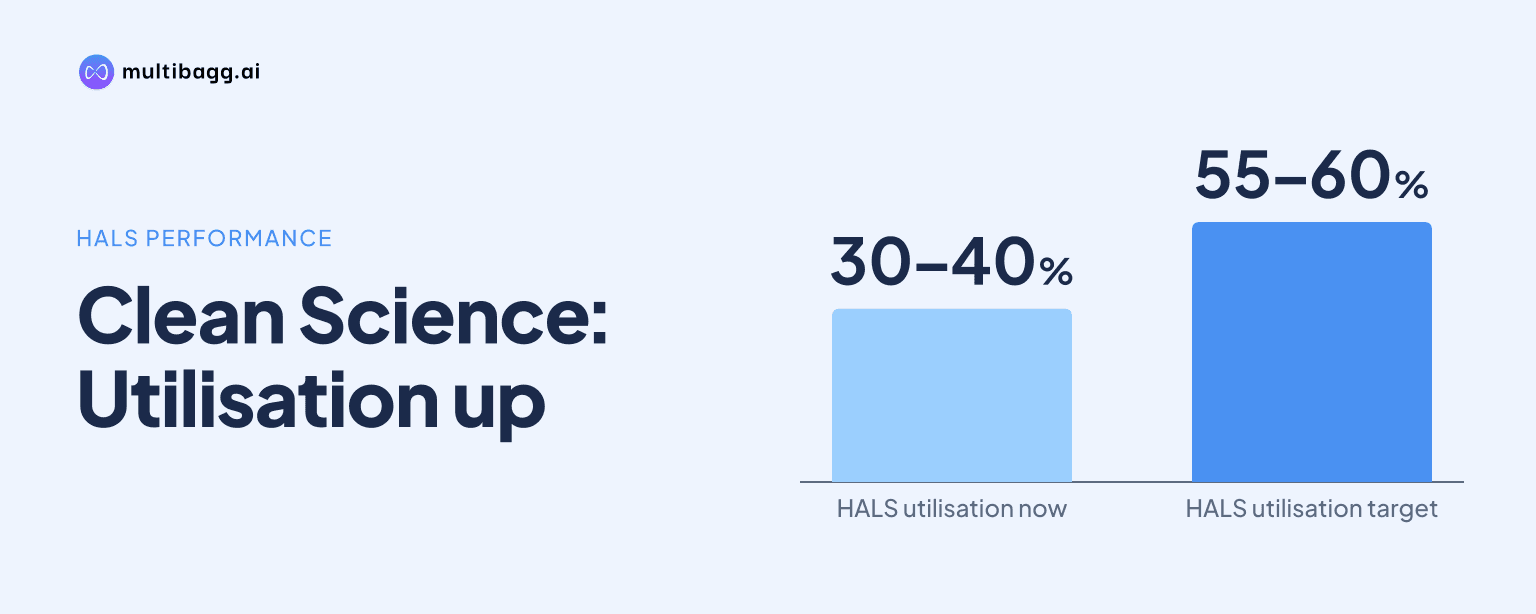
Clean Science and Technology Limited expects HALS utilisation to reach 55% to 60% in the coming few quarters, from about 30% to 40% currently, as advanced grades increase and total HALS capacity rises from about 11,500 tonnes to about 12,500 tonnes. Management said higher-end grades would drive most of the utilisation increase.
Know Clean Science & Technology inside out
Results, valuation, peers and who's buying, in one view.
How will Clean Science raise HALS utilisation to 55%-60%?
Clean Science plans to raise hindered amine light stabiliser, or HALS, utilisation through advanced-grade sales, new customer additions and higher purchases from existing customers. Management put present utilisation at about 30% to 40% and expects 55% to 60% in the coming few quarters, with the increase largely coming from higher-end HALS grades.
The HALS ramp was visible in Q2 FY27, when segment revenue doubled year on year on robust volume growth. In H1 FY27, HALS volumes reached 67% of the volume sold during the whole of the prior financial year, indicating that the business has gained volume faster than the comparable annual base.
Management said Clean Science continues to add customers and expand wallet share with existing customers every quarter. It also said the portfolio was 60% HALS 770 and 40% advanced HALS at the time of the call, with the advanced-grade share expected to rise quarter by quarter.
Which advanced HALS products will Clean Science add?
Clean Science plans a 1,000-tonne line for product 2020, an advanced HALS grade, after completing plant and commercial trials. Management expects this line to start in April or May, and said the capacity addition reflects a move from the earlier greenfield phase to adding lines for products ready for market supply.
CFCL, Clean Science's subsidiary, has completed trials for another advanced HALS grade and expects a commercial launch in H2 FY27. Management said it expects to begin shipping that product to Europe in November or December, although the pace of revenue will depend on customer adoption after the launch.
The company said advanced-grade additions under its NOR Collaboration Association would take total HALS capacity from about 11,500 tonnes to about 12,500 tonnes. This planned 1,000-tonne expansion is directed at advanced products rather than additional capacity for the established HALS 701 and HALS 770 grades.
Management also outlined debottlenecking and light-stabiliser adjacencies for the next few quarters. These products are intended to serve the same customer base as HALS, while management said it was not pursuing a separate Performance segment pipeline beyond HALS adjacencies at this stage.
How will backward integration affect Clean Science's HALS costs?
Clean Science expects in-house production of selected HALS building blocks to improve the margins of the relevant HALS segments by about 5% to 7%. Management said this benefit would not be significant across the entire company, but would improve cost competitiveness and reduce dependence on imported intermediates.
One precursor has already started after Clean Science installed an ethoxylation facility. A second intermediate, which the company currently buys from China, is scheduled to begin internal production in the following quarter; management described both inputs as building blocks rather than solvents.
The integration plan follows a Q2 FY27 period of elevated crude-linked inputs. Management said phenol, acetone and methanol prices were 50% to 100% higher year on year, while coal and freight costs also increased, limiting the company's ability to pass higher costs to customers.
On a consolidated basis, raw-material cost was 43.3%, compared with 39.7% in the period cited by management. Management also said phenol prices were about Rs 1,300 in China and above Rs 1,550 in India, a gap that constrained pricing in products including hydroquinone and MEHQ.
Got a follow-up? Ask IRIS
What has HALS contributed to Clean Science's FY27 performance?
Clean Science reported Q2 FY27 consolidated revenue of Rs 295 crore, up 23% year on year, with EBITDA of Rs 92 crore and profit after tax of Rs 56 crore. Management attributed the revenue increase primarily to consistent HALS sales, while consolidated EBITDA grew 6% with support from CFCL's turnaround.
For H1 FY27, consolidated sales increased 17% to Rs 559 crore, EBITDA was Rs 188 crore and profit after tax was Rs 129 crore. The revenue mix was 77% Performance, 14% Pharma Intermediates and 7% FMCG, showing that the HALS ramp remains part of the broader Performance business.
Stand-alone Q2 FY27 revenue increased 11% sequentially to Rs 226 crore, while EBITDA was Rs 82 crore and profit after tax was Rs 55 crore. Management said the sequential revenue increase was volume-led, but stand-alone raw-material cost increased to 41% from 35% in Q1 FY27.
Management did not give an EBITDA margin target for HALS at 60% utilisation, citing crude-linked input costs and the wider macroeconomic environment. Its stated mechanisms for margin improvement are a higher share of advanced grades and 5% to 7% cost benefits in the HALS segments covered by backward integration.
What other projects could affect Clean Science's growth plan?
Clean Science hopes to begin commercial production at Performance Chemical 2 in Q4 FY27, likely in January or February. Management set a first-year utilisation target of 20% to 25%, while cautioning that sample stabilisation, customer validation and qualification make the initial ramp difficult to forecast.
The company invested about Rs 50 crore in its subsidiary in Q2 FY27 and Rs 150 crore in H1 FY27, taking total investment in the subsidiary to Rs 900 crore. Management said Performance Chemicals was largely funded and did not provide a FY28 capex total because new adjacency investments require board approval.
Clean Science has also begun supplying small quantities of Clean Antioxidant 962, with current production of about 500 tonnes. Management said the product is made within existing parent-company assets, with no dedicated capital expenditure, and gave no sales target while the grade remains at an early supply stage.
Conclusion
Clean Science is shifting its HALS strategy from initial capacity creation toward utilisation, advanced-grade mix and selected in-house intermediates. The plan combines a move from about 30% to 40% utilisation toward 55% to 60%, a 1,000-tonne product 2020 line and an overall capacity increase to about 12,500 tonnes, while HALS revenue doubled year on year in Q2 FY27.
The next disclosed milestones are expected European shipments of an advanced HALS grade in November or December, the targeted April or May start for product 2020 and hoped-for Performance Chemical 2 production in Q4 FY27. Management has not set a HALS margin target because Chinese pricing and crude-linked feedstock costs remain unresolved factors affecting price pass-through.