










Cohance expects H2 CDMO recovery on stronger orders
Key highlights
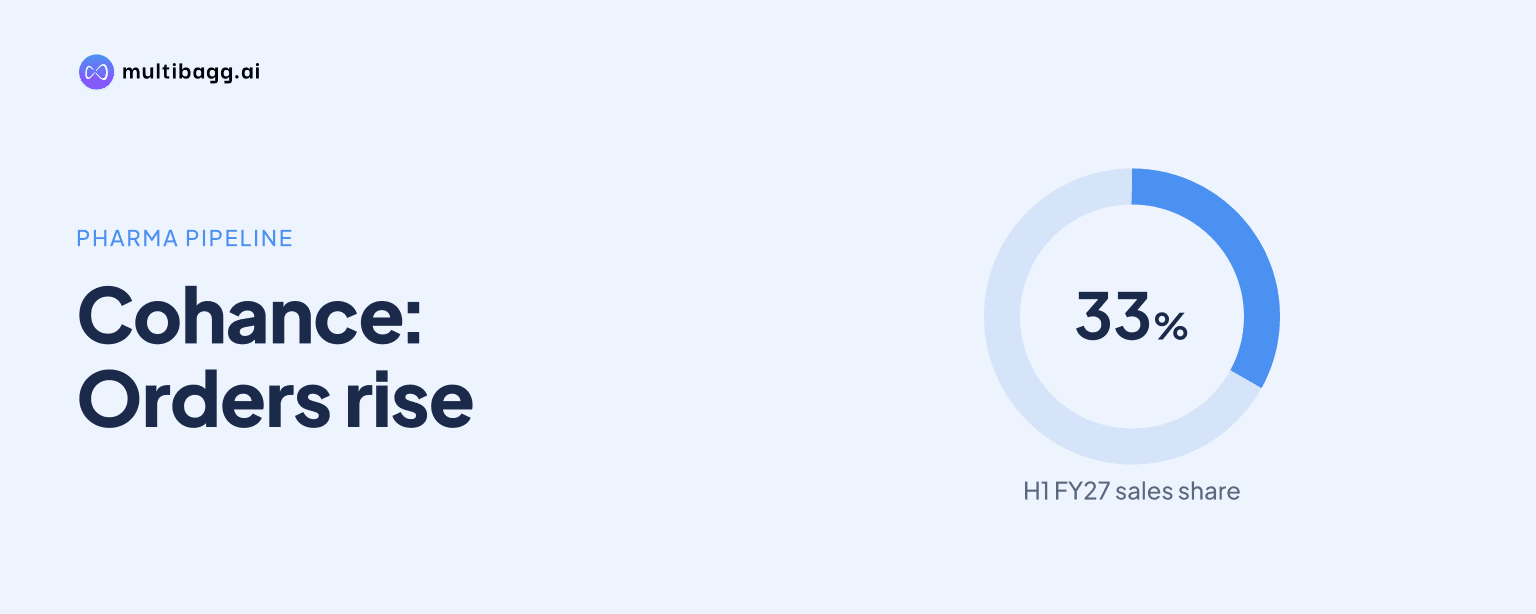
- Pharma CDMO represented 33% of Cohance sales in H1FY27.
- Cohance reported 10 Phase III molecules in H1FY27, up from 2 in FY23.
- RFQ inflow reached 1.5 times the H1FY26 level in H1FY27.
- Cohance secured 3 large-pharma programmes: 2 commercial and 1 Phase III.
powered by IRIS
Cohance Lifesciences expects sequential Pharma CDMO recovery in H2FY27 as its Q3/Q4 order book and commercial reload visibility improve, supported by three new large-pharma programmes and a pipeline of 10 Phase III molecules. The presentation does not provide a Pharma CDMO revenue or profit forecast, but says customer destocking affected H1 and scheduled deliveries are expected to aid the second half.
Know Cohance Lifesciences inside out
Results, valuation, peers and who's buying, in one view.
Why does Cohance expect Pharma CDMO recovery in H2FY27?
Cohance expects H2FY27 recovery because it reports a stronger Q3/Q4 order book, improved commercial reload visibility and multiple reload orders across existing commercial programmes. The company says these orders give greater visibility into scheduled Q3/Q4 deliveries, while late-stage and commercial request-for-proposal activity is strengthening.
The reported H1 issue was customer destocking in antibody-drug conjugates, or ADCs, which affected performance. Cohance says improved order visibility supports H2 recovery, but it does not disclose the H1 revenue impact, the value of its order book, delivery volumes or a margin target for Pharma CDMO.
Pharma CDMO accounted for 33% of Cohance sales in H1FY27, compared with 59% for API+ and 8% for Specialty Chemicals. The small-molecule business includes 19 commercial patented molecules, while relationships with the top 20 innovators contribute more than 85% of its revenue.
How has Cohance's Phase III pipeline changed since FY23?
Cohance's Phase III small-molecule pipeline increased to 10 molecules in H1FY27 from two in FY23, while Phase III intermediates rose to 13 from six. The disclosed change is an increase of eight molecules and seven intermediates, giving Cohance a larger set of later-stage programmes than it reported in FY23.
Cohance also reports that request-for-quotation, or RFQ, inflow reached 1.5 times the H1FY26 level in H1FY27. It does not disclose the number or value of RFQs, their conversion rate, or how much of the flow relates to Phase III projects, so the higher inflow is not a quantified sales forecast.
The company links its programme development to process research and development, hazardous chemistry, complex chiral chemistry and multistep synthesis. Its strategy is to diversify its customer base beyond strategic relationships to obtain higher-quality requests for proposal and improve conversion, particularly in later-stage programmes.
What do Cohance's three large-pharma programme wins cover?
Cohance secured three significant programmes with large global pharmaceutical customers, consisting of two commercial programmes and one Phase III programme. Management says these wins are expected to deepen strategic global-pharma relationships and broaden medium-term opportunities, although the presentation does not identify customers, products, contract duration or expected revenue.
The two commercial awards accompany reload orders across existing commercial programmes, making scheduled Q3/Q4 delivery execution central to the stated H2FY27 recovery. Cohance's small-molecule business has 19 commercial patented molecules and 10 Phase III molecules, providing the disclosed commercial and development base for these orders.
Over the next 12 to 18 months, Cohance plans to deepen large-pharma partnerships through its existing network and external advisory board. Over the subsequent 12 to 24 months, it plans to expand flow chemistry and peptide capabilities organically and inorganically, without disclosing capital expenditure, acquisition targets or capacity additions.
Got a follow-up? Ask IRIS
How are ADC and oligonucleotide capabilities supporting Cohance?
Cohance is building an integrated ADC offering across payloads, linkers and bioconjugation, and supplies two unique commercial ADC payloads to large innovators. It is also working with three other large-pharma innovators on clinical collaborations, customised payloads and dedicated capacity, and has supplied an adjacent payload order to a European Union partner.
NJ Bio added 17 new customers in calendar year 2025, including two large innovator pharmaceutical companies. Cohance says the NJ Bio reorganisation is intended to strengthen commercial focus and integration with India's payload-linker operations, while ADC good manufacturing practice campaigns included an end-to-end development programme.
Bioconjugation capacity expansion is on track for early FY28, according to Cohance, with the stated aims of improving utilisation and moving towards break-even. That milestone follows H2FY27, so the nearer-term ADC outlook rests on improving order visibility, increased payload and linker RFQ activity, and the development pipeline.
In oligonucleotides, Cohance says its nucleic-acid business, formerly Sapala Organics, grew revenue 33.6% year on year in Q2 and 83.1% in H1. It says Q2 growth was achieved without early Phase III supplies, while repeat orders and fee-for-service work supported customer engagement in nucleosides, amidites and other nucleic-acid building blocks.
What must Cohance execute to deliver its H2FY27 plan?
Cohance must deliver commercial reload orders on schedule, progressively normalise affected operations and improve platform utilisation to execute its H2FY27 Pharma CDMO plan. The company also cites quality improvement, operational compliance and regulatory compliance as continuing priorities alongside capacity expansion for customer programmes.
Cohance says it has a quality track record at United States Food and Drug Administration-approved sites, but does not provide inspection dates, observations or quality-performance measures. Its disclosed recovery plan therefore depends on commercial execution and operational progress rather than a numerical H2FY27 revenue or profitability target.
The nucleic-acid business is being integrated through coordinated commercial activity and use of Cohance's manufacturing network for larger customer programmes and scale-up. Cohance plans to extend capabilities across building blocks, oligonucleotides and conjugation applications, combining chemistry, development, manufacturing and commercial supply.
API+ remains Cohance's largest business at 59% of H1FY27 sales, against 33% for Pharma CDMO. API+'s H2 priorities include order-book conversion, new-product execution, pricing discipline, product mix and cost optimisation, which are distinct from the CDMO recovery plan but involve the same broader manufacturing platform.
Conclusion
Cohance's H2FY27 Pharma CDMO recovery case is based on disclosed commercial activity rather than a quantified financial forecast. A stronger Q3/Q4 order book, reload orders, three large-pharma programme wins, RFQ inflow at 1.5 times H1FY26 and expansion to 10 Phase III molecules from two in FY23 together point to a broader later-stage and commercial pipeline.
The next indicators are scheduled Q3/Q4 commercial deliveries, normalisation of the H1-affected operations and conversion of later-stage RFQs. Management also identifies early FY28 for bioconjugation capacity expansion and sets a 12-to-24-month plan to broaden flow chemistry and peptide capabilities.