










Cohance gets SBTi validation for FY2035 emissions targets
Key highlights
- Cohance received SBTi Services validation on 24 July 2026 for its FY2035 and FY2050 targets.
- Cohance targets a 58.8% Scope 1 and 2 emissions reduction and a 35.0% Scope 3 reduction by FY2035 from FY2025.
- Cohance targets a 90.0% reduction across Scope 1, 2 and 3 emissions by FY2050.
- Cohance's 7 MWp Ankleswar solar project is expected to generate 10.85 million kilowatt-hours annually and reduce emissions by about 7,714 tCO2e.
powered by IRIS
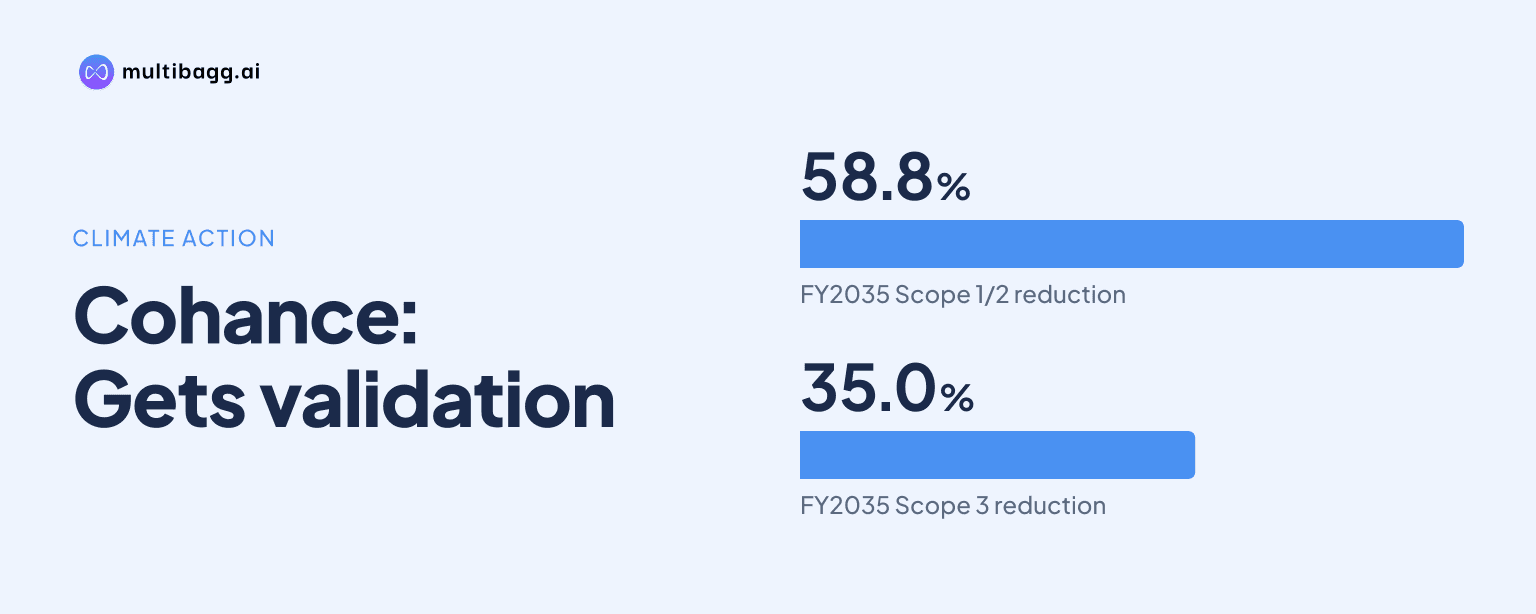
Cohance Lifesciences received SBTi Services validation on 24 July 2026 for targets to reduce absolute Scope 1 and 2 greenhouse-gas emissions 58.8% and Scope 3 emissions 35.0% by FY2035 from a FY2025 baseline. Cohance also commits to a 90.0% reduction across all three scopes and net-zero emissions across its full value chain by FY2050.
Know Cohance Lifesciences inside out
Results, valuation, peers and who's buying, in one view.
What are Cohance's FY2035 emissions targets?
Cohance targets an absolute 58.8% reduction in Scope 1 and 2 emissions and a 35.0% reduction in Scope 3 emissions by FY2035, measured from FY2025. Both targets are designated near-term targets in the presentation, but they cover different emissions groups and have a 23.8-percentage-point gap between their reduction rates.
Cohance's ESG aspirations page describes the FY2035 objectives as reductions of more than 58% for Scope 1 and 2 and more than 35% for Scope 3. Its ESG profile gives the more precise approved targets of 58.8% and 35.0%, both against the FY2025 baseline, and says the combined SBTi targets were approved on 24 July 2026.
Who validated Cohance's climate targets?
SBTi Services validated Cohance's near-term and net-zero greenhouse-gas targets on 24 July 2026. The presentation says the targets conform with Science Based Targets initiative, or SBTi, Near-Term Criteria version 5.3 and Net-Zero Criteria version 1.3, and identifies them as approved for the combined entity.
Cohance reported other sustainability assessments separately from the SBTi validation. It held an EcoVadis Gold sustainability rating in January 2026 after progressing from Silver, and reported a 2025 CDP rating of B for Climate Change and A- for Water Security. Management's stated 2027 objective is to retain the Gold rating and reach CDP management level.
Which completed projects support Cohance's emissions plan?
Cohance has completed a 7 megawatt-peak, or MWp, SURJA-II solar plant at Ankleswar under a group-captive model. The project is expected to generate 10.85 million kilowatt-hours of renewable electricity annually and has an indicative greenhouse-gas impact of about 7,714 tonnes of carbon-dioxide equivalent, or tCO2e, according to the internal sustainability update.
Cohance also replaced a diesel-fired thermic fluid heater at ACP with a briquette-fired boiler, for which it reports an indicative reduction of about 3,626 tCO2e. The two disclosed project estimates total about 11,340 tCO2e, although the presentation does not state a common measurement period for those impacts or link them to the FY2025 emissions baseline.
A separate 3.3 MWp on-site solar installation has been completed across contract development and manufacturing organisation, or CDMO, Units I, III and V and finished dosage forms, or FDF, IV. Unlike the 7 MWp Ankleswar plant, Cohance provides no annual generation or tCO2e estimate for the 3.3 MWp installation.
Got a follow-up? Ask IRIS
What water and waste actions has Cohance completed?
Cohance has completed a 60 kilolitres-per-day zero-liquid-discharge system at NCRM, including a boiler. This water-management project sits alongside a target to reduce, reuse and recycle specific water consumption by 30% by 2030, rather than forming part of the stated FY2035 greenhouse-gas reduction targets.
Cohance also targets a 15% reduction in hazardous waste sent to landfill by 2030. The presentation therefore sets distinct dates for environmental measures: water and landfill-waste targets for 2030, Scope 1 and 2 and Scope 3 reduction targets for FY2035, and a full-value-chain net-zero commitment for FY2050.
How does Cohance's FY2050 target compare with its FY2035 plan?
Cohance aims for a 90.0% absolute reduction in Scope 1, 2 and 3 emissions by FY2050 from FY2025, while committing to net-zero greenhouse-gas emissions across its full value chain by the same year. The long-term target uses one all-scope reduction measure, whereas the FY2035 plan separately sets a 58.8% target for Scope 1 and 2 and a 35.0% target for Scope 3.
The stated reduction level rises 31.2 percentage points from the FY2035 Scope 1 and 2 target of 58.8% to the FY2050 all-scope target of 90.0%. For Scope 3, the difference is 55.0 percentage points between the 35.0% FY2035 objective and the 90.0% FY2050 all-scope objective.
Cohance's ESG aspirations also state an objective to transition more than 90% of total energy use to renewable sources by 2050. The presentation does not provide an interim renewable-energy share, the installed renewable capacity required by FY2050, or a quantified pathway from the completed 7 MWp and 3.3 MWp solar projects to that objective.
What implementation milestones has Cohance identified?
Cohance lists signing a third-party power-purchase agreement for renewable power for all facilities as an upcoming milestone. The proposed agreement follows the completed 7 MWp group-captive solar plant at Ankleswar and 3.3 MWp on-site installations, but the presentation does not disclose its capacity, execution date or expected emissions effect.
Other upcoming items include retention of EcoVadis Gold, ISO 28000 certification and SA 8000 recertifications across sites. Cohance also cites the British Safety Council's 2026 International Safety Award at Merit level for two active pharmaceutical ingredient sites and two CDMO sites, while its stated next safety objective is five-star certification and the Sword of Honour.
Conclusion
Cohance has a formally validated emissions pathway from a FY2025 baseline: a 58.8% cut in Scope 1 and 2 emissions and a 35.0% cut in Scope 3 emissions by FY2035, followed by a 90.0% reduction across all scopes by FY2050. Completed solar, boiler-conversion and water-management projects provide disclosed implementation actions, including about 11,340 tCO2e of combined indicative impact for two projects.
Next, the key disclosed item is the planned third-party renewable-power agreement for all facilities, for which capacity and expected emissions effects remain undisclosed. Cohance also has 2030 targets for a 30% reduction, reuse and recycling of specific water consumption and a 15% reduction in hazardous waste to landfill, ahead of the FY2035 emissions deadline.