










Compuage Infocom Limited enters liquidation after CIRP failure
Key highlights
- Compuage Infocom's CIRP expired on November 20, 2025, its 750th day, without an approved plan.
- All 14 revised resolution plans failed to secure the required 66% CoC voting share.
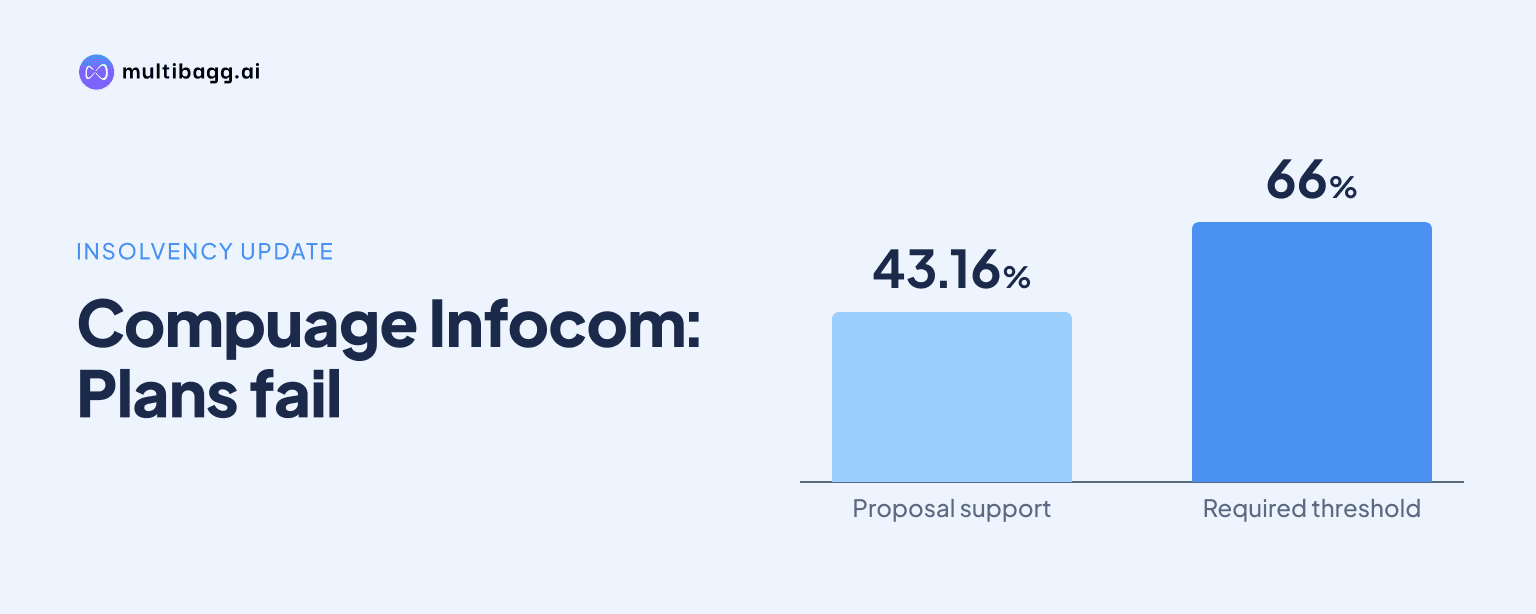
- The CoC liquidation proposal received 43.16% support, below the 66% threshold.
- Ashok Mittal was appointed liquidator and must file a preliminary report within 30 days of liquidation commencement.
powered by IRIS
Compuage Infocom Limited entered liquidation after its corporate insolvency resolution process, or CIRP, expired on November 20, 2025, the 750th day from commencement, without any of 14 resolution plans securing 66% creditor approval. The Adjudicating Authority applied Section 33(1)(a) of the Insolvency and Bankruptcy Code and appointed Ashok Mittal as liquidator.
Know Compuage Infocom inside out
Results, valuation, peers and who's buying, in one view.
Why was Compuage Infocom liquidated?
Compuage Infocom was liquidated because no resolution plan was approved before the extended CIRP period ended on November 20, 2025. The CIRP commenced on November 2, 2023, and the order records that the expiry date was the 750th day from the insolvency commencement date. Under Section 33(1)(a) of the Code, the Adjudicating Authority must order liquidation where it does not receive a resolution plan before the maximum CIRP period ends.
The order distinguishes this route from creditor-approved liquidation under Section 33(2). Under that provision, the Committee of Creditors, or CoC, needs at least 66% of voting share to decide on liquidation during CIRP. The CoC's liquidation proposal received only 43.16% support, so it did not meet that threshold. The tribunal held that a separate 66% liquidation vote was not required under Section 33(1) once the CIRP ended without an approved plan.
The resolution professional filed the liquidation application on November 24, 2025, five days after the CIRP deadline. The tribunal condoned the five-day delay, describing it as minor and arising during the filing of the application. It also rejected Central Bank of India's objection to liquidation, noting that its separate IA No. 711 of 2026 had been dismissed and that no CoC resolution had been passed to extend or continue the CIRP.
How did Compuage Infocom's resolution process fail?
Compuage Infocom's resolution process failed because two Form G invitations, 14 prospective resolution plans and a challenge process did not produce the required 66% creditor vote. At the 20th CoC meeting on August 14, 2025, all 14 revised plans were put to e-voting. Voting began on August 16, 2025 and was extended until November 14, 2025, creating a 90-day voting window.
None of the 14 plans secured approval by November 14, 2025. The tribunal found that the process then expired on November 20, 2025 without a resolution plan, despite repeated deliberations and the extended CIRP period. The order therefore treats the absence of a plan, rather than a creditor decision to liquidate, as the legal basis for moving the company into liquidation.
The tribunal recorded that the CoC remained divided after the voting process. At its 22nd meeting, held on November 15 and November 18, 2025, the resolution professional presented three choices: continue with the existing Form G, issue a fresh Form G, or file for liquidation. The first two alternatives were subject to a further CIRP extension, but the CoC made no decision on any of the options.
Got a follow-up? Ask IRIS
Why could Compuage Infocom creditors not agree?
Compuage Infocom's creditors could not agree because major CoC members backed different next steps after the 14 plans failed. Indian Bank, holding 31.45% voting share, and Bandhan Bank, with 7.77%, requested a liquidation application. Central Bank of India, holding 29.02%, and Punjab National Bank, with 12.56%, preferred a fresh Form G.
Tata Capital Limited, with a 0.72% voting share, stated at the 22nd meeting that it would abide by the majority, while other members did not communicate their positions. The division meant the CoC neither approved a fresh attempt to seek plans nor passed a liquidation resolution. In the earlier liquidation vote, 12.56% voted against, 1.08% abstained and 43.20% did not vote, alongside the 43.16% vote in favour.
Indian Bank, the consortium's lead bank and largest CoC member, subsequently told the tribunal that it did not oppose liquidation. It submitted that a further extension would increase costs and prejudice creditors after two Form G processes, 14 plans and a challenge process. The bank's 31.45% share made it the largest individual voter, but not enough to determine the outcome without support from other creditors.
Tata Capital supported the liquidation application in its reply and said it had voted for liquidation and the appointment of the applicant as liquidator at the November 18, 2025 meeting. Its financial creditor claim of Rs 4.47 crore was admitted in full, and it was recognised as an unsecured financial creditor. Tata Capital said Compuage Infocom had defaulted on channel-finance facilities from March 2023, with its loan account classified as a non-performing asset on June 3, 2023.
What happens after Compuage Infocom's liquidation order?
Compuage Infocom will now be managed through the liquidation process by Ashok Mittal, whom the tribunal appointed under Section 34 of the Code. His Insolvency and Bankruptcy Board of India, or IBBI, registration number is IBBI/IPA-001/IP-P-02549/2021-2022/13889. The order states that his authorisation for assignment was valid until December 31, 2026.
Mr Mittal must take control of Compuage Infocom's assets and initiate the liquidation process under Chapter III of Part II of the Code and the applicable Liquidation Process Regulations. He may continue or institute proceedings concerning avoidance transactions, fraudulent trading or wrongful trading under Section 35(1)(l). The former resolution professional, Gajesh Labchand Jain, is relieved subject to procedural and necessary compliance under Section 34(5).
A fresh moratorium starts under Section 33(1)(iv), and the liquidator must issue a public announcement stating that Compuage Infocom is in liquidation. The order is deemed notice of discharge to the company's officers, employees and workmen. The CoC will continue to function during liquidation under Regulation 8 of the IBBI (Liquidation Process) Regulations, 2016.
The liquidator's fee will be approved by the CoC or determined under Regulation 4 of the 2016 regulations, as applicable. The registry must furnish the order within seven days of its passing to the IBBI, the Regional Director for the Ministry of Corporate Affairs' Western Region, the Registrar of Companies Mumbai-I, the Official Liquidator attached to the Bombay High Court, the former resolution professional and Mr Mittal.
Conclusion
The order moves Compuage Infocom from a 750-day resolution process into liquidation because no proposed resolution obtained the mandatory 66% CoC approval. Although the separate liquidation vote also failed at 43.16% support, the tribunal found that Section 33(1)(a) applied after the CIRP deadline of November 20, 2025 passed without an approved plan.
The next disclosed milestone is Mr Mittal's preliminary report, which must be filed within 30 days of the liquidation commencement date under Regulation 13. Investors and creditors can also watch for the public liquidation announcement, Regulation 15 progress reports and any proceedings concerning avoidance transactions or fraudulent or wrongful trading that the order permits the liquidator to pursue.