










Compuage Infocom: 14 revised plans miss creditor threshold
Key highlights
- Compuage Infocom’s 14 revised resolution plans did not reach the 66% creditor threshold by 14 November 2025.
- Compuage Infocom’s CoC had Rs 623.72 crore of admitted claims, led by Indian Bank’s 31.45% voting share.
- Compuage Infocom’s liquidation proposal received 43.16% support, 12.56% opposition, 1.08% abstentions and 43.20% non-votes.
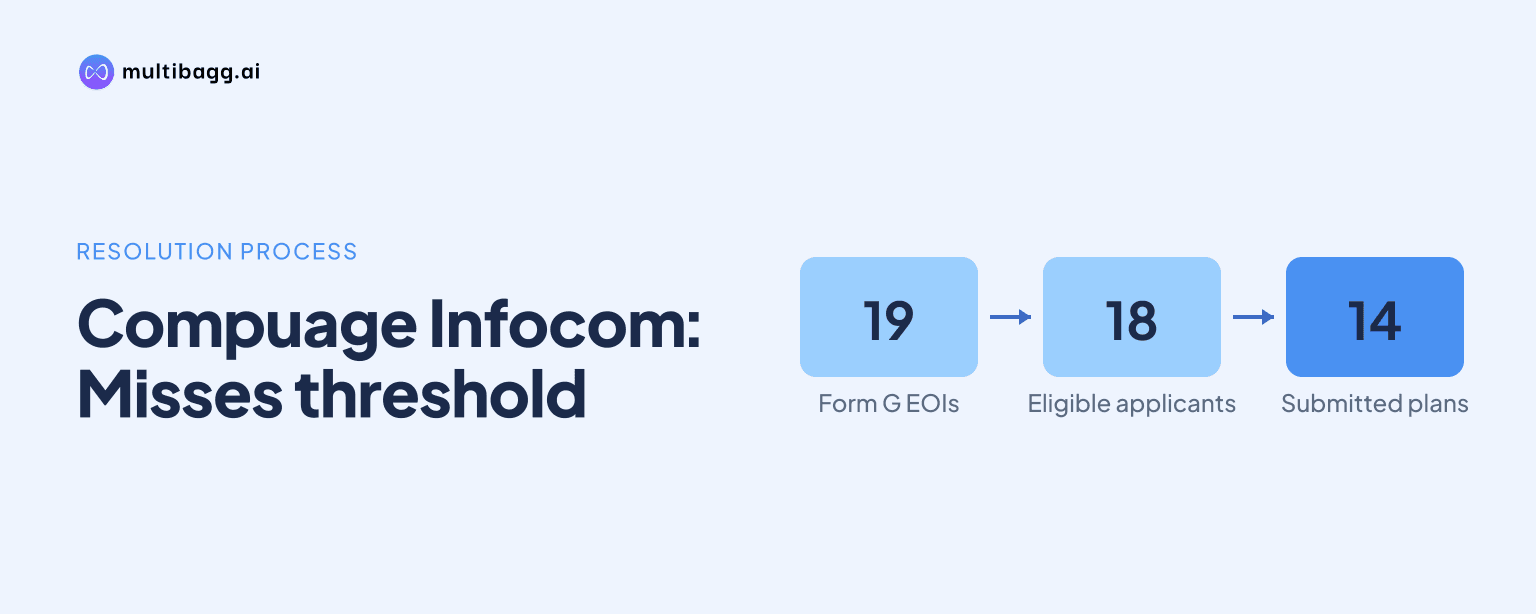
- Compuage Infocom’s second Form G process received 19 expressions of interest, with 18 eligible applicants and 14 submitted plans.
powered by IRIS
Compuage Infocom Limited’s 14 revised resolution plans failed to secure the required 66% creditor vote by 14 November 2025, despite two Form G processes and a 90-day voting window. The failed process covered Rs 623.72 crore of admitted claims and led the resolution professional to seek liquidation under Section 33(1) of the Insolvency and Bankruptcy Code, 2016.
Know Compuage Infocom inside out
Results, valuation, peers and who's buying, in one view.
Why did Compuage Infocom’s 14 revised plans fail?
Compuage Infocom’s 14 revised plans failed because none received support from creditors holding at least 66% of the Committee of Creditors, or CoC, voting share. The plans went to e-voting at the 20th CoC meeting on 14 August 2025, voting began on 16 August 2025, and the window was extended until 14 November 2025. The order does not disclose the vote received by each bidder or the commercial terms of the proposals.
The 14 revised plans emerged from the second sale process, not the original Form G invitation. Compuage Infocom received five plans in the first process, but by the CoC meetings of 26 August and 19 September 2024, only NPL Bluesky Automotive Private Limited had provided the required earnest money deposit and annexures. Three other prospective resolution applicants had indicated they intended to withdraw.
At its 11th meeting on 25 October 2024, the CoC approved a fresh Form G with 94.94% voting support because the earlier plans did not comply with the Code. The second process produced 19 expressions of interest, of which 18 were eligible as at 3 January 2025, and 14 plans by 27 February 2025. Greater applicant participation therefore did not produce the required creditor majority.
How did Compuage Infocom’s two Form G processes differ?
Compuage Infocom’s first Form G process began on 2 January 2024 and resulted in five plans, but it did not deliver a compliant resolution plan. Form G is the insolvency-process invitation for expressions of interest. The initial deadline moved from 17 January to 16 February 2024, the five plans were formally opened on 30 May 2024, and they were circulated to CoC members on 3 June 2024.
Compuage Infocom’s second process attracted more applicants after a fresh Form G was issued on 17 November 2024. Its deadline for expressions of interest was extended from 3 December to 13 December 2024. Fourteen applicants submitted plans, while four other prospective resolution applicants did not submit plans. The change from five plans in the first process to 14 in the second was material, but neither round obtained a creditor-approved outcome.
What changed in Compuage Infocom’s revised-plan process?
Compuage Infocom’s CoC changed the scope of the plans on 30 April 2025 by excluding inventory in India and Singapore and funds held in India and at the Singapore branch. The CoC set 20 May 2025 as the deadline for revised submissions. All 14 prospective resolution applicants submitted revised plans by that date, and the plans were opened and circulated at the 17th CoC meeting on 27 May 2025.
The order records the exclusions but does not state why the inventory and funds were removed, their value, or whether the exclusions affected consideration offered under the plans. Before voting, the CoC approved an updated creditor list at its 18th meeting on 19 June 2025 with 75.28% voting support. The updated list incorporated claims received up to 16 June 2025 and was taken on record in IA No. 4326 of 2025.
Got a follow-up? Ask IRIS
Who controlled Compuage Infocom’s creditor vote?
Compuage Infocom’s CoC had admitted claims of Rs 623.72 crore, with Indian Bank and Central Bank of India together accounting for 60.47% of voting share. Indian Bank held the largest share, 31.45%, on an admitted claim of Rs 196.15 crore. Central Bank of India held 29.02%, based on Rs 181.01 crore of admitted claims.
Compuage Infocom’s lenders split over the next step at the 22nd CoC meeting held on 15 November 2025 and reconvened on 18 November 2025. Indian Bank and Bandhan Bank, with a combined 39.22%, asked the resolution professional to apply for liquidation. Central Bank of India and Punjab National Bank, with 41.58% combined, preferred a fresh Form G, while Tata Capital Limited, holding 0.72%, said it would follow the majority.
Why did Compuage Infocom’s liquidation vote also fail?
Compuage Infocom’s separate CoC liquidation proposal failed because it received 43.16% support, below the 66% threshold. Voting Item No. 12 at the 20th CoC meeting drew 12.56% opposition, 1.08% abstentions and 43.20% non-votes. The CoC therefore neither approved liquidation nor proposed the name of a liquidator.
Compuage Infocom’s resolution professional nevertheless filed a Section 33(1) liquidation application on 24 November 2025, arguing that no plan had secured 66% approval and the Corporate Insolvency Resolution Process, or CIRP, had exceeded its statutory period despite extensions. The order records that an extension granted on 12 January 2026 extended the CIRP to 20 November 2025, described as its 750th day. The Tribunal distinguished Section 33(1), which applies where no resolution plan is received before the permitted CIRP period expires, from Section 33(2), which requires a 66% CoC liquidation decision.
Indian Bank, the 31.45% lead creditor, did not oppose the application and said further extensions would increase costs and prejudice creditors. Tata Capital Limited, with 0.72%, supported the application and stated that it had voted for liquidation and appointment of the resolution professional as liquidator at the 22nd meeting. Central Bank of India opposed liquidation in view of IA No. 711 of 2026.
Conclusion
Compuage Infocom’s insolvency process produced more potential bidders in its second round, rising from five initial plans to 14 plans and then 14 revised submissions. But the commercial process did not yield the mandatory 66% CoC approval, and the separate liquidation motion received only 43.16% support. The result was a resolution process without either an approved plan or a CoC-approved liquidation decision.
What happens next depends on the Section 33(1) application filed on 24 November 2025 and Central Bank of India’s opposition through IA No. 711 of 2026. The order records that the matter was reserved for orders after a hearing on 27 October 2026, while Indian Bank and Tata Capital Limited supported liquidation. The Tribunal’s decision on that application will determine whether Compuage Infocom moves into liquidation despite the failed CoC vote.