










CONCOR withholds FY27 volume revision as domestic flows recover
Key highlights
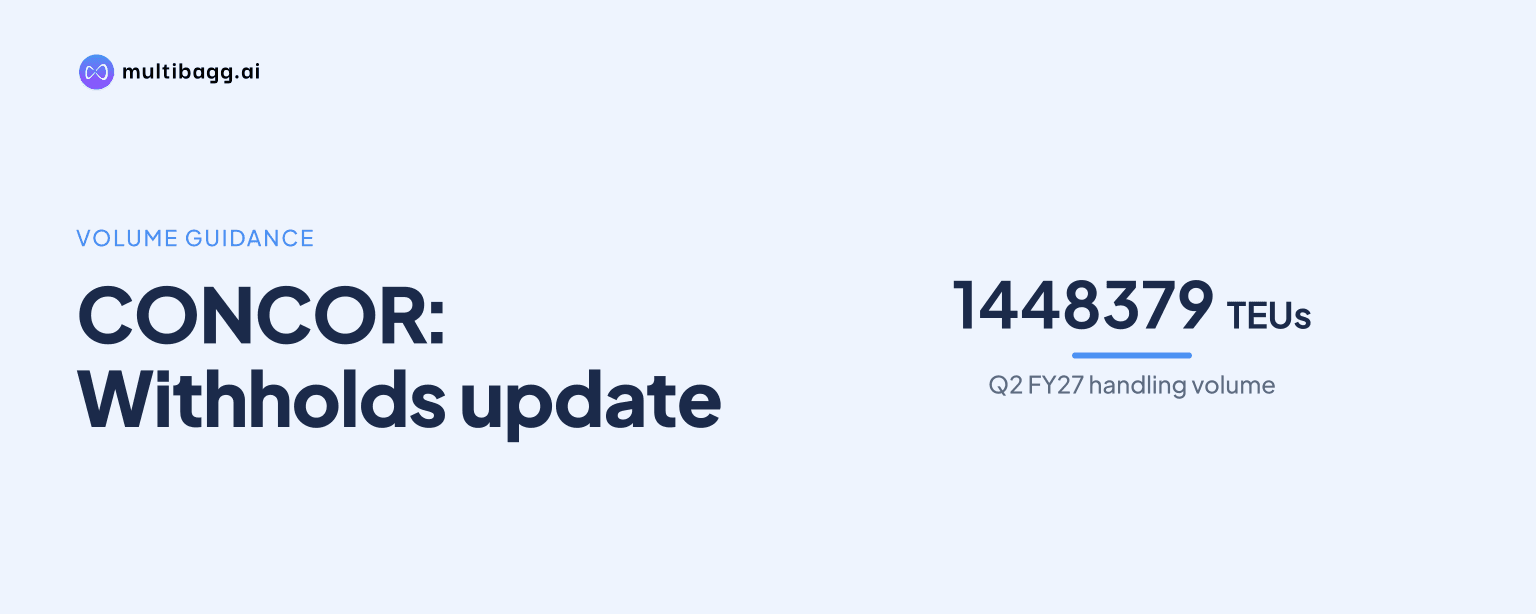
- CONCOR handled a quarterly record 1,448,379 TEUs in Q2 FY27.
- Domestic handling volume increased 4.22% in H1 FY27 despite disruptions in tiles, gunny bales and foodgrains.
- CONCOR plans to review FY27 volume guidance in December 2026 rather than issue an immediate revision.
- Bulk-cement volume was about 12,000 TEUs in Q2 FY27 versus 14,000 TEUs in the prior full year.
powered by IRIS
Container Corporation of India Limited withheld a revision to FY27 volume guidance on November 3, 2026, despite domestic handling growth of 4.22% in H1 FY27, as management sought another month of clarity on West Asian disruption and trade-route conditions before issuing a new forecast.
Know Container Corporation Of India inside out
Results, valuation, peers and who's buying, in one view.
Why has CONCOR withheld its FY27 volume-guidance revision?
CONCOR has withheld a revised FY27 volume forecast because management said the geopolitical and trade environment was still evolving. Management plans to review guidance in December after observing conditions for one more month, arguing that frequent revisions would undermine the usefulness of guidance while conditions could change within a week.
Management said it hoped existing domestic guidance would hold at least for H2 FY27, conditional on trade routes normalising and the West Asia crisis not deepening. H1 EXIM, or export-import, throughput rose 4.57%, domestic throughput increased 4.22%, and total throughput grew 4.48%, indicating positive physical-volume growth despite disrupted cargo streams.
The caution followed turbulence in container trade, including the practical closure of the Strait of Hormuz for container traffic, according to management. CONCOR nevertheless handled a quarterly record 1,448,379 twenty-foot equivalent units, or TEUs, in Q2 FY27, and reported operating turnover of Rs 2,373 crore.
What caused CONCOR’s weaker domestic cargo trend in H1 FY27?
CONCOR’s domestic trajectory was held back by the Morbi tile shutdown, a July interruption in Bengal gunny-bale cargo, a foodgrain tariff difference and weaker polymer traffic. Management said Gulf-related gas-supply disruption caused the Morbi tile cluster to practically shut in Q1 FY27, with the cluster still weak through July before volumes improved in August and September.
Gunny-bale traffic in eastern India was absent in July because of geopolitical issues, management said, but returned in August and September. Polymer traffic was also affected, although management reported an emerging recovery in that stream rather than providing a volume figure.
Foodgrain traffic shifted away from containers between July and September because containers carried a busy-season surcharge while railway BCN wagons did not. Management said the resulting 10% rate differential moved some foodgrain cargo to BCN wagons; it expects recovery from October after the surcharge applied to both containers and railway wagons.
Domestic margin pressure reflected lower available cargo, competition and higher expenses rather than a separately identified one-off cost. Management said CONCOR reduced rates in some locations to retain volumes after tile cargo disappeared, while fuel, staff, land and road-transport expenses increased; staff and land costs are partly fixed, so management expects higher volumes to improve cost absorption.
Which domestic cargo streams are supporting CONCOR’s recovery?
CONCOR is relying on recovering tiles and gunny bales, bulk cement, foodgrains, potential fertilizer movements and a new GAIL contract to rebuild domestic volume. Management said Morbi tile traffic showed robust growth in August and September, while foodgrain volumes could recover after the September tariff change and GAIL traffic is expected toward the end of November.
Bulk cement is the most quantified expansion stream. CONCOR added 195 tank containers in Q2 FY27, taking the fleet to about 1,100, and moved about 12,000 TEUs during the quarter, compared with 14,000 TEUs in the entire prior year. Management said 2,000 tank containers were in the pipeline and new bulk-cement traffic streams were being established almost every week.
The company is discussing containerised fertilizer-bag movements with manufacturers after Indian Railways changed its rating system to gross tonne kilometre, or GTKM, based pricing. Management did not disclose expected fertilizer volumes, so the discussions remain a prospective source of traffic rather than a volume forecast.
CONCOR added 13 rakes in Q2 FY27, taking H1 additions to 32 and its total fleet to 456 rakes. It also began an assured-transit service from Whitefield to Tughlakabad via Tondiarpet on August 14, 2026, providing additional domestic capacity while management waits to assess whether recovery can support its existing guidance.
Got a follow-up? Ask IRIS
Are CONCOR’s tariff cuts increasing traffic without reducing revenue?
Management said Dadri revenue increased after two to three months of lower upper-deck tariffs, while it was too early to assess the effect of Tughlakabad reductions introduced about 15 days before the November 3 call. Dadri rates for 40-foot containers were reduced by 10% to 20%, depending on the route and distance slab, to increase double-stack rail volumes.
Management attributed the Dadri revenue increase to volume gains following the lower rates, but did not provide a revenue or volume delta. The cuts are intended to support a shift from road to rail on Dedicated Freight Corridor routes, alongside CONCOR’s newly started cabotage service from Jawaharlal Nehru Port Trust, or JNPT, to Dadri.
At Tughlakabad, CONCOR reduced export and import handling charges by 10% to 20%, depending on traffic type. Management said customers had bypassed the terminal when its land costs were passed through, and the revised tariff is intended to bring Delhi-bound cargo by rail to Tughlakabad rather than by truck from outside the city.
The company reported a Q2 FY27 rail-freight margin of 28.3%, almost in line with the prior year, and an overall operating margin of about 31.5%. Management said higher operating expenses reflected increases across staff, fuel, handling and road-transport costs, rather than one abnormal item.
What external risks could still alter CONCOR’s second-half volumes?
The principal risk is prolonged or deeper West Asian disruption that delays normalisation of shipping routes and cargo flows. Management said its expectation for stronger EXIM, domestic and allied-logistics volumes in the coming quarter depended on trade routes normalising and the regional crisis not worsening.
Port data show that cargo patterns shifted during Q2 FY27. CONCOR’s JNPT market share rose 3.53 percentage points year on year to 63.75%, while Mundra declined 1.8 percentage points to 34.65% and Pipavav fell 2 percentage points to 47.81%. Management cautioned that increased transshipment volumes complicate comparisons because transshipment containers do not move within India by either rail or road.
Longer-haul movements supported Q2 network activity. Average lead increased 4.9% year on year to 817 kilometres from 779 kilometres, with EXIM lead rising to 722 kilometres from 686 kilometres and domestic lead reaching 1,315 kilometres from 1,298 kilometres. Those distance gains do not resolve demand uncertainty, but they show CONCOR carried cargo over longer routes during the quarter.
Conclusion
CONCOR is retaining, rather than revising, FY27 volume guidance because H1 domestic growth of 4.22% and recovering tile and gunny-bale traffic have not yet removed uncertainty from West Asia-related trade disruption. Bulk cement, foodgrains and the GAIL contract offer possible support for domestic volumes, while Dadri tariff reductions have so far coincided with higher revenue, according to management.
The next disclosed marker is management’s December guidance review after one further month of monitoring geopolitical conditions. Investors can watch whether GAIL traffic begins toward the end of November, whether the 2,000 tank containers in the pipeline expand bulk-cement volumes, and whether lower tariffs at Dadri and Tughlakabad continue to convert road cargo into rail traffic.