










CONCOR Targets 18%-19% JNPT Rail Share as DFC Services Ramp
Key highlights
- CONCOR expects JNPT rail modal share to rise to 18%-19% from about 13%-14% in the medium term.
- JNPT’s Q2 rail coefficient was 12.88%, versus 24.85% at Mundra and 64.81% at Pipavav.
- JNPT double-stacking was about 30%, constrained by vessel delays and shortages of empty containers.
- CONCOR’s overall train lead distance increased 4.9% to 817 from 779 in the corresponding quarter.
powered by IRIS
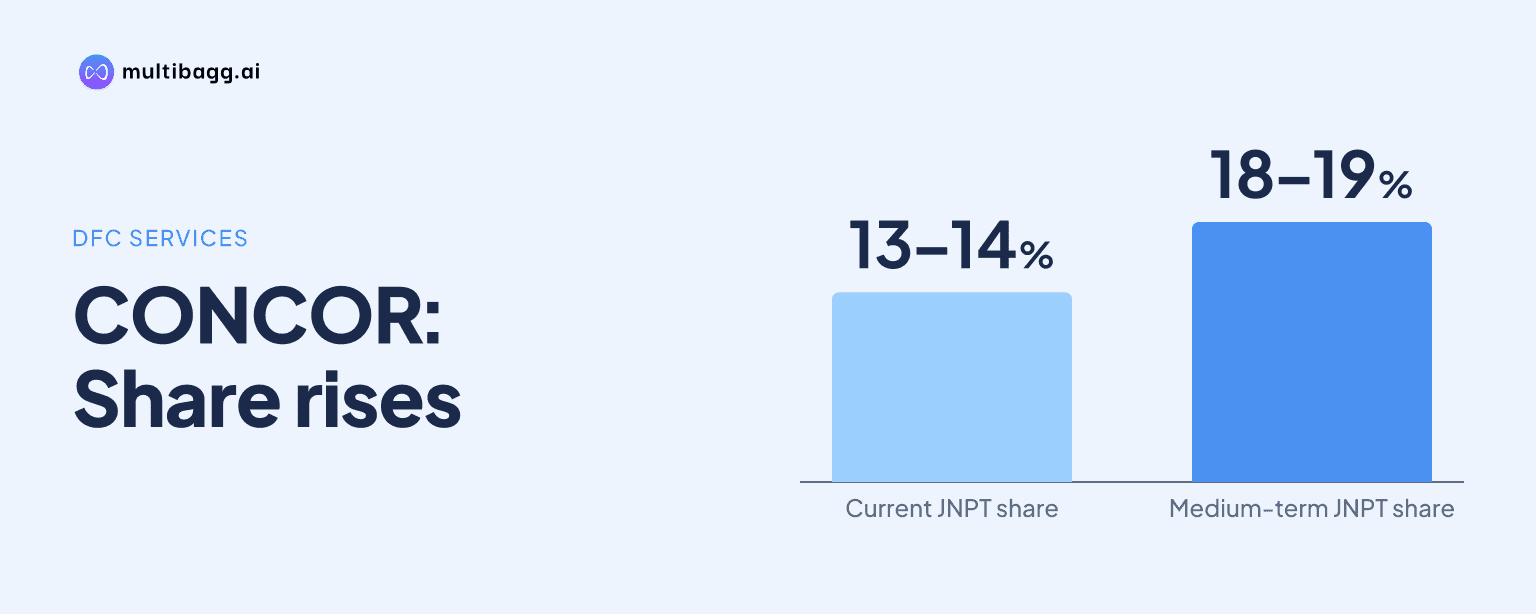
CONCOR expects JNPT rail modal share to rise to 18%-19% in the medium term from about 13%-14%, supported by the fully connected Dedicated Freight Corridor (DFC), discounted upper-deck rates and new rail services. Management said JNPT double-stacking was about 30% so far because erratic vessel schedules constrained container availability.
Know Container Corporation Of India inside out
Results, valuation, peers and who's buying, in one view.
How much can CONCOR increase JNPT rail share?
CONCOR expects JNPT rail modal share to reach 18%-19% in the medium term, compared with the 13%-14% level cited by management. The expectation depends on the DFC connection between JNPT and northern India, which management said would be meaningful and significant for CONCOR. It said the modal shift would produce a substantial increase in volumes, but did not set a time-bound volume target or a precise market-share recovery target.
The reported second-quarter, or Q2, rail coefficient at JNPT was 12.88%. Management cautioned that this measure is not directly comparable because total port handling includes transshipment and transit containers. Such containers do not move by either road or rail into the hinterland, so a rise in their share of port throughput can reduce the apparent rail coefficient.
JNPT’s reported Q2 rail coefficient was lower than the figures at two other ports. Mundra’s coefficient was 24.85% and Pipavav’s was 64.81%, against JNPT’s 12.88%. CONCOR said it was working with ports on a more appropriate index because transshipment volumes complicate comparisons, making the 18%-19% objective a medium-term operational expectation rather than a quarterly forecast.
What is CONCOR doing to shift cargo from road to rail?
CONCOR has started a cabotage service at a JNPT terminal after receiving customs approval. The service aggregates domestic small cargoes and parcels that had moved by road towards Delhi into 40-foot containers, which are placed on the upper deck of double-stack trains. Management said it would strengthen the newly launched service to shift light-goods traffic from road to rail.
CONCOR has also reduced the charge for 40-foot containers carried on the upper deck of double-stack trains. Management said the measure is intended to move both light and heavy cargo from road to rail, particularly northbound cargo because the DFC connects JNPT with northern India. It did not disclose the size of the price reduction or quantify the volume response.
The company cited operating indicators rather than an aggregate JNPT traffic number. At Dadri, management said eight trains were loaded on one day and seven were double-stacked. It also said volumes and performance at Dadri and Varnama had increased significantly, while a direct Ludhiana-to-JNPT service through Dadri had begun and the Khatuwas terminal was generating good DFC-linked volumes.
Why is JNPT double-stacking still about 30%?
JNPT double-stacking was about 30% because vessel schedules had been erratic during the preceding two to three months, according to CONCOR. Management said import containers were getting held up around the Gulf of Oman, including at Fujairah and Khor Fakkan. The disruption affected the arrival of import containers and reduced the availability of empty containers for Indian exporters.
The shortage of empty containers affected both export activity and DFC utilisation. Management said shipping lines were concentrating on handling loaded containers and were not bringing sufficient empties, preventing the full benefit of DFC operations from being realised in the first two to three months after the connection became operational. Heavy rains also occasionally affected DFC routes during the period.
CONCOR said volume performance had improved from October and double-stacking should rise once vessels return to normal schedules. It did not publish October physical-volume data because it releases such figures quarterly. Management said the December-quarter disclosure would provide the next reported data point on whether the October improvement translated into sustained rail traffic growth.
Got a follow-up? Ask IRIS
What port operations could determine the modal shift?
The speed and capacity of railway handling inside JNPT could determine whether bonded cargo moves to inland container depots or is cleared locally through container freight stations, according to CONCOR. Cargo released locally generally continues by road, while better port-yard handling can move more bonded cargo into the hinterland by rail. The company identified port-yard mobility as a condition for a larger road-to-rail shift.
JNPT has strengthened its port yards in anticipation of double-stack DFC traffic, but management said further upgrades would be needed for a large-scale modal shift. The port is adding handling machines and railway lines, according to CONCOR. Faster movement of empty and loaded rakes through the port yards would allow more cargo to reach inland container depots instead of being cleared near the port.
CONCOR’s overall train lead distance increased 4.9% to 817 in the quarter from 779 in the corresponding quarter a year earlier. Management did not attribute the full increase specifically to JNPT or the DFC. Empty-running cost totalled Rs 98.82 crore, comprising Rs 21.73 crore for export-import, or EXIM, operations and Rs 77.09 crore for domestic operations; EXIM cost reduced marginally while domestic cost increased marginally.
How do pricing and tariff changes support CONCOR’s plan?
CONCOR is using lower commercial rates to seek higher volumes, citing its experience at Dadri before applying a handling-charge reduction at the TKD terminal. Management said Dadri revenue increased rather than declined after the reduction because it incentivised volumes. The TKD reduction had been in effect for only 15 days at the time of the call, so management said it was still observing the revenue and volume effect.
Indian Railways has issued four notifications that changed tariff structures for bulk cement, fertiliser, fly ash and food grains from earlier slabs to gross tonne-kilometre, or GTKM, slabs, management said. CONCOR said it had already benefited in bulk cement carried in tank containers and was procuring specialised tank containers. It began seeking food-grain opportunities from October and said it was pursuing a level playing field for containerised fertiliser.
CONCOR had not started fly-ash operations because rates for BOXN wagons remained favourable, management said. It nevertheless said it was working on a model to establish a presence in fly ash. Management’s plan across the four commodity streams is to containerise cargo that still moves substantially by road, with bulk cement the only stream for which it reported an existing benefit.
Conclusion
CONCOR’s 18%-19% medium-term JNPT rail-share expectation rests on several linked measures rather than the DFC connection alone. The corridor enables direct and double-stack services, while cabotage aggregation, upper-deck price reductions, the Ludhiana-JNPT service and port-yard upgrades are intended to redirect northbound cargo from road. JNPT’s 12.88% Q2 rail coefficient, compared with Pipavav’s 64.81%, illustrates the gap management is seeking to narrow, although transshipment affects those comparisons.
The December-quarter disclosure is the next scheduled evidence point after management reported improved physical-volume signals in October without releasing monthly data. Investors can watch whether vessel schedules normalise, empty-container availability improves and JNPT double-stacking rises above about 30%. Management said it could take one or two more quarters to assess the modal-shift trend because transshipment has distorted port data and a clearer public index is still being developed.