










CONCOR posts record turnover despite West Asia disruption
Key highlights
- CONCOR handled a record 1,448,379 TEUs in Q2 FY27.
- CONCOR reported record Q2 FY27 operating turnover of Rs 2,373 crore and total income of Rs 2,466 crore.
- First-half EXIM throughput grew 4.57%, compared with 4.22% growth in domestic throughput.
- CONCOR market share at JNPT rose 3.5 percentage points to 63.75%.
powered by IRIS
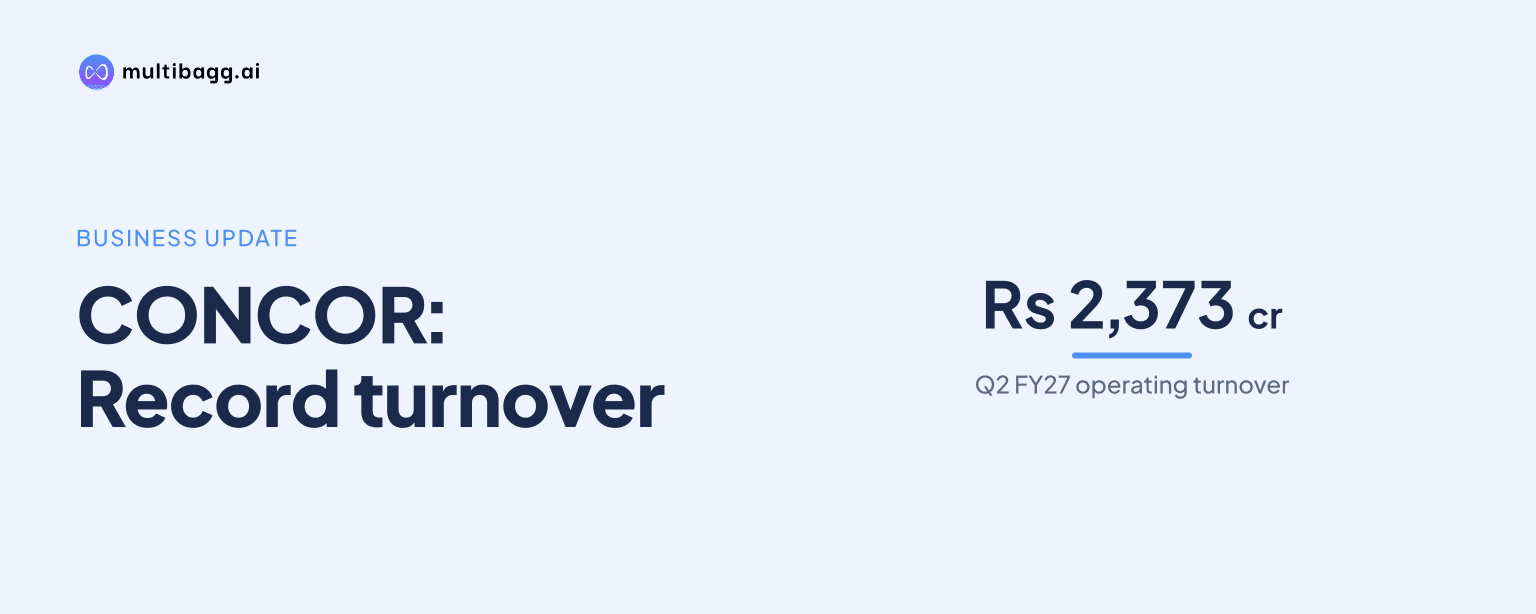
In Q2 FY27, Container Corporation of India Limited recorded its highest-ever quarterly operating turnover of Rs 2,373 crore, handling 1,448,379 twenty-foot equivalent units (TEUs) and reporting total income of Rs 2,466 crore despite West Asia shipping disruption, according to management’s November 3, 2026 earnings call.
Know Container Corporation Of India inside out
Results, valuation, peers and who's buying, in one view.
What did CONCOR report in Q2 FY27?
CONCOR reported record quarterly handling, operating turnover and total income in Q2 FY27. Total handling reached 1,448,379 TEUs, operating turnover was Rs 2,373 crore and total income was Rs 2,466 crore. Management said revenue growth was 0.93% and announced a dividend of Rs 1.9 per share.
Standalone profit before tax was Rs 462 crore, equivalent to Rs 154 crore a month during the three-month quarter. The newly announced dividend took the first-half dividend to Rs 3.5 per share. Management presented the three record operating measures while describing geopolitical conditions as challenging.
How did West Asia disruption affect CONCOR trade flows?
CONCOR said the Strait of Hormuz was practically closed for container traffic after a Gulf ceasefire collapsed within days. Management said West Asia ports that had been engines of regional trade were not handling usual cargo, while flows shifted to Khor Fakkan and Fujairah and Indian ports on both coasts handled additional transshipment cargo.
Despite these route changes, first-half export-import, or EXIM, throughput rose 4.57%, domestic throughput increased 4.22% and combined throughput grew 4.48%. EXIM growth was therefore 0.35 percentage points above domestic growth. Management did not disclose absolute first-half TEU volumes on the call.
CONCOR’s average lead, or distance moved, increased 4.9% to 817 kilometres in Q2 from 779 kilometres in the corresponding quarter a year earlier. EXIM lead rose to 722 kilometres from 686 kilometres, while domestic lead increased to 1,315 kilometres from 1,298 kilometres. The higher average lead coincided with the cargo-routing changes management described.
Which operations supported CONCOR volumes in Q2 FY27?
CONCOR identified Nepal traffic, reefer exports, direct port delivery and bulk cement as growth areas in Q2 FY27. Nepal traffic rose to 107 rakes from 45 rakes, an increase of 138%. Reefer exports grew 18.48%, supported by a new Hyderabad-to-JNPT service carrying pharmaceutical products.
Direct port delivery exports increased 7.48% and laden exports rose 3.28%. CONCOR also began new direct-port-delivery long-lead traffic from JNPT to CTKR, new less-than-container-load exports from Dadri to Dronagiri and JNPT, and a GCTK-to-IDBR EXIM long-lead service.
Bulk cement in tank containers was another expanding stream. CONCOR added 195 tank containers during Q2, taking the total to about 1,100, and carried about 12,000 TEUs of bulk cement during the quarter. That was close to the 14,000 TEUs it carried in the entire previous year, although management did not provide a comparable prior-year quarter figure.
CONCOR added 13 rakes in Q2, taking first-half additions to 32 and its total fleet to 456 rakes. It also added 414 containers and seven reach stackers, while moving 1,661 double-stack trains. Capital expenditure was Rs 299.75 crore in Q2 and Rs 418.05 crore in the first half.
Got a follow-up? Ask IRIS
What is pressuring CONCOR domestic traffic and margins?
CONCOR said several domestic cargo streams were disrupted in the first half, though volumes began recovering in August and September. The Morbi tile cluster practically shut in Q1 after gas supplies were affected, and tile traffic remained weak until July before improving in the following two months.
Gunny-bale traffic in Bengal was absent in July but returned in August and September. Food-grain traffic also moved away from containers between July and September because the busy-season surcharge applied to containers but not railway BCN wagons, creating a 10% rate differential, according to management.
Management said domestic earnings before interest and tax, or EBIT, margins were affected by lower volumes, competitive pricing and higher costs rather than a one-off item. It said CONCOR reduced rates in certain markets to retain traffic and market share, while fuel, staff and land expenses increased.
Staff and land costs include fixed expenses, management said, meaning a recovery in traffic could improve their absorption. Management expected food-grain volumes to recover from October because the busy-season surcharge then applied to both containers and BCN wagons.
How is CONCOR seeking incremental traffic?
CONCOR is using new services, rate changes and prospective cargo contracts to pursue incremental traffic in the second half. It launched an Assured Transit train from Whitefield to Tughlakabad via Tondiarpet on August 14, 2026, alongside its existing Tughlakabad-to-Shalimar service.
Management said the opening of the Dedicated Freight Corridor enabled a cabotage service from JNPT to Dadri, which it planned to strengthen in the next quarter. It also said a contract with GAIL had been signed and that traffic was expected around the end of November, subject to the planned start.
CONCOR reduced upper-deck rates for 40-foot EXIM containers from Dadri to JNPT and certain other terminals by 10% to 20%, depending on the route and distance slab. Management said the measure was intended to increase double-stack traffic and encourage a modal shift from road to rail.
At Tughlakabad, CONCOR also cut export and import handling charges by 10% to 20% across traffic types. Management said it aimed to attract cargo consumed in Delhi back to rail after customers moved outside the National Capital Region because land costs had been passed through. JNPT market share increased 3.5 percentage points to 63.75%, while earnings before interest, tax, depreciation and amortisation, or EBITDA, was 25.79% of total income.
Conclusion
CONCOR combined record Q2 FY27 handling of 1,448,379 TEUs with Rs 2,373 crore of operating turnover and Rs 462 crore of standalone profit before tax. First-half EXIM throughput grew 4.57%, ahead of 4.22% domestic growth, but domestic margins faced pressure from disrupted cargo streams, rate competition and higher fixed-cost absorption.
The next developments to watch are management’s planned December review of FY27 guidance, the expected commencement of GAIL traffic around the end of November and the direction of West Asia trade routes. Management also said 2,000 tank containers were in the pipeline and that it was discussing containerised fertilizer-bag traffic with manufacturers, while its outlook remained conditional on the regional crisis not deepening and routes normalising.