








Confidence Petroleum targets 100 CNG stations by next Diwali
MAX Plan at ₹4,999/yr

Find your next multibaggerBe a Pro Investor
Research stocks and track your picks on the go. Download the app.
Key highlights
- Confidence has completed capex on 56 Bengaluru CNG stations and has 10 additional stations in its pipeline.
- Confidence is targeting 100 Bengaluru CNG stations by next Diwali.
- Management said six CNG stations would become operational soon.
- Confidence needs 34 more stations beyond its stated 66-site completed-capex and pipeline base to reach 100.
powered by IRIS
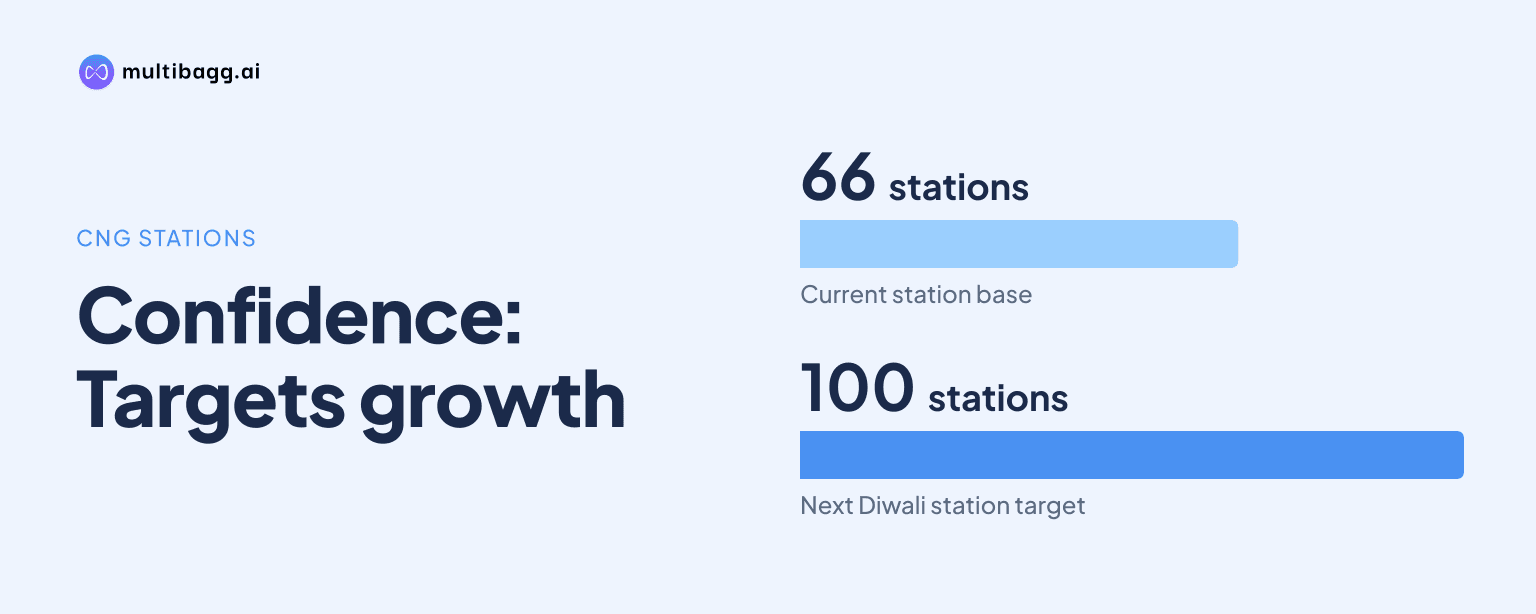
Confidence Petroleum said it is targeting 100 Bengaluru compressed natural gas (CNG) stations by next Diwali after completing capital expenditure on 56 stations and placing another 10 in the pipeline. Management said it will first lift daily sales volumes at operating locations to reduce logistics costs and operating expenses before accelerating the remaining rollout.
Know Confidence Petroleum India inside out
Results, valuation, peers and who's buying, in one view.
How close is Confidence to 100 Bengaluru CNG stations?
Confidence has completed capital expenditure on 56 Bengaluru CNG stations and said 10 more stations are in the pipeline, taking the identifiable rollout base to 66 stations. Management also said that six stations would become operational soon, although the call did not specify whether those six were included within the 56 capex-complete sites or the 10 pipeline locations.
The distinction between capital expenditure completion and operational status matters because management referred separately to stations becoming operational. An analyst said the joint-venture plan had targeted 100 CNG stations and that, after more than four years, about 50 had been completed. Management responded with the higher figure of 56 stations where capex had been done, rather than giving a reconciled count of live stations.
On that stated basis, Confidence has 34 stations still to account for before reaching the 100-station target. The 66-station figure is not a count of operational outlets: it combines 56 sites where capex has been completed with 10 sites that management described as being in the pipeline. The transcript does not provide station-wise commissioning dates, investment per station, or a current count of outlets selling CNG.
When does Confidence expect to complete its Bengaluru CNG target?
Confidence expects to complete the 100-station Bengaluru target by next Diwali. Nitin Khara first said the target could be completed within two to three quarters, then referred to the next three to four quarters, before stating that the company was focused on finishing it by next Diwali.
Those comments provide a directional timetable but not a dated commissioning schedule. The transcript does not state the calendar year of the Diwali reference, the quarter in which the call occurred, or the number of stations expected to open in each quarter. Accordingly, the disclosed milestone is the next-Diwali target, while the two-to-four-quarter statements indicate management’s expected execution window rather than formal numerical guidance.
The schedule follows a rollout that the analyst characterised as delayed by more than four years. Confidence did not give a reason for the earlier delay, identify regulatory, land, supplier or commissioning constraints, or provide an updated timetable for each of the remaining 34 stations. Its answer focused instead on a sequencing decision: make existing outlets carry more volume before expanding the network further.
Why is Confidence prioritising volume at existing CNG stations?
Confidence said it is prioritising higher kilograms-per-day sales at stations already established because greater throughput can lower logistics costs and operating expenses. Management said the company was already achieving “good numbers” in kilograms-per-day sales and expected further additions to daily volumes before increasing the station count in upcoming quarters.
The mechanism described on the call is operational rather than a change in the 100-station endpoint. Management said that getting stations online first would provide logistics-cost benefits, which would help reduce operating expenses. It did not quantify current kilograms sold per day, the expected volume increase, transport savings, operating-cost reduction or the level of station utilisation required before opening the remaining locations.
Confidence’s disclosed measures of execution therefore include commissioning more stations, lifting daily sales at the established network and advancing the 10 stations in the pipeline. Management presented higher sales per day as a route to improved logistics economics while maintaining its target of 100 Bengaluru CNG stations. The call did not disclose CNG revenue, earnings before interest, tax, depreciation and amortisation margins, or CNG segment profitability.
Got a follow-up? Ask IRIS
What does the Bengaluru plan mean for Confidence’s wider business?
Confidence said CNG retailing in Bengaluru is one of several businesses it intends to grow over the next five years, alongside packed liquefied petroleum gas, auto LPG, bulk LPG and high-pressure cylinder manufacturing. Management said its central objective across the LPG businesses was to increase volumes in retail and bulk supply, while also growing CNG retail.
The CNG plan is therefore part of a multi-segment growth agenda rather than the only stated priority. When asked which business had the greatest growth potential over the coming five years, management said it was focused on all segments. It did not disclose revenue or EBITDA, meaning earnings before interest, tax, depreciation and amortisation, by segment despite an investor request for segment revenue and EBITDA margins.
Management also maintained that it was on track with an earlier expectation of 10% to 15% quarter-on-quarter growth in revenue and profit after tax, or PAT, while noting that LPG prices fluctuate and can affect revenue. That statement was not accompanied by a CNG-specific target. As a result, the Bengaluru station goal should not be read as a disclosed forecast for CNG revenue, group revenue, PAT or margin improvement.
What remains unconfirmed about the CNG expansion?
Confidence has not disclosed how many of the 56 capex-complete Bengaluru stations are operating, how many are selling CNG each day, or how much further capital is needed to reach 100. Management’s statement that six stations would soon become operational indicates near-term commissioning activity, but it did not give a date, location, daily sales capacity or regulatory status for those sites.
The call also leaves the relationship between the analyst’s reference to a joint venture with GAIL India Company and the 100-station rollout unexplained. Management answered the timetable question but did not describe ownership, capital commitments, gas supply arrangements, profit sharing or the respective responsibilities of the parties. These omissions limit assessment of the pace and economics of the remaining 34 stations.
For the immediate period, the operational test is whether additional sites are commissioned while kilograms-per-day sales rise at the existing network. Management’s stated rationale is that volume growth can improve logistics economics and reduce operating expenses. The transcript contains no benchmark against which to measure that improvement, so future disclosures on operating station count, daily throughput and costs would clarify progress.
Conclusion
Confidence has set a clear endpoint of 100 Bengaluru CNG stations by next Diwali, supported by 56 sites with completed capex and 10 more in the pipeline. The company’s emphasis is not solely on adding locations: management says increasing sales volumes at established stations should reduce logistics costs and operating expenses, linking rollout execution to station-level throughput.
The next item to watch is whether the six stations management said would soon become operational are commissioned and whether the pipeline advances toward the 66-site base it identified. Investors will also need updates on the unresolved operating-station count, kilograms-per-day sales and the timetable for the remaining 34 stations before the next-Diwali target can be measured in detail.

