










CPIL Holds 33% of Parallel LPG; Segment Is 6% Nationally
Key highlights
- CPIL sold 685 TMT and held 33% of India’s 2,089 TMT parallel LPG market in FY25-26.
- Parallel marketers represented 6% of India’s 35,045 TMT LPG market, while OMCs held 94%.
- CPIL held 33% of private PCD and bulk LPG sales but 30% of private Auto LPG sales.
- India’s LPG consumption rose from 26.3 MMT in FY20 to 35.04 MMT in FY26.
powered by IRIS
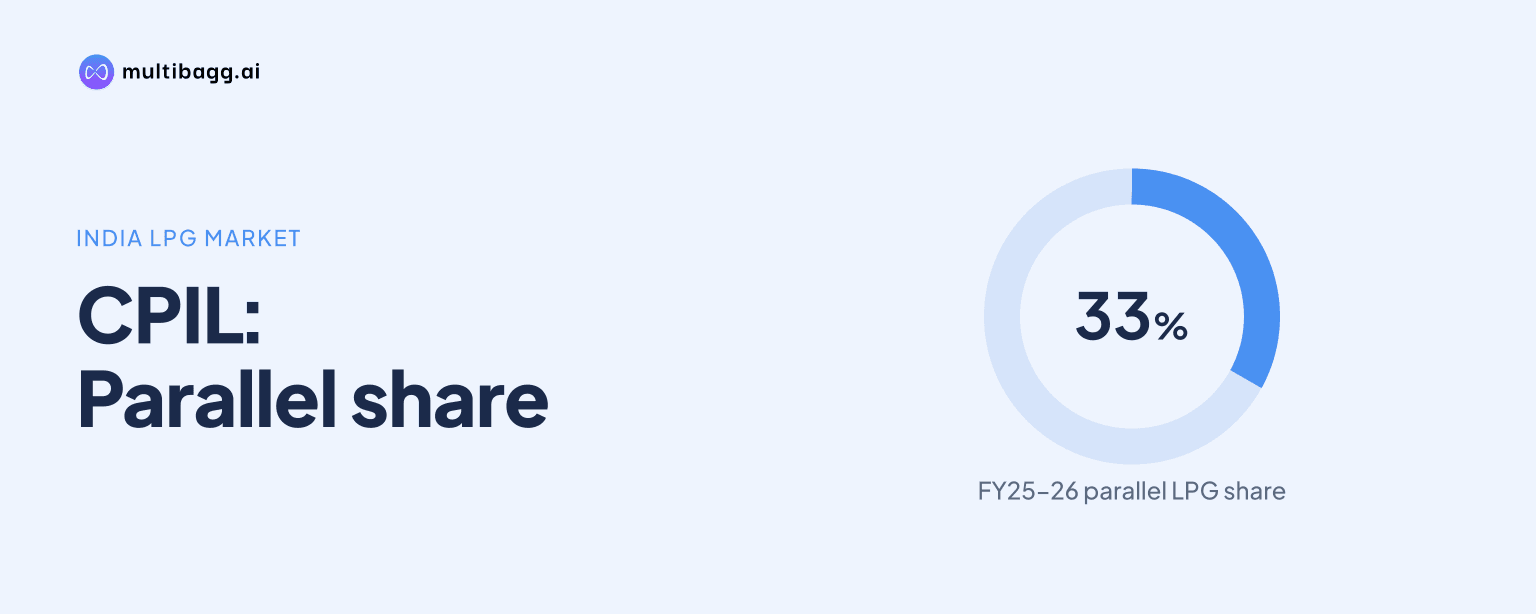
Confidence Petroleum India Limited held 33% of India’s parallel LPG market in FY25-26 through 685 TMT of sales, but all parallel marketers together represented 2,089 TMT, or 6%, of the 35,045 TMT national LPG market. CPIL’s leadership is therefore within a segment where oil marketing companies retain 94% of total supply.
Know Confidence Petroleum India inside out
Results, valuation, peers and who's buying, in one view.
How large is CPIL’s position in India’s parallel LPG market?
CPIL accounted for 685 TMT, or 33%, of the 2,089 TMT sold by India’s parallel LPG marketers in FY25-26. The presentation describes this as roughly one in every three tonnes sold by the country’s 105 parallel marketers, while the other 104 marketers sold 1,404 TMT, or 67%.
The position is different when measured against the full 35,045 TMT Indian LPG market. Oil marketing companies, or OMCs, supplied 32,956 TMT and held 94% of the market, whereas all parallel marketers supplied 2,089 TMT and held 6%. CPIL’s disclosed 33% share is therefore of parallel-marketer sales rather than total Indian LPG consumption.
TMT means thousand metric tonnes. The table separates the national market from the parallel-marketer subset, so CPIL’s 685 TMT is not presented as a direct 33% share of the 35,045 TMT total market.
Which LPG channels account for CPIL’s parallel-market position?
CPIL held 33% of packed cylinder distribution and bulk LPG sales within the parallel-marketer segment, selling 608 TMT from a 1,836 TMT market in FY25-26. Packed cylinder distribution, or PCD, and bulk LPG represented the larger portion of the 2,089 TMT parallel-marketer market.
In Auto LPG, CPIL sold 77 TMT and held 30% of the 253 TMT parallel-marketer category, while other marketers sold 176 TMT, or 70%. CPIL’s disclosed share was therefore 3 percentage points higher in PCD and bulk LPG than in Auto LPG.
CPIL lists more than 68 bottling plants, more than 3,400 GoGas dealers and more than 315 Auto LPG stations. Its network also included more than 478 LPG road tankers, more than 300 industrial customers and more than 3,400 direct customers, covering packed, bulk and vehicle-fuel distribution channels.
How has India’s LPG market grown through FY26?
India’s LPG consumption rose from 26.3 MMT in FY20 to 35.04 MMT in FY26, according to the presentation’s market-size series. MMT means million metric tonnes, and the presentation cites an approximate 5% compound annual growth rate, or CAGR, over FY20 to FY26.
Growth increased in the final reported year: consumption rose by 3.74 MMT from 31.3 MMT in FY25 to 35.04 MMT in FY26. That was larger than the 1.6 MMT increase from 29.7 MMT in FY24 to 31.3 MMT in FY25. The presentation projects a 40-42 MMT Indian LPG market by FY2030.
The presentation identifies households as the base of demand, stating that about 90% of LPG is used for household cooking. It also cites approximately 33 crore LPG consumers and says around 60% of demand is imported, linking market growth to continued overseas supply requirements.
Got a follow-up? Ask IRIS
What growth pools does CPIL identify for LPG?
CPIL identifies non-subsidised commercial, industrial and Auto LPG pools as the areas where growth now sits. Its next-decade drivers include industrial process heat, formalisation in hotels, restaurants and catering, or HoReCa, Auto LPG, and curbing cylinder diversion.
CPIL’s model spans LPG imports, road logistics, bottling, PCD distribution, Auto LPG distribution and cylinder manufacturing. Since 2022, it says it has imported LPG from the Middle East and Gulf, started sourcing from the United States and uses four time-chartered vessels. CPIL also says it is in active discussions with other city gas distribution, or CGD, players to expand into more cities.
Piped natural gas, or PNG, is not presented as an immediate substitute for LPG. The presentation cites 1.74 crore PNG connections in August 2026, equal to about 5% of the LPG consumer base, across 309 CGD areas authorised on paper. It also says the connection count represented 14% of the PNG rollout target.
What limits CPIL’s addressable LPG market?
CPIL’s national market opportunity is limited by the 94% share held by OMCs in FY25-26. Although CPIL led the 2,089 TMT parallel-marketer market with 685 TMT, parallel marketers as a group remained a 6% portion of the 35,045 TMT total LPG market.
Supply conditions are another disclosed factor. The presentation says LPG offtake in April-August 2026 was about 16% lower year on year because of West Asia supply constraints, which it characterises as a supply dip rather than lower demand. It also says net debt and working capital increased with longer procurement cycles from new geographies and are expected to normalise as West Asia settles.
Conclusion
CPIL’s 33% share of parallel LPG sales establishes its scale among private marketers, especially in the 1,836 TMT PCD and bulk category where it sold 608 TMT. However, the 6% national share held by all parallel marketers places that position in context, as OMCs supplied 32,956 TMT of the 35,045 TMT market in FY25-26.
The next measures to watch are progress toward the presentation’s FY2030 market projection of 40-42 MMT, the outcome of CPIL’s discussions with additional CGD players, and West Asia supply conditions. The presentation identifies these conditions after the approximately 16% year-on-year offtake decline in April-August 2026 as an unresolved operating factor.