










Accord FY26 revenue and profit fell as cash rose sharply
Key highlights
- Accord's FY26 revenue was Rs 70.07 crore, down from Rs 79.02 crore in FY25.
- FY26 profit for the year was Rs 4.50 crore, compared with Rs 5.94 crore in FY25.
- Cash and bank balances rose to Rs 22.33 crore in FY26 from Rs 1.27 crore in FY25.
- Accord's FY26 debt-to-equity ratio was 0.18 times, down from 0.81 times in FY25.
powered by IRIS
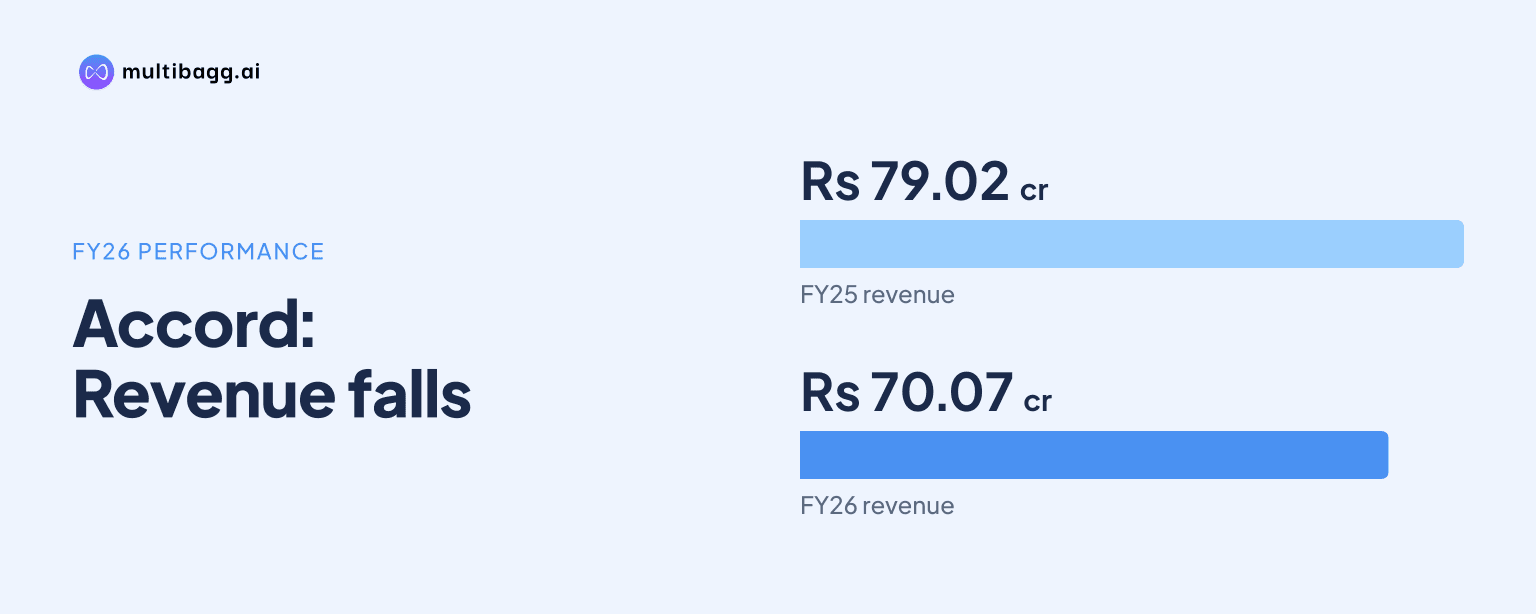
Accord Transformer & Switchgear reported FY26 revenue of Rs 70.07 crore and profit for the year of Rs 4.50 crore, down from Rs 79.02 crore and Rs 5.94 crore respectively in FY25, while cash and bank balances rose to Rs 22.33 crore from Rs 1.27 crore.
Know Accord Transformer & Switchgear inside out
Results, valuation, peers and who's buying, in one view.
Why did Accord's FY26 earnings decline?
Accord's FY26 earnings declined as revenue, earnings before interest, tax, depreciation and amortisation (EBITDA), and profit for the year all fell from their FY25 levels. Revenue from operations decreased by Rs 8.95 crore to Rs 70.07 crore, EBITDA decreased by Rs 2.02 crore to Rs 7.23 crore, and profit for the year declined by Rs 1.44 crore to Rs 4.50 crore.
The FY26 decline followed a substantial expansion between FY24 and FY25. Revenue had risen from Rs 48.54 crore in FY24 to Rs 79.02 crore in FY25, while profit for the year increased from Rs 1.61 crore to Rs 5.94 crore. FY26 revenue and profit remained above FY24 levels, but both retreated from the FY25 level reported in the presentation.
Accord's EBITDA margin was 10.39% in FY26, compared with 11.68% in FY25 and 5.50% in FY24. Its profit after tax (PAT) margin was 6.40% in FY26, below 7.51% in FY25 but above 3.31% in FY24. The FY26 figures therefore show lower absolute earnings and lower margins than FY25, while margins remained above FY24 levels.
How did Accord's costs change in FY26?
Accord's FY26 expense mix changed most visibly through the inventory line, employee costs and direct expenses. The change in inventories of work-in-progress and finished goods was an expense of Rs 28.67 lakh in FY26, compared with negative Rs 7.98 crore in FY25. Employee benefits expense increased to Rs 5.78 crore from Rs 3.62 crore, while direct expenses rose to Rs 3.60 crore from Rs 2.37 crore.
Cost of material consumed declined to Rs 49.31 crore in FY26 from Rs 68.36 crore in FY25, alongside lower revenue. However, the reported inventory movement shifted by Rs 8.26 crore between the two years, while other expenses increased by Rs 49.72 lakh to Rs 4.06 crore. Depreciation and amortisation also rose to Rs 62.60 lakh from Rs 40.50 lakh.
Total expenses fell to Rs 64.30 crore in FY26 from Rs 71.02 crore in FY25, a smaller reduction than the Rs 8.84 crore fall in total income to Rs 70.36 crore. Other income increased to Rs 28.78 lakh from Rs 16.94 lakh, while finance costs declined to Rs 55.04 lakh from Rs 67.38 lakh. Profit before tax consequently fell to Rs 6.06 crore from Rs 7.98 crore, and tax expense declined to Rs 1.55 crore from Rs 2.04 crore.
Got a follow-up? Ask IRIS
What changed in Accord's balance sheet?
Accord's balance sheet shifted toward a larger equity base, lower borrowings and substantially higher liquid balances in FY26. Total shareholders' funds increased to Rs 48.87 crore from Rs 21.54 crore in FY25, including share capital of Rs 20.57 crore compared with Rs 29.43 lakh a year earlier. Reserves and surplus increased to Rs 28.30 crore from Rs 21.25 crore.
Short-term borrowings fell to Rs 8.36 crore in FY26 from Rs 16.71 crore in FY25, while long-term borrowings declined to Rs 47.22 lakh from Rs 79.32 lakh. Total current liabilities reduced to Rs 33.81 crore from Rs 37.23 crore, although trade payables increased to Rs 18.57 crore from Rs 15.11 crore and other current liabilities increased to Rs 6.83 crore from Rs 4.39 crore.
On the asset side, current assets increased to Rs 75.29 crore from Rs 52.63 crore. Cash and bank balances rose by Rs 21.06 crore, while short-term loans and advances increased to Rs 8.90 crore from Rs 63.86 lakh. Trade receivables declined by Rs 13.49 crore to Rs 15.01 crore, whereas inventories increased by Rs 6.27 crore to Rs 24.35 crore. Property, plant and equipment and intangible assets rose to Rs 7.95 crore from Rs 7.11 crore.
How did Accord's returns and liquidity move in FY26?
Accord's reported return ratios declined in FY26 while its liquidity and leverage ratios moved in the opposite direction. Return on equity (ROE) fell to 9.22% from 27.59% in FY25, and return on capital employed (ROCE) fell to 11.45% from 22.17%. Earnings per share decreased to Rs 2.90 from Rs 4.27.
The debt-to-equity ratio declined to 0.18 times in FY26 from 0.81 times in FY25 and 1.51 times in FY24. This movement occurred alongside the increase in shareholders' funds to Rs 48.87 crore and the reduction in short-term borrowings to Rs 8.36 crore. The presentation reports the ratio rather than providing a separate reconciliation of its debt definition.
Accord's current ratio increased to 2.23 times in FY26 from 1.41 times in FY25 and 1.07 times in FY24. Current assets of Rs 75.29 crore exceeded current liabilities of Rs 33.81 crore in FY26, with the Rs 22.33 crore cash and bank balance forming a major part of current assets. The higher current ratio coincided with lower reported revenue and profit than FY25.
Conclusion
Accord's FY26 accounts show an earnings retreat after FY25, with revenue declining to Rs 70.07 crore and PAT declining to Rs 4.50 crore. At the same time, shareholders' funds more than doubled to Rs 48.87 crore, cash and bank balances reached Rs 22.33 crore, and the reported debt-to-equity ratio fell to 0.18 times.
What to watch next is whether Accord converts its reported order book of Rs 173 crore as at 30 September 2026 into revenue and earnings. Management also identifies demand across residential, commercial and industrial sectors, while the FY26 accounts leave open how the larger cash balance, inventories of Rs 24.35 crore and short-term advances of Rs 8.90 crore will develop in subsequent periods.