










Accord plans 5,000 MVA capacity in planned 220–400 kV complex
Key highlights
- Accord’s planned complex is designed for transformers ranging from 220 kV to 400 kV.
- Accord expects annual production capacity of up to 5,000 MVA upon commissioning.
- Accord reported an order book of Rs 173 crore as at 30 September 2026.
- The site plan specifies 18-metre sheds, except for one shed planned at 30 metres.
powered by IRIS
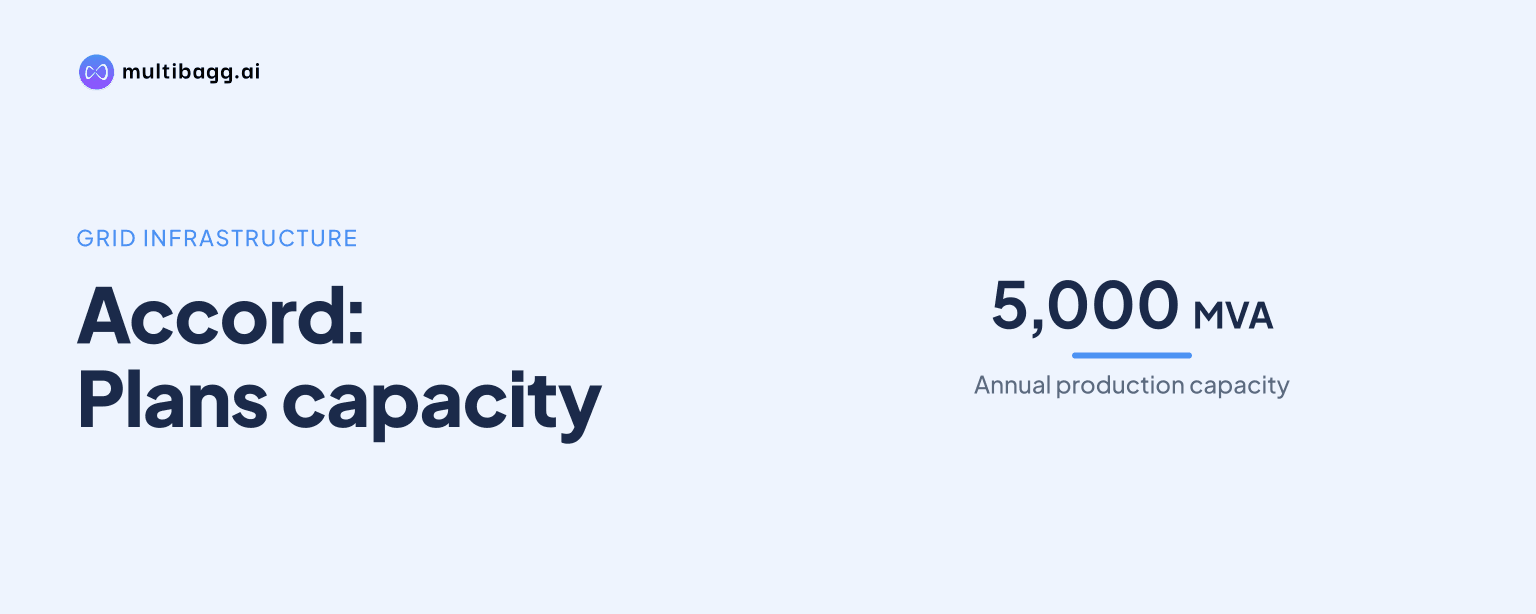
Accord Transformer & Switchgear Limited says its planned integrated manufacturing complex is designed for 220–400 kilovolt, or kV, transformers and annual capacity of up to 5,000 megavolt-amperes, or MVA, upon commissioning. The layout combines assembly, winding, testing, impulse and dispatch functions, although Accord has not disclosed a commissioning date or project cost.
Know Accord Transformer & Switchgear inside out
Results, valuation, peers and who's buying, in one view.
What transformers and capacity is Accord planning?
Accord is planning a complex designed to manufacture transformers across voltage classes from 220 kV to 400 kV, with annual production capacity of up to 5,000 MVA upon commissioning. The presentation describes the facility as fully integrated, technologically advanced and highly automated, and says it is intended to support expansion into high-value product segments.
The 5,000 MVA figure is a capacity measure rather than a target number of transformer units. Accord does not disclose how this capacity would be divided between 220 kV transformers, products above 220 kV, or other equipment shown in the complex layout.
Accord’s presentation frames the 220 kV to 400 kV range as part of a proposed move into advanced power transmission and distribution infrastructure. The company says the complex will support demand for such infrastructure, but it does not provide demand forecasts, customer commitments or utilisation assumptions for the up-to-5,000 MVA capacity.
What functions will the Accord complex include?
Accord’s layout includes manufacturing, testing, storage and dispatch functions within the planned complex. Listed areas include an assembly bay, winding cell, insulation area, coil store, main store, fabrication, painting and powder coating, tank-up, finished goods and dispatch.
The site plan also identifies extra-high-voltage, or EHV, assembly, a 220 kV EHV tank-up area, a testing laboratory, an impulse area and a ready-transformer EHV area. These functions indicate that testing and handling infrastructure is included alongside transformer assembly rather than being limited to final production stages.
Other named areas include electric and vacuum ovens, copper scrap storage, a scrap yard, a compact-substation shed, a low-tension control-panel shed and a 30-kilolitre oil tanker. The layout also identifies electric-vehicle, or EV, and battery energy storage system, or BESS, areas, extending the disclosed site plan beyond the 220 kV to 400 kV transformer production line.
Accord says the complex will incorporate future-ready automation systems to enhance productivity and operational efficiency, as well as dust-free manufacturing infrastructure intended to support product quality and reliability. The presentation does not quantify automation spending, anticipated output improvement, defect reduction or the share of processes that will be automated.
How does the complex compare with Accord’s Bhiwadi expansion?
Accord has disclosed two separate manufacturing expansion approaches: incremental plant and machinery additions at its existing Bhiwadi facility, and the planned 220 kV to 400 kV integrated complex. The Bhiwadi additions are intended to enhance throughput, optimise turnaround times and help execute higher-volume and complex projects.
The integrated complex has a disclosed design capacity of up to 5,000 MVA a year upon commissioning, while Accord gives no current or planned MVA figure for Bhiwadi. This means the presentation provides a defined future capacity objective for the complex but does not allow a numerical comparison with the existing facility.
Accord also says it is enhancing its Quality Assurance Department through investments in advanced testing facilities, foil-winding equipment and busbar machines. The complex layout separately identifies a testing laboratory, impulse area, winding cell and insulation area, linking the planned configuration with the company’s stated quality and customisation initiatives.
The presentation refers to Industry 4.0 practices including automated material handling, process monitoring and data-driven inventory management. Management says these practices are intended to improve productivity, minimise human error and provide a scalable basis for future growth, but does not state whether they are already deployed at Bhiwadi or will be introduced through the planned complex.
Got a follow-up? Ask IRIS
How does Accord link the complex to its growth strategy?
Accord links the proposed complex to expansion in EV charging infrastructure, renewable-energy solutions, solar transformers and renewable-energy transformers. Its strategic roadmap says a collaboration with NHEV supports a pan-India network of fast-charging stations, while the planned facility includes dedicated EV and BESS areas.
The company reported an order book of Rs 173 crore as at 30 September 2026, spanning residential, commercial and industrial sectors. Accord does not break down that order book by voltage class, transformer type, customer sector or whether any orders relate to the planned 220 kV to 400 kV complex.
Accord also cites more than 12 years of experience in its niche market and says its operations follow ISO 9001 quality, ISO 14001 environmental and ISO 45001 safety management systems. It identifies partnerships with Schneider Electric, Siemens of Germany and Lucy Electric of England, but does not say whether any of these partners will provide technology, equipment, orders or funding for the complex.
The site plan reserves a white area for future expansion, and specifies 18-metre shed heights except for one 30-metre shed. While these provisions show that further physical development is contemplated, Accord does not state the reserve area’s size or the additional MVA capacity that future expansion could support.
What details has Accord not disclosed about the project?
Accord has not disclosed a commissioning date, capital expenditure, funding plan, land area, construction status or project milestones for the planned up-to-5,000 MVA complex. Accordingly, the stated annual capacity remains a design expectation upon commissioning rather than reported operating capacity.
The presentation also does not identify approvals, customer contracts, product-wise capacity allocation or expected utilisation for the 220 kV to 400 kV range. It names EHV assembly, testing, impulse, winding, fabrication and 220 kV tank-up functions, but does not quantify the output expected from any individual production area.
Accord’s existing Bhiwadi plan is similarly stated in operational rather than financial terms: incremental plant and machinery additions are intended to improve throughput and turnaround times. Neither the Bhiwadi plan nor the integrated-complex plan includes a disclosed budget, funding source or implementation timetable in the presentation.
Conclusion
Accord’s disclosed plan combines a 220 kV to 400 kV transformer range, dedicated EHV assembly and testing functions, automation initiatives and annual capacity of up to 5,000 MVA upon commissioning. Compared with the incremental plant and machinery additions planned at Bhiwadi, the complex has a more detailed integrated layout and a stated future capacity measure.
The next developments to watch are any commissioning timetable, capital-expenditure or funding disclosure, and further detail on the 5,000 MVA capacity mix. Accord has also reserved site space for future expansion and identified EV, BESS, solar and renewable-energy transformer opportunities, but has not quantified their expected contribution to capacity or the Rs 173 crore order book as at 30 September 2026.