










Accord H1 FY27 profit rose 238% as finance costs halved
Key highlights
- Accord reported H1 FY27 total income of Rs 53.00 crore, up 90.91% from Rs 27.76 crore.
- Accord’s H1 FY27 PAT rose 237.85% to Rs 4.23 crore from Rs 1.25 crore.
- Accord’s H1 FY27 finance costs fell to Rs 15.58 lakh from Rs 32.42 lakh.
- Accord reported an order book of Rs 173 crore as of September 30, 2026.
powered by IRIS
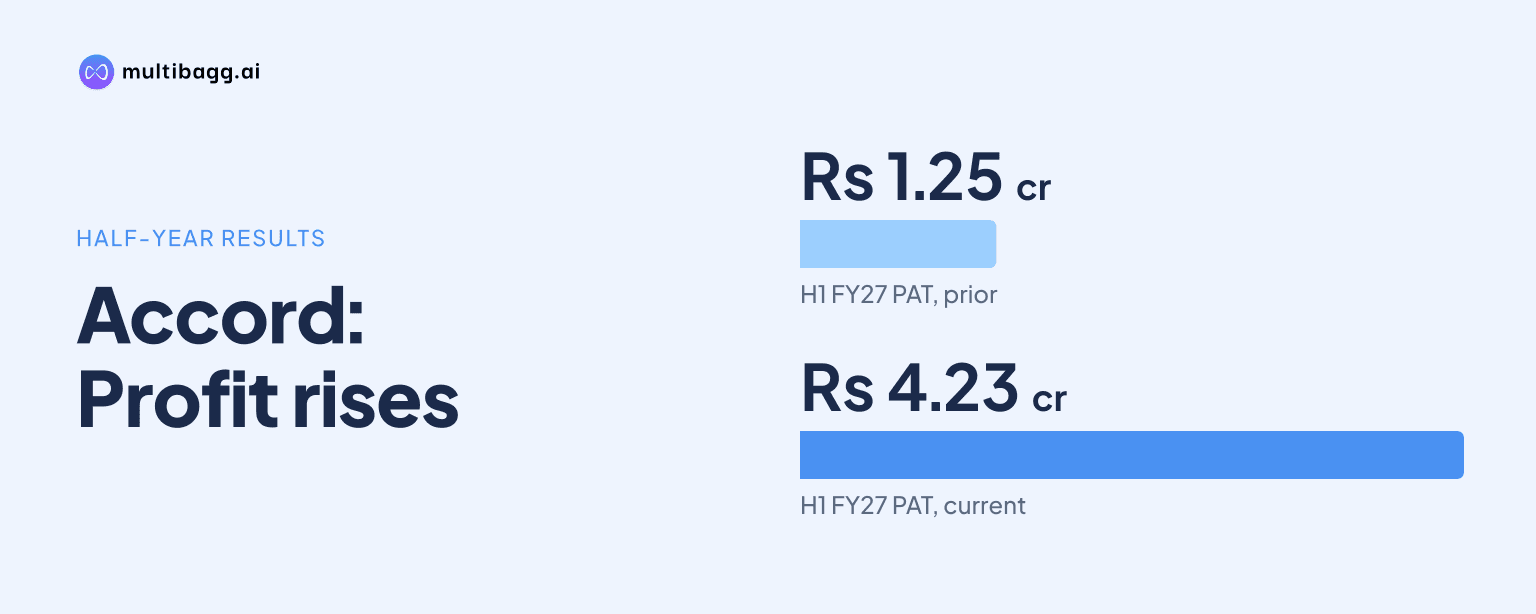
Accord Transformer & Switchgear Limited (Accord) reported profit after tax of Rs 4.23 crore in H1 FY27, up 237.85% from Rs 1.25 crore a year earlier, after total income rose 90.91% to Rs 53.00 crore and finance costs fell to Rs 15.58 lakh from Rs 32.42 lakh.
Know Accord Transformer & Switchgear inside out
Results, valuation, peers and who's buying, in one view.
How did Accord’s H1 FY27 earnings change?
Accord’s H1 FY27 earnings increased across income, operating profit and profit after tax, with profit after tax rising faster than sales. Revenue from operations rose to Rs 52.68 crore from Rs 27.71 crore in H1 FY26, an increase of Rs 24.97 crore. Other income increased to Rs 32.01 lakh from Rs 4.69 lakh, taking total income to Rs 53.00 crore from Rs 27.76 crore.
The presentation’s profit and loss statement identifies the periods as H1 FY27 and H1 FY26, where FY means financial year. However, the separate key-highlights chart labels the Rs 53.00 crore total-income figure as “H2 FY27”, despite comparing it with H1 FY26 and showing the same 90.91% growth rate as the H1 FY27 profit and loss statement. Accord does not explain this labelling difference in the supplied presentation.
What drove Accord’s operating-profit increase?
Accord’s earnings before interest, tax, depreciation and amortisation, or EBITDA, rose 170.40% to Rs 6.21 crore in H1 FY27 from Rs 2.29 crore in H1 FY26. This increase exceeded the 90.91% increase in total income, while total expenses rose to Rs 46.78 crore from Rs 25.46 crore. The difference between total income and total expenses was Rs 6.21 crore in H1 FY27, compared with Rs 2.29 crore a year earlier.
Raw-material expense was the largest cost line and increased to Rs 41.59 crore from Rs 20.56 crore. Employee-benefit expense rose to Rs 3.28 crore from Rs 2.68 crore, while other expenses declined to Rs 1.91 crore from Rs 2.21 crore. Raw materials therefore accounted for most of the Rs 21.32 crore increase in total expenses between the two half-year periods.
The management commentary gives EBITDA as Rs 6.27 crore, whereas the detailed profit and loss statement and key-highlights table show Rs 6.21 crore, or 621.25 lakh. The supplied presentation provides no reconciliation for the Rs 6 lakh difference, so the detailed statement is the basis for the period comparison shown above.
Why did Accord’s net profit grow faster than total income?
Accord’s profit after tax grew faster than income because EBITDA growth was accompanied by lower finance costs. Finance costs fell 51.94% to Rs 15.58 lakh in H1 FY27 from Rs 32.42 lakh in H1 FY26, a reduction of Rs 16.84 lakh. Depreciation and amortisation expense increased to Rs 34.86 lakh from Rs 29.08 lakh, but the finance-cost reduction was larger than that additional charge.
Profit before tax, or PBT, rose 239.26% to Rs 5.70 crore from Rs 1.68 crore. Tax expense increased to Rs 1.48 crore from Rs 43.15 lakh, leaving reported profit after tax, or PAT, of Rs 4.23 crore versus Rs 1.25 crore. The Rs 3.91 crore EBITDA increase, together with the lower finance charge, preceded a Rs 4.02 crore increase in PBT.
Got a follow-up? Ask IRIS
What does Accord’s order book indicate after H1 FY27?
Accord said it received orders of about Rs 77 crore during H1 FY27, taking its order book to Rs 173 crore as of September 30, 2026. The order book was Rs 120.32 crore above the Rs 52.68 crore of H1 FY27 revenue from operations, although the presentation does not specify delivery dates, cancellation terms or the portion expected in any particular financial year.
Management said its renewable-energy and power-infrastructure presence was strengthened during the half year through vendor approvals from renewable-energy, utility and infrastructure companies. It also cited completion of the 17.6 type test at CPRI and a five-year UGVCL registration. The presentation does not quantify revenue, orders or margins attributable to those approvals, the type test or the registration.
Accord’s stated core business includes the design, manufacture, supply, installation and commissioning of transformers, substations, switchgear panels, busducts and related assemblies. Its markets include power transmission and distribution, renewable energy, industrial applications, infrastructure projects and electric-vehicle charging networks. These market descriptions provide the operating context for the Rs 77 crore of H1 FY27 orders but do not break those orders down by product or customer segment.
How is Accord planning to expand transformer capacity?
Accord plans an extra-high-voltage, or EHV, plant intended to extend its capability to the 220 kilovolt class and provide annual transformer manufacturing capacity of 8,000 megavolt-amperes, or MVA. Management said it held a Bhoomi Pujan, a ceremonial start to construction, for this plant during H1 FY27. The presentation gives no completion date, project cost, funding plan or expected revenue contribution.
The proposed facility follows a FY26 installed manufacturing capacity of more than 1,200 MVA across Accord’s two manufacturing units in Bhiwadi, Rajasthan. Management also cited land acquired at Khairthal-Tijara for future expansion and said the EHV investment would broaden the product range and serve more customers. The presentation does not state the acquired land area or a timetable for its development.
Accord was incorporated in 2014 and lists two Bhiwadi manufacturing facilities, with its head office in Manesar, Gurugram, Haryana. Its presentation says it has served more than 1,000 clients and has operations across five or more key segments, including transformers, switchgear, substations, busducts and electric-vehicle solutions. These figures describe the operating base from which management plans to add 220 kilovolt capability.
Conclusion
Accord’s 170.40% EBITDA increase exceeded its 90.91% total-income growth in H1 FY27, while finance costs declined by Rs 16.84 lakh. Those movements accompanied a 239.26% rise in PBT and a 237.85% increase in PAT, showing that operating profit expanded faster than reported income during the half year.
The next disclosed points to watch are conversion of the Rs 173 crore order book reported on September 30, 2026, and progress on the planned 8,000 MVA EHV plant. Management has announced the plant’s 220 kilovolt capability and future-expansion land at Khairthal-Tijara, but has not disclosed construction timing, project expenditure, financing or commissioning dates.