










CPIL capex coincided with LPG volumes tripling by FY26
Key highlights
- CPIL spent Rs 900 crore on capex during FY22-FY26.
- CPIL’s LPG sales volumes rose from 2.68 lakh metric tonnes in FY22 to 8.57 lakh metric tonnes in FY26.
- CPIL’s FY26 revenue from operations was Rs 4,705 crore, compared with Rs 1,428 crore in FY22.
- CPIL’s H1 FY27 LPG sales volumes were 4.87 lakh metric tonnes, versus 4.13 lakh metric tonnes in H1 FY26.
powered by IRIS
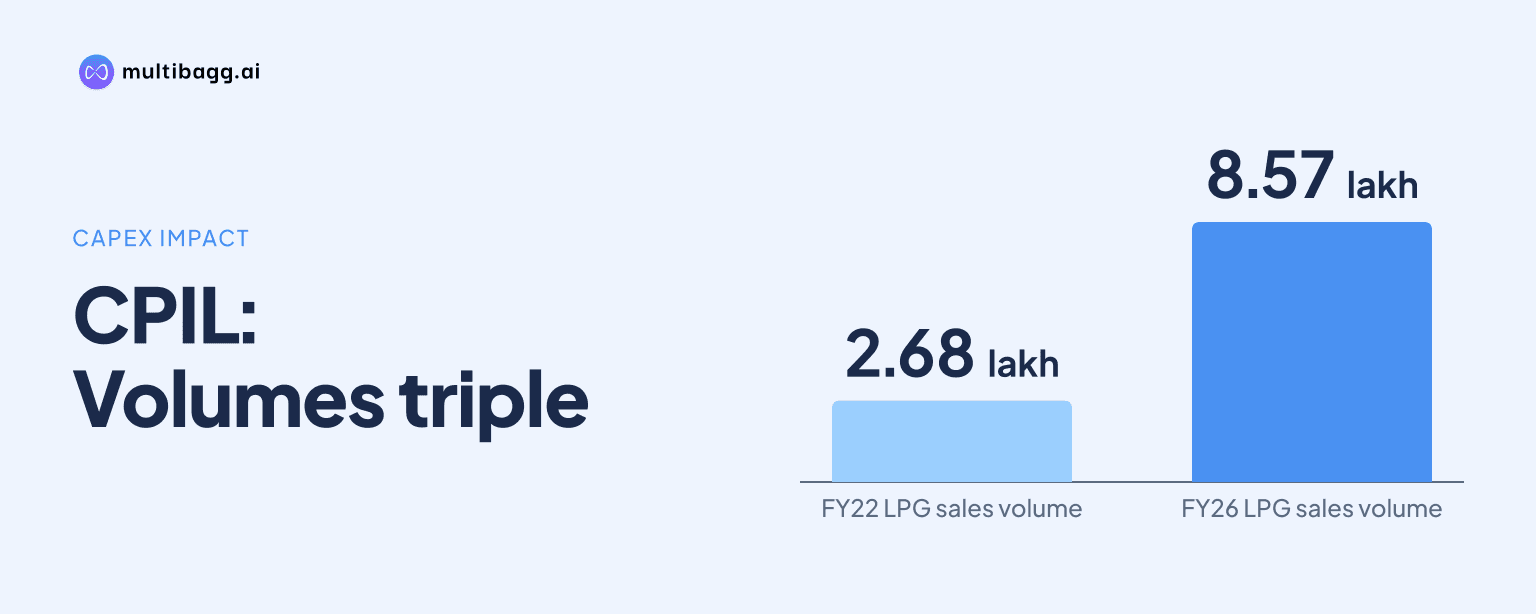
Confidence Petroleum India Limited spent Rs 900 crore on capital expenditure from FY22 through FY26, while its overall liquefied petroleum gas (LPG) sales volumes rose to 8.57 lakh metric tonnes from 2.68 lakh metric tonnes. CPIL’s presentation links capacity creation and infrastructure strengthening with the 3.2-times increase, but does not disclose returns for individual projects.
Know Confidence Petroleum India inside out
Results, valuation, peers and who's buying, in one view.
How much did CPIL spend and how much did LPG volume grow?
CPIL spent Rs 900 crore on capital expenditure across FY22-FY26, while overall LPG sales volumes increased by 5.89 lakh metric tonnes. Annual capex was Rs 56 crore in FY22, Rs 213 crore in FY23, Rs 245 crore in FY24, Rs 272 crore in FY25 and Rs 114 crore in FY26.
The volume increase accelerated in FY26. LPG sales rose from 2.68 lakh metric tonnes in FY22 to 4.10 lakh metric tonnes in FY23, 5.07 lakh metric tonnes in FY24 and 5.29 lakh metric tonnes in FY25, before reaching 8.57 lakh metric tonnes in FY26. The FY26 increase of 3.28 lakh metric tonnes was larger than the cumulative increase from FY22 to FY25.
The sequence shows that volume growth accompanied the investment programme, rather than proving a direct return on every rupee spent. In FY26, capex declined 58% from Rs 272 crore in FY25 to Rs 114 crore, while LPG volume increased 62% from 5.29 lakh metric tonnes to 8.57 lakh metric tonnes. This is consistent with greater use of capacity created in earlier years.
What physical network supports CPIL’s LPG sales volumes?
CPIL lists more than 68 bottling plants, more than 3,400 GoGas dealers and more than 315 Auto LPG stations as its distribution base. Its logistics network includes more than 478 LPG road tankers, more than 225 heavy commercial vehicles and light commercial vehicles, and more than 300 direct industrial customers.
The bottling footprint includes eight plants in Tamil Nadu, five each in Madhya Pradesh and Uttar Pradesh, and four each in Rajasthan, Gujarat and Karnataka. CPIL also identifies two bottling plants in Indonesia. It describes the network as a strategically located pan-India backbone for moving LPG from sourcing and bottling into packed-cylinder, bulk-industrial and automotive channels.
CPIL’s packed-LPG offering covers cylinders from 2 kilograms to 425 kilograms. Its direct-to-customer model began in the hotel, restaurant and catering segment and now serves institutional and industrial buyers, while the Janata Cylinder Yojana uses small dealers, stock points, Petroleum and Explosives Safety Organisation-approved godowns and freight-on-road logistics for rural homes and small businesses.
The Auto LPG footprint is concentrated in Tamil Nadu and Karnataka. Tamil Nadu has 113 stations and Karnataka has 108, together representing 221 of the stated 315-plus stations; Maharashtra has 53, Telangana 28, Madhya Pradesh seven, Rajasthan five and West Bengal one. The station network is therefore more geographically concentrated than CPIL’s bottling and dealer base.
Got a follow-up? Ask IRIS
Did CPIL’s volume growth translate into higher revenue and profit?
CPIL’s revenue from operations rose to Rs 4,705 crore in FY26 from Rs 1,428 crore in FY22, an increase of Rs 3,277 crore alongside the rise in LPG volumes. Revenue advanced to Rs 2,205 crore in FY23, Rs 2,698 crore in FY24 and Rs 3,146 crore in FY25 before reaching the FY26 level.
Earnings before interest, tax, depreciation and amortisation, or EBITDA, did not follow the revenue trend in every year. EBITDA rose from Rs 186 crore in FY22 to Rs 216 crore in FY23 and Rs 359 crore in FY24, then declined to Rs 324 crore in FY25 before recovering to Rs 347 crore in FY26. The EBITDA margin fell to 7.4% in FY26 from 13.0% in FY22.
Profit after tax, or PAT, was Rs 97 crore in FY26 compared with Rs 90 crore in FY22. The reported PAT margin declined to 2.1% from 6.3% over that period, showing that revenue and volume growth did not translate into a proportionate increase in net profit. Finance costs were Rs 84 crore in FY26, compared with Rs 9 crore in FY22.
The first half comparison shows continued volume expansion. LPG sales volumes were 4.87 lakh metric tonnes in H1 FY27, compared with 4.13 lakh metric tonnes in H1 FY26, while revenue from operations was Rs 4,644 crore and PAT was Rs 132 crore. H1 FY27 EBITDA was Rs 304 crore versus Rs 165 crore a year earlier, although its EBITDA margin was 6.6% compared with 7.9%.
What funding and supply-chain factors should readers track?
CPIL reported net debt to equity of 0.5 times in H1 FY27, up from 0.2 times in FY26 and 0.1 times in FY22. The presentation attributes higher short-term borrowing to increased LPG imports from the United States during Middle East supply disruptions.
CPIL has imported LPG since 2022 from the Middle East and Gulf, and says it has expanded sourcing to the United States and other regions. It has four ships on time charter. Management says net debt and working capital increased because of longer procurement cycles from new geographies and expects them to normalise as West Asia settles.
Supply availability remains relevant to that funding position. CPIL cites an approximately 16% year-on-year decline in LPG offtake during April-August 2026, which it characterises as a supply dip rather than reduced demand. The broader sourcing model may support procurement flexibility, but it also lengthens the import and working-capital cycle identified by management.
What further expansion has CPIL disclosed?
CPIL plans 100 CNG stations in Bengaluru through its joint venture with GAIL Gas India, with more than 50 stations completed at the presentation date. Elsewhere in the presentation, CPIL lists 55 CNG stations with GAIL Gas in Bengaluru, placing the network above the halfway point of the disclosed target.
Management says CPIL is in active discussions with other city gas distribution players to extend the CNG network into more cities. The presentation gives no capital budget, timetable or signed agreement for that potential expansion. CPIL also operates 15 LPG-cylinder manufacturing units, including 13 owned and two leased facilities, and three high-pressure cylinder plants through subsidiaries.
Conclusion
CPIL’s FY22-FY26 figures show a substantial expansion in operating scale: Rs 900 crore of capex coincided with LPG volumes increasing from 2.68 lakh metric tonnes to 8.57 lakh metric tonnes and revenue from operations rising from Rs 1,428 crore to Rs 4,705 crore. Margins moved differently, with FY26 EBITDA and PAT margins below their FY22 levels.
The next disclosed points to watch are progress towards 100 Bengaluru CNG stations, the outcome of discussions with other city gas distributors, and management’s expectation that working capital and net debt will normalise as West Asia supply conditions settle. CPIL’s H1 FY27 LPG volume of 4.87 lakh metric tonnes provides the nearer-term operating comparison for the remainder of FY27.