










Control Print Q2 operating revenue rises 31% to Rs 131 crore
Key highlights
- Control Print reported Q2 FY27 standalone operating revenue of Rs 131 crore, versus approximately Rs 100 crore a year earlier.
- Control Print’s H1 FY27 standalone operating revenue was Rs 235 crore, compared with Rs 202 crore in H1 FY26.
- Coding and marking contributed approximately 94% to 95% of Control Print’s operating revenue.
- Standalone cost of goods sold fell to 41.65% of operating revenue from 42.32% in the preceding quarter.
powered by IRIS
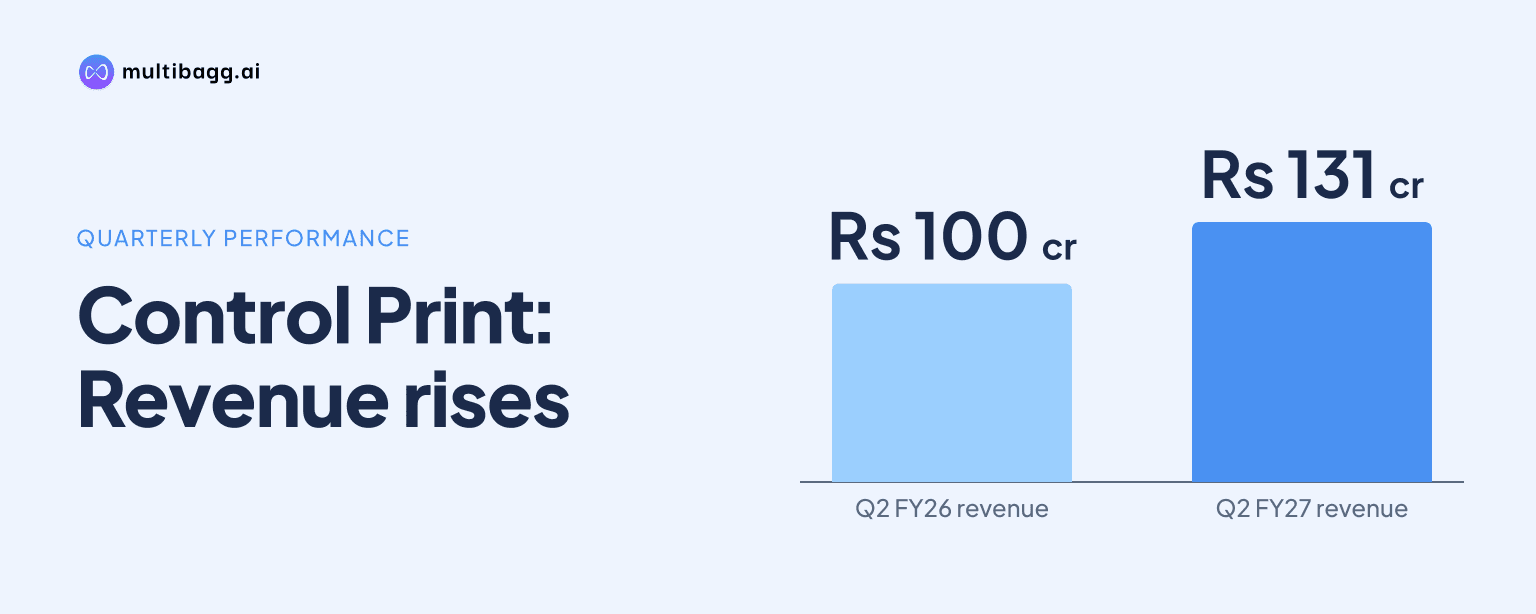
Control Print Limited reported standalone operating revenue of Rs 131 crore in Q2 FY27, about 31% above approximately Rs 100 crore a year earlier, as coding and marking contributed roughly 94% to 95% of operating revenue. First-half standalone operating revenue reached Rs 235 crore, compared with Rs 202 crore in H1 FY26.
Know Control Print inside out
Results, valuation, peers and who's buying, in one view.
How fast did Control Print’s operating revenue grow in Q2 FY27?
Control Print’s standalone operating revenue rose by approximately Rs 31 crore year on year to Rs 131 crore in Q2 FY27 from about Rs 100 crore in Q2 FY26. Management reported total standalone revenue of approximately Rs 134 crore for the quarter ended September 2026, compared with the Rs 131 crore operating-revenue measure.
The increase continued through the first half of FY27. Standalone operating revenue was Rs 235 crore in H1 FY27, Rs 33 crore above Rs 202 crore in H1 FY26, while total standalone revenue was Rs 241 crore. Management had reported full-year total revenue of Rs 460 crore in FY26, up from Rs 395 crore in FY25 and Rs 347 crore in FY24.
Consolidated operating revenue increased by Rs 32 crore to about Rs 144 crore in Q2 FY27 from Rs 112 crore in Q2 FY26. The Rs 13 crore gap between consolidated and standalone operating revenue reflects businesses outside the standalone entity, although management did not provide a business-by-business reconciliation during the October 29 call.
Which business drove Control Print’s Q2 FY27 revenue growth?
Control Print said coding and marking was the principal revenue driver because it accounted for approximately 94% to 95% of total operating revenue. This indicates that the mature coding-and-marking operation supplied most of the Rs 131 crore standalone operating revenue reported for Q2 FY27.
Management identified pipes, food, dairy, cable, wire, fast-moving consumer goods, steel and wood as the top-performing coding-and-marking verticals. It also described Control Print as one of the market leaders in cement, plywood, sugar and dairy, while citing new customers and development work on printers, inks and cartridges for the next half.
Track & Trace and packaging remain smaller development areas in the group’s plan. Management said Track & Trace had gained new customers and was developing new solutions, while packaging had gained traction in co-packing and was building a pipeline for machines, laminates and co-packing activities. The call did not disclose revenue for either of these businesses.
What changed in Control Print’s Q2 cost structure?
Control Print’s standalone cost of goods sold was 41.65% of operating revenue in Q2 FY27, down from 42.32% in the preceding quarter. The 0.67-percentage-point sequential decline was the reported improvement in the principal cost ratio as management sought higher contribution margin in coding and marking.
Employee costs fell to 17% of standalone operating revenue in Q2 FY27 from approximately 18% in the corresponding prior-year quarter and 19% for FY26. Manufacturing costs were approximately 2.26% and depreciation approximately 3.5% of operating revenue, with management saying both ratios were in line with earlier periods.
Other expenses moved higher, reaching approximately 15% of standalone operating revenue in Q2 FY27 versus about 13% in the prior-year period and FY26. On a consolidated basis, cost of goods sold was 44% of operating revenue in Q2 FY27, compared with about 40% in Q2 FY26, while employee benefit costs were approximately 20% and other expenses were 14%.
Got a follow-up? Ask IRIS
How does Control Print plan to improve profitability?
Control Print plans to pursue profitability improvement through implemented price increases, procurement optimisation, lower input costs and lower overheads. Management said it would also examine the economy, efficiency and effectiveness of operations, but did not give a numerical profitability target or a deadline for these measures.
The operating plan includes consolidating coding and marking, increasing the installed base and providing more robust solutions. Management said it was hopeful of improving contribution margin in a segment that contributes approximately 94% to 95% of operating revenue, but described this as an objective rather than formal guidance.
For overseas subsidiaries, management said its focus was to increase revenue and optimise costs. It said business plans had been issued and execution had been mandated strictly, an area of attention given consolidated Q2 FY27 operating revenue of Rs 144 crore and consolidated cost of goods sold of 44%, compared with the standalone 41.65% ratio.
What did Control Print say about Track & Trace and VShapes?
Control Print described the FY27 outlook for Track & Trace as positive, citing domestic and international opportunities, new solutions and an order pipeline scheduled for delivery over the next two quarters. Management said it would seek to convert these opportunities through better marketing and sales strategies, without disclosing the pipeline’s value.
On VShapes, the Joint Managing Director said demand was not the central issue and characterised the problem as execution. Management said progress was being made in technology development and execution, but gave no break-even date, loss limit or decision point for closing the operation.
The Joint Managing Director also said more than Rs 100 crore had been invested in the Track & Trace business over the past six years as part of Control Grid standalone. An analyst cited subsidiary losses at profit before tax of around Rs 12 crore in the March quarter, around Rs 8 crore in the June quarter and around Rs 5 crore in the September quarter; management said the direction was improving but quarterly and half-year results could vary.
Conclusion
Control Print’s Q2 FY27 performance showed a Rs 31 crore year-on-year increase in standalone operating revenue to Rs 131 crore, led by the coding-and-marking business. The company also reported a sequential reduction in standalone cost of goods sold to 41.65% of operating revenue, while other expenses increased to approximately 15% from about 13% in the prior-year period and FY26.
The next disclosed milestones are delivery of the Track & Trace order pipeline in the next two quarters and execution of plans for higher overseas-subsidiary revenue and lower costs. Management has also linked future profitability improvement to price increases, procurement savings, input costs and overheads, while warning that smaller subsidiary results can vary between quarters.