










Control Print says V-Shapes cost base is down about 25%
Key highlights
- Control Print said V-Shapes has reduced its original cost base by about 25%.
- Control Print replaced an estimated 65% to 70% of V-Shapes' original workforce.
- Control Print expects V-Shapes retrofit testing possibly in January, with management targeting 70% to 80% performance from roughly 30%.
- Control Print increased the V-Shapes sales team from zero people to three people.
powered by IRIS
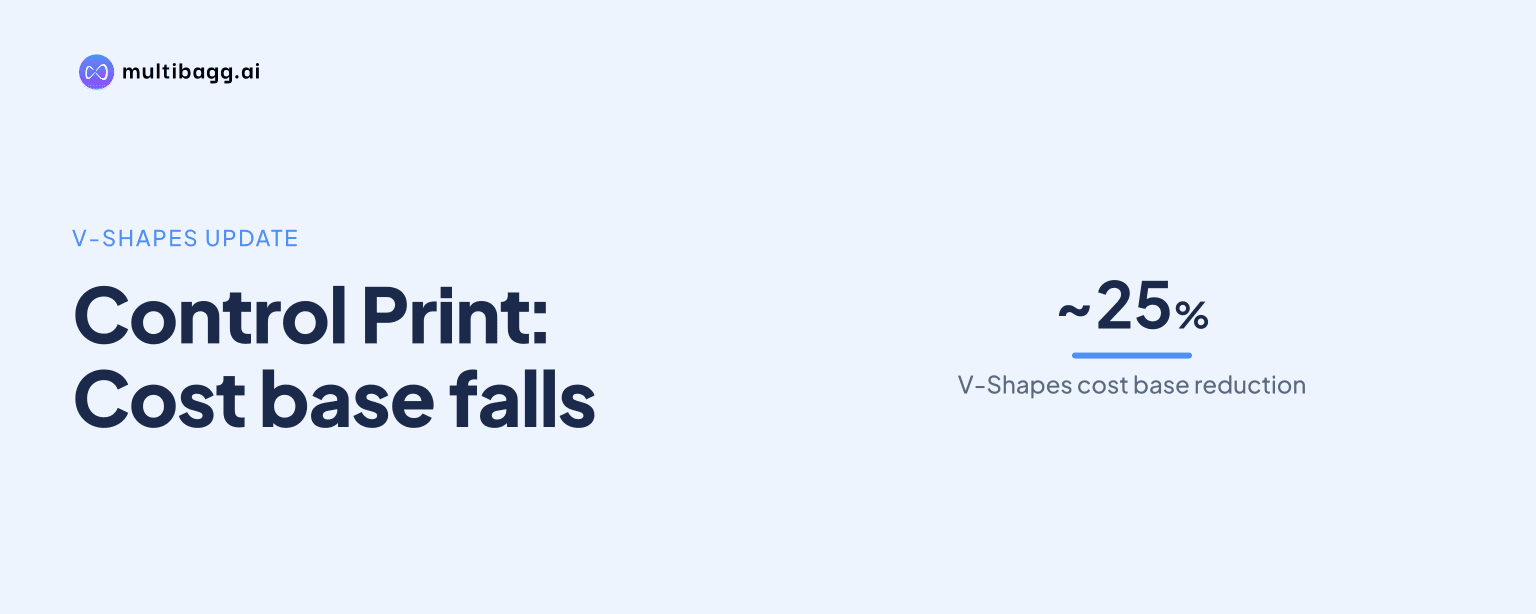
Control Print Limited said on October 29, 2026 that V-Shapes had reduced its original cost base by about 25%, while it prioritises machine retrofits and materials production before a wider sales rollout. Management expects retrofit testing possibly in January and is targeting a blueprint for future machines by January or February.
Know Control Print inside out
Results, valuation, peers and who's buying, in one view.
How has Control Print reduced V-Shapes costs?
Control Print said V-Shapes has lowered its cost base by about 25% from its original level, and management linked that change to reducing losses at the packaging unit. The restructuring included replacing an estimated 65% to 70% of the original workforce after management reviewed the capability, productivity and operating approach of the Italian business.
Control Print said the personnel changes were lengthy because employment contracts in Italy may need to be bought out if employees do not resign or move to another role. Most replacement employees are now on contract, while V-Shapes uses more outside consultants rather than keeping all work in-house. Management said this structure has increased flexibility and improved average productivity per employee.
Control Print has also expanded the V-Shapes sales team from zero people to three. Management described the sales hires, removal of excess costs and workforce replacement as fundamental structural changes, while saying further work remains. In particular, V-Shapes has not yet been moved onto Control Print's SAP platform because management said implementation could disrupt other operations for three or four months.
What is Control Print changing in V-Shapes machines?
Control Print is addressing machine reliability by identifying failures and inconsistencies that affect end customers, then applying design fixes through retrofits. Management said some problems were basic, including ensuring drawings match the machines being built, while its analysis has also focused on the points at which breakdowns and inconsistent performance occur.
Control Print said it had completed a set of design fixes and was retrofitting them into machines. Management said it may not know before the end of 2026 whether the retrofits are fully successful, with actual testing possibly taking place in January. It expects performance could rise to 70% to 80% of the desired level from roughly 30%, but this is a management expectation rather than a reported operating outcome.
Control Print is separately developing a blueprint for the next machines it sells, rather than relying only on retrofits of existing machines. Management is targeting completion in January or February. It said the revised development process models and checks components in software before progressing to the next stage, allowing design adjustments without rebuilding the machine from scratch.
Got a follow-up? Ask IRIS
How does Control Print plan to lower V-Shapes material costs?
Control Print is preparing temporary manufacturing arrangements in India that management expects to lower material costs and provide more consistency and control over production. The company had identified two locations for the temporary setup and had ordered machines that were nearing readiness for commissioning or testing at the time of the October 29 call.
The plan follows uncertainty around the Unnati project in Assam. Management said the programme had not been stopped but had been suspended after the project was told that an incentive had run out. Control Print still needed to take delivery of the ordered machines, meaning the initiative was not yet operating as completed manufacturing capacity.
Control Print described V-Shapes as a packaging solution for a single snap mono-dose, acquired as a technology and patent transaction. Management said the business has a patent moat but that machine performance and cost need further improvement. The Indian materials initiative is therefore part of the unit's cost-control and manufacturing-consistency work, not a disclosed production-volume or revenue target.
Why is Control Print limiting V-Shapes sales expansion?
Control Print is limiting new V-Shapes projects until it can scale without adding service problems. Management said it has some good projects but does not intend to take on a large number of additional assignments before its product performance, service capability and team can support machines operating across multiple locations.
That cautious approach sits alongside the increase in the V-Shapes sales team from zero people to three. Control Print is adding commercial capability, but management said accepting too many projects now could multiply existing issues because the business does not yet have the required service depth. Reliability improvements and service readiness are consequently the near-term conditions for a broader machine-sales push.
Co-packing is the exception in the commercial update. Control Print said co-packing was progressing and had regular orders, although it gave no order value, customer count or revenue figure. Management also said investors should not expect major V-Shapes numbers between the October 2026 call and the end of the financial year, even as it continues work on the platform and international business structure.
Conclusion
Control Print's V-Shapes update points to a turnaround centred on operational rebuilding rather than rapid sales growth. The about 25% cost-base reduction, replacement of 65% to 70% of original staff, expansion from zero to three sales employees, machine-failure analysis and planned Indian materials production show that management is addressing costs, personnel, manufacturing and customer-facing reliability together.
The next milestones are possible retrofit testing in January and the January or February target for a blueprint for future machines. Investors should also watch whether Control Print receives and commissions the equipment for its temporary Indian materials setup, and whether it provides evidence that regular co-packing orders can be supplemented by machine sales without the service constraints management has identified.