










Cosmic CRF sees Rs 400 crore potential at Amzen in FY28
Key highlights
- Cosmic CRF targets 25% Amzen utilisation in FY28, equal to roughly 37,000 to 38,000 metric tonnes.
- Management linked 25% Amzen utilisation to about Rs 400 crore of potential revenue at Rs 1.10 lakh per metric tonne.
- Cosmic CRF said commissioning could take roughly three months after final approval.
- Management said domestic container demand could rise from 1 lakh to nearly 5 lakh units.
powered by IRIS
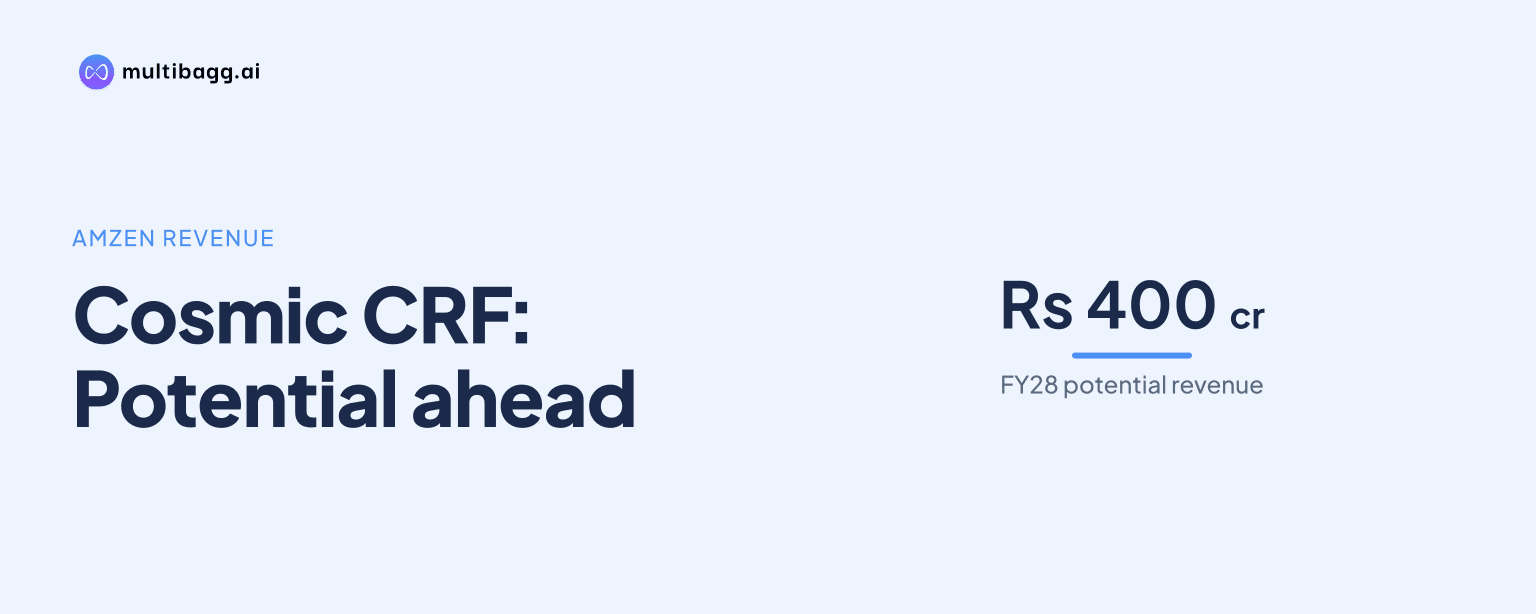
Cosmic CRF Limited said on November 6, 2026 that 25% utilisation of Amzen in FY28 could open roughly Rs 400 crore of revenue potential, following about three months of commissioning after final approval, although tribunal clearance, product approvals and customer acceptance remain conditions.
Know Cosmic CRF inside out
Results, valuation, peers and who's buying, in one view.
When could Cosmic CRF restart Amzen?
Cosmic CRF said Amzen could begin production after roughly three months of commissioning once final approval is received. During its H1 FY27 earnings call on November 6, 2026, management said approval could arrive in December or January, with January through March, or April at the latest, required to prepare the plant and start the first production phase.
The acquisition remained subject to procedural clearance at the time of the call. Management said the next hearing was scheduled for November 25, while the committee of creditors had approved the transaction and eligibility matters had received Supreme Court clearance. It described the remaining process as procedural, but did not give a confirmed approval or closing date.
Cosmic CRF said it had pursued Amzen for more than one-and-a-half years and was already preparing for the takeover. It had established a base in the Jalandhar-Ludhiana region with 12 people, while its teams, bankers, valuers, legal advisers and due-diligence personnel assessed civil work, machinery, maintenance contracts and refurbishment requirements.
What products could Cosmic CRF make at Amzen?
Cosmic CRF plans to use Amzen for freight-wagon activity and several fabricated-product lines, not for passenger-coach manufacturing. Management differentiated freight wagons from Vande Bharat, Tejas Express and Rajdhani passenger trains, saying the immediate plan is freight cars, while passenger-related work would initially be limited to body parts.
The proposed initial mix includes wagon manufacturing, wagon repair, locomotive-shell manufacturing, containers, sheet piles and bridge structures. The container opportunity includes 20-foot and 40-foot sea-freight units, including open-top and high-cube formats. Management said Amzen had previously manufactured containers for Concor, but Cosmic CRF intends to serve a wider group of container users.
Management also referred to setting up defence-related work, saying Amzen had a defence facility that was not fully used. It said the plant had historically supplied 850 wagons to private wagon holders, railway boards and repair-maintenance customers. That production history could reduce prototype requirements for some wagon types, although newer products would still require approvals.
How much Amzen capacity does Cosmic CRF plan to use?
Cosmic CRF's FY28 target is 25% utilisation of Amzen's stated 150,000-metric-tonne capacity, equal to roughly 37,000 to 38,000 metric tonnes. Management linked that volume to a price assumption of Rs 1.10 lakh per metric tonne and said it could open about Rs 400 crore of revenue potential across the planned product categories.
Management cautioned that reported revenue may not match capacity use in the first year. Some customers may initially use job-work arrangements, supplying their own material for processing, because Amzen would be a new supplier in Delhi and Punjab. Cosmic CRF said several former-group plants in Punjab were operating through job work because of constrained working capital.
For FY29, management said it saw no reason not to achieve more than 75% of the then-installed capacity, but it also outlined a larger eventual operating base. It referred to potential wagon capacity increasing from 3,600 to 7,200 units, alongside sheet piles, locomotive shells, sea-freight containers and defence work. These changing capacity bases mean the FY28 and later utilisation statements are management targets, not directly comparable volume forecasts.
Got a follow-up? Ask IRIS
What could delay Cosmic CRF's Amzen ramp-up?
Cosmic CRF identified approvals as the main constraint on the pace of Amzen's utilisation. Management said the planned lines would require certifications and clearances involving the Bureau of Indian Standards, the Research Designs and Standards Organisation and the Defence Research and Development Organisation, as well as other compliance processes.
Management said it could manufacture the planned products and begin full operations within nine months if approvals did not delay the process. However, it said wagon prototyping may take time and customer acceptance must be developed. Those factors qualify management's FY28 target of 25% utilisation and its stated objective to reach at least 70% of 150,000 metric tonnes by FY30.
The plan is also linked to discussions with Russian counterparties on technology. Management said it had signed an earlier arrangement and had resumed talks, adding that the technology available could be better than what was signed in FY25. It did not disclose commercial terms, product specifications or a completion date for any technology arrangement.
How does container demand fit Cosmic CRF's Amzen plan?
Cosmic CRF said Amzen is interested in the container-manufacturing promotion scheme because management expects domestic demand to expand. It referred to Rs 10,000 of support per container, but said the more significant opportunity was a potential increase in indigenous container requirements from 1 lakh to nearly 5 lakh units.
Management said Cosmic CRF already has capabilities in perforated sheets, end lockers, angle channels, fabrication, bevelling and forgings. It nevertheless said more space is needed because its existing 14-acre site has no spare room. Amzen could therefore support container production alongside wagon work rather than depending on containers as the only route to utilisation.
The broader product mix is intended to reduce reliance on a single sector, according to management. The FY28 25% case includes wagons, repair work, containers, sheet piles, bridge structures and locomotive shells. Cosmic CRF did not disclose segment-wise orders, revenue or margins for these individual Amzen lines.
Conclusion
Cosmic CRF's Amzen strategy is a multi-product capacity plan rather than only a freight-wagon acquisition. Management's central FY28 case is 25% use of 150,000 metric tonnes, or roughly 37,000 to 38,000 metric tonnes, with about Rs 400 crore of potential revenue across wagon-related and fabricated-product lines.
The next event to watch is the November 25 hearing, because management's roughly three-month commissioning schedule begins only after final approval. Progress will then depend on product clearances, customer acceptance and the conversion of initial job work into regular orders as Cosmic CRF pursues its FY29 utilisation target of more than 75%.