










Cosmic CRF Limited targets 324,600 MT capacity by FY29
Key highlights
- Cosmic CRF targets 174,600 MT of installed capacity in FY28, compared with 133,600 MT in its FY26 roadmap.
- The FY29 capacity roadmap reaches 324,600 MT, including a 150,000 MT addition linked to Amzen.
- Amzen has capacity for 3,600 wagons a year, scalable to 7,200 wagons, plus 20,000 MT per annum of bridge fabrication.
- Cosmic CRF’s FY30 base-case revenue trajectory excluding Amzen is Rs 1,178 crore at 80% targeted operating capacity.
powered by IRIS
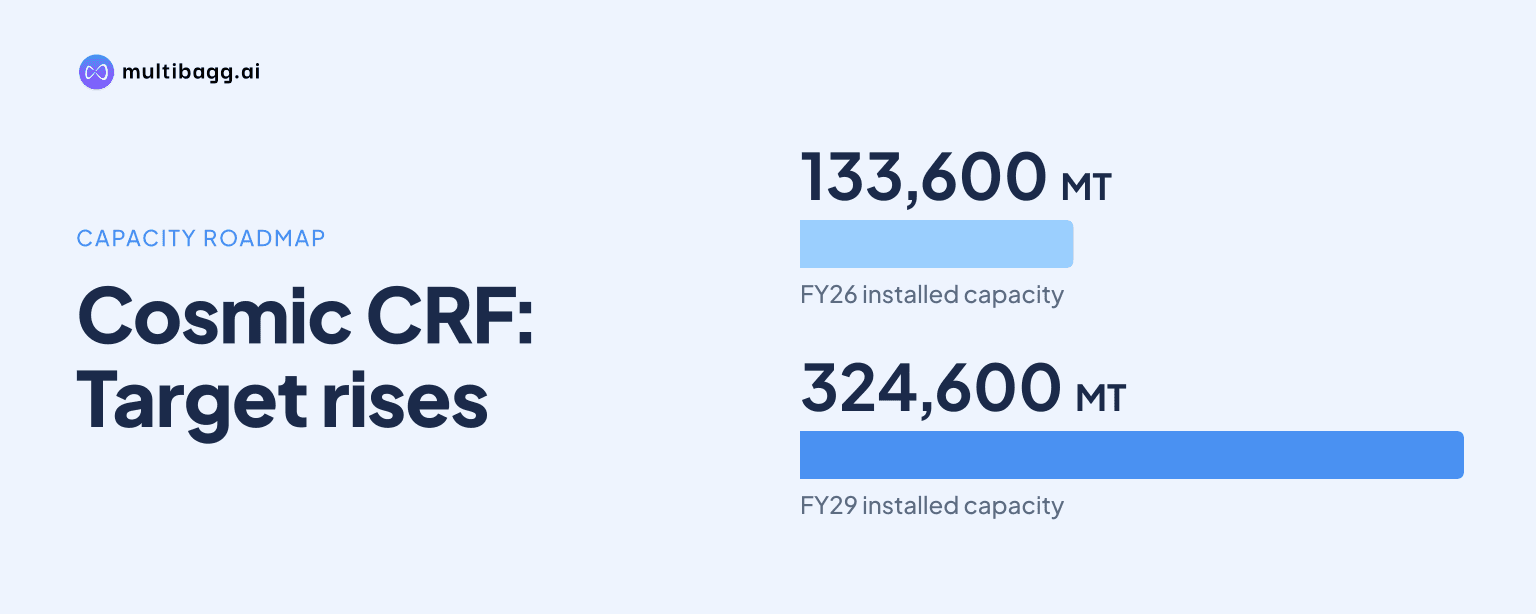
Cosmic CRF Limited targets 324,600 metric tonnes (MT) of installed capacity by FY29, up from 174,600 MT targeted for FY28, with the 150,000 MT difference linked to Amzen Transportation Industries Private Limited. Cosmic CRF says the Amzen transaction remains subject to statutory approvals, despite a Rs 60 crore security deposit and a letter of intent.
Know Cosmic CRF inside out
Results, valuation, peers and who's buying, in one view.
How does Cosmic CRF plan to reach 174,600 MT by FY28?
Cosmic CRF plans to reach 174,600 MT of installed capacity by FY28 through expansion at its Singur standalone site and its Howrah and Jangalpur subsidiaries. The presentation describes this as 30% targeted installed-capacity growth from 133,600 MT in H1FY27, while its capacity roadmap labels 133,600 MT as the FY26 base.
The FY28 target is 41,000 MT above the 133,600 MT base and excludes Amzen. Management describes FY28 volume capacity as about 175,000 metric tonnes per annum, comprising 65,000 MT at Singur, 85,000 MT at NSEPPL in Howrah and about 25,000 MT at CSEL in Jangalpur.
Cosmic CRF’s roadmap compares the FY29 capacity target with 12,000 MT in FY23, a 27-times level. The presentation also says capacity rose from 12,000 MT in FY23 to 133,600 MT in H1FY27 as the company shifted capacity between wagon and infrastructure products amid an anticipated sector slowdown in wagon ordering.
Which operations provide Cosmic CRF’s FY28 expansion?
Cosmic CRF’s FY28 expansion is planned across three operating units, led by a 20,000 MT increase at NSEPPL. Singur is targeted to rise from 55,000 MT in FY26 to 65,000 MT in FY28, NSEPPL from 65,000 MT to 85,000 MT, and CSEL from 13,600 MT to 24,600 MT.
Singur remains the railway CRF, or cold-rolled formed, core, with higher-specification sections and value-added fabrication. NSEPPL is identified as the infrastructure engine and has 24,000 MT a year of galvanizing capacity, while CSEL is intended to add forged components from FY28 alongside springs and fabrication.
The product mix has broadened since FY23, when the presentation identifies CRF sections for wagons as the focus. By FY25, Cosmic CRF had added sheet piles, wagon end and side bodies, railway components, fabricated steel items, and cold-rolled angles and channels; FY26 additions included tested crash barriers, poles, galvanized products and several spring types.
What does Amzen add to Cosmic CRF’s FY29 plan?
Amzen represents the planned 150,000 MT increase from the FY28 target of 174,600 MT to the FY29 target of 324,600 MT. Cosmic CRF describes this increment as new railway, wagon and infrastructure units under way beyond the FY28 plan, rather than capacity within Singur, NSEPPL or CSEL.
The disclosed Chandigarh plant has three divisions: railway, heavy fabrication and special vehicles. Its capabilities include 3,600 wagons a year under an RDSO, or Research Designs and Standards Organisation, assessment, with scope to scale to 7,200 wagons; 20,000 MT per annum of bridge fabrication; and 10,000 sea-freight containers a year.
Cosmic CRF also identifies 20-foot and 40-foot containers as a planned new product category. The presentation says the wagon capability would extend the business from CRF sections to finished wagon manufacturing and repair, while the bridge-fabrication capability is aligned with Dedicated Freight Corridor needs.
The company’s existing expansion plan separately includes an 11,000 MT forged-components unit from FY28. It also lists 3,600 wagons of manufacturing and repair capacity, 10,000 containers a year and defence-sector products in research and development as next-stage segments, while liquid-metal units remain under evaluation.
Got a follow-up? Ask IRIS
Is Cosmic CRF’s Amzen transaction complete?
No, Cosmic CRF does not describe the Amzen transaction as complete because statutory approvals are still required. The company says it was declared successful resolution applicant in the corporate insolvency resolution process, received a letter of intent, paid a Rs 60 crore security deposit and received a positive order from the Supreme Court.
The presentation does not give a date for completion or say that statutory approvals have been received. The FY29 target of 324,600 MT is therefore transaction-dependent to the extent of the disclosed 150,000 MT Amzen addition, whereas the FY28 target of 174,600 MT is explicitly stated to exclude Amzen.
Management presents the proposed combination as making Cosmic CRF India’s most integrated wagon manufacturer, from CRF sections to finished wagons. That is management’s stated outcome from the Amzen plan, not a reported operating result, and depends on completion of the approval process.
What revenue and utilization assumptions support the capacity plan?
Cosmic CRF’s base-case revenue bridge excluding Amzen moves from Rs 717 crore in FY26 to Rs 1,178 crore in FY30 under an 80% targeted operating-capacity assumption. The bridge includes Rs 448 crore attributed to Cosmic CRF, Rs 476 crore to NS Engineering, Rs 136 crore to springs and fabrication, and Rs 118 crore to forging.
Management estimates Singur’s 55,000-MT-to-65,000-MT expansion at Rs 80,000 per MT and NSEPPL’s 65,000-MT-to-85,000-MT expansion at Rs 70,000 per MT. The bridge also assumes 3,600 MT of spring capacity, 10,000 MT of fabrication capacity and an 11,000-MT forging unit from FY28.
The FY29 roadmap targets utilization of about 85% within two years, compared with the 80% operating-capacity assumption used in the FY30 revenue bridge. Management says operating capacity could cross 90% if demand from the exchequer increases, making public expenditure a disclosed demand variable in the plan.
The base-case bridge does not include Amzen, so its Rs 1,178 crore FY30 figure should be read separately from the FY29 capacity roadmap. The presentation does not provide a revenue estimate specifically for the additional 150,000 MT linked to Amzen or a timetable for bringing that capacity into operation.
Conclusion
Cosmic CRF’s plan combines a 41,000 MT expansion through its three existing operating units by FY28 with a further 150,000 MT increment associated with Amzen in FY29. The strategy broadens the operating mix from railway CRF sections into infrastructure products, galvanizing, springs, forging, wagon manufacturing, bridge fabrication and containers.
The next development to watch is the statutory-approval process for Amzen, because it underpins the 150,000 MT addition in the FY29 roadmap. Management’s stated milestones also include utilization of about 85% within two years and the FY30 base-case revenue path of Rs 1,178 crore at 80% targeted operating capacity, excluding Amzen.