










Cosmic CRF puts 78% of Rs 612 crore order book in infrastructure
Key highlights
- Cosmic CRF reported an H1FY27 order book of Rs 612 crore, up 39% year on year.
- Infrastructure accounted for 78% of Cosmic CRF's H1FY27 order book, while railways accounted for 22%.
- Cosmic CRF's installed capacity was 133,600 MT in H1FY27, versus 69,000 MT in H1FY26.
- Cosmic CRF targets total installed capacity of 174,600 MT by FY28.
powered by IRIS
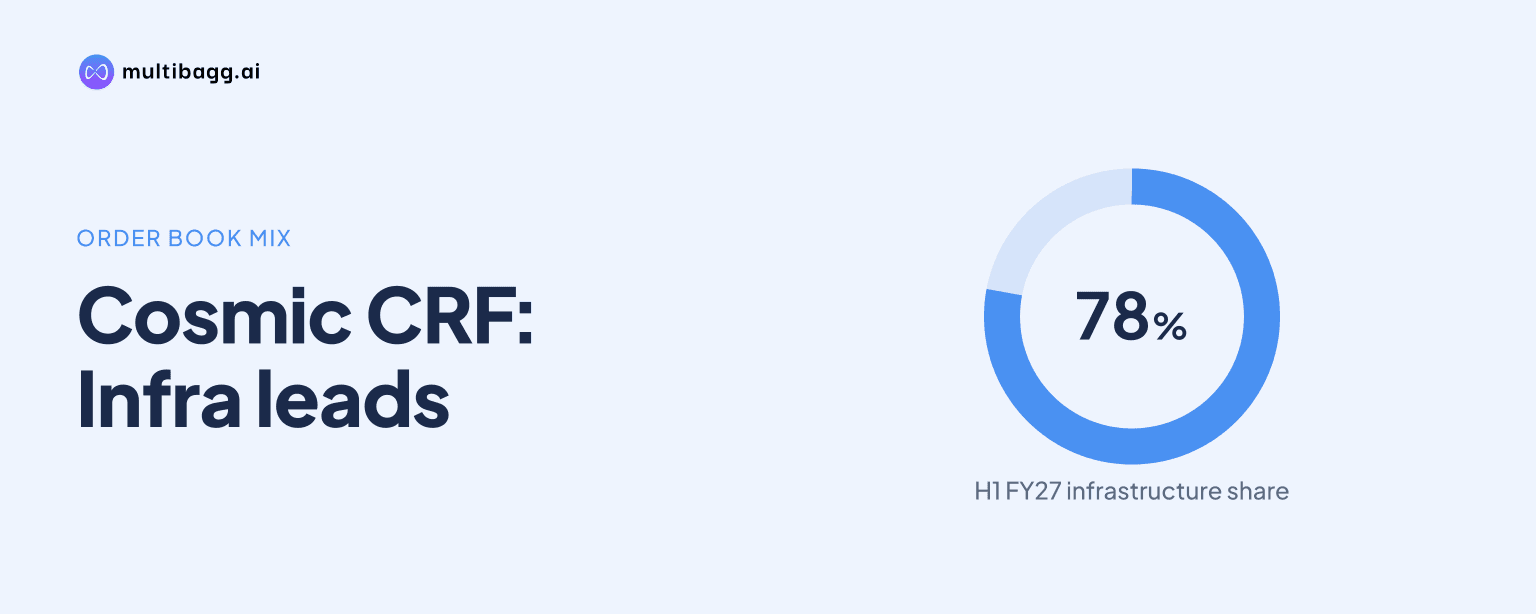
Cosmic CRF Limited reported an H1FY27 order book of Rs 612 crore, up 39% year on year, with infrastructure contributing 78% and railways 22%. Cosmic CRF is using production lines that can switch between wagon and infrastructure products as it prepares for an anticipated moderation in wagon ordering across the railway sector.
Know Cosmic CRF inside out
Results, valuation, peers and who's buying, in one view.
How has Cosmic CRF shifted its order book toward infrastructure?
Cosmic CRF has made infrastructure the larger part of its H1FY27 order book, with Rs 612 crore of orders split 78% for infrastructure and 22% for railways. The presentation describes this mix as diversification across railways and infrastructure for balanced revenue visibility, rather than an exit from railway-linked manufacturing.
Cosmic CRF says railway momentum was expected to moderate because a slowdown in wagon ordering was anticipated across the sector. The presentation also cites pressure on public expenditure from the west Asian crisis as a factor affecting conditions. Its stated response is to pivot capacity and products toward infrastructure while retaining railway CRF sections, wagon components and related fabrication.
The operating mechanism is fungible production capacity. Cosmic CRF says its manufacturing lines can make either wagon or infrastructure products, allowing the group to switch output between those categories. This flexibility is central to the stated strategy because the H1FY27 order book is already led by infrastructure even though railways remain a substantial addressable market.
What infrastructure products can Cosmic CRF supply?
Cosmic CRF identifies sheet piles, crash and tested barriers, poles, high masts, galvanised angles and channels, and fabricated steel as its infrastructure products. Its railway portfolio includes wagons and wagon components, coach components and bogie components, creating two product channels for its cold rolled formed, or CRF, sections, fabrication and engineering operations.
Sheet piles are a major element of the infrastructure push. The presentation says NS Engineering made Cosmic CRF a leader in sheet piles, while a later product overview gives the business an approximately 22% share of the sheet-pile market in FY25. That position sits alongside products added in FY26, including tested crash barriers, lighting poles, flag poles, high masts, galvanised products and ST and octagonal poles.
Cosmic CRF also cites in-house galvanising, springs, forging and fabrication units as parts of its manufacturing platform. Management says its galvanising bath adds up to 2.5% margin, while the company’s own springs, forging and fabrication units support ready-to-use products. The presentation describes this as a one-stop offering for rail and infrastructure requirements.
How does the infrastructure mix compare with railway opportunities?
Cosmic CRF's booked business is infrastructure-led despite the presentation identifying several future railway demand indicators. Railways made up 22% of the Rs 612 crore H1FY27 order book, compared with infrastructure's 78%, whereas the presentation cites a planned 100,000-wagon railway mega tender valued at Rs 40,000 crore in May 2026.
The presentation also cites Rs 2.93 lakh crore of railway capital outlay in Budget 2026-27 and plans for 300 trains, comprising 200 Vande Bharat and 100 Amrit Bharat trains. These are market figures included in the presentation, not orders reported by Cosmic CRF. They show that the company’s infrastructure tilt is occurring alongside, rather than instead of, a stated railway opportunity pipeline.
Cosmic CRF's FY28 operating plan preserves a railway-focused role for its Singur standalone operation. That unit is planned to make CRF sections, fabrication and prototype products, with capacity moving from 55,000 metric tonnes, or MT, in FY26 to 65,000 MT in FY28. The company therefore presents its product mix as broader than wagons, not as solely dependent on infrastructure.
Got a follow-up? Ask IRIS
What capacity supports Cosmic CRF's product mix?
Cosmic CRF reported installed capacity of 133,600 MT in H1FY27, compared with 69,000 MT in H1FY26, while actual production increased to 106,370 MT from 55,941 MT. The increase gives the company more output capacity for infrastructure products as well as railway sections, springs and fabrication.
Cosmic CRF says capacity expanded from 12,000 MT in FY23 to 133,600 MT in H1FY27. The presentation describes utilisation as approximately 80% and targets approximately 85% within two years. Management says economies of scale and positive operating leverage are expected from FY28, which is a future expectation rather than a reported H1FY27 outcome.
The Howrah subsidiary, NSEPPL, is the infrastructure engine in the FY28 plan. Its capacity is targeted to rise from 65,000 MT in FY26 to 85,000 MT in FY28, with CRF sections, sheet piles, high masts, octagonal poles and crash barriers in its product range. The unit also has 24,000 MT a year of galvanising capacity under the plan.
Has the order-book shift coincided with higher H1FY27 earnings?
Cosmic CRF reported H1FY27 consolidated revenue of Rs 318.3 crore, up 4.5% from Rs 304.5 crore in H1FY26, while earnings before interest, tax, depreciation and amortisation, or EBITDA, increased 14.9% to Rs 43.5 crore. EBITDA margin increased to 13.7% from 12.4% a year earlier.
The half-year comparison with H2FY26 shows a different pattern. Revenue was Rs 412.1 crore in H2FY26, making H1FY27 revenue 22.8% lower half on half, but EBITDA rose 7.1% from Rs 40.6 crore. EBITDA margin increased from 9.9% in H2FY26 to 13.7% in H1FY27 as total expenditure declined 26.0% to Rs 274.8 crore.
Reported profit after tax was Rs 26.2 crore in H1FY27, versus Rs 24.5 crore in H1FY26 and Rs 26.1 crore in H2FY26. Profit after tax margin was 8.2%, compared with 8.0% a year earlier and 6.3% in the preceding half year. The presentation does not quantify how much of these changes resulted specifically from infrastructure products or the 78% infrastructure order-book share.
What is Cosmic CRF planning beyond FY27?
Cosmic CRF targets total installed capacity of 174,600 MT by FY28, up from 133,600 MT in H1FY27. The plan comprises 65,000 MT at Singur, 85,000 MT at NSEPPL and 24,600 MT at the Jangalpur subsidiary, CSEL, representing a 41,000 MT increase from the H1FY27 total.
CSEL is planned to expand from 13,600 MT in FY26 to 24,600 MT in FY28. Its disclosed product role includes helical and Casnub springs, fabrication and forged components from FY28. Cosmic CRF also lists wagon manufacturing and repair for 3,600 wagons, an 11,000 MT forged-components unit and 10,000 20-foot and 40-foot containers a year among future product initiatives.
The company’s next-stage list includes defence-sector products in research and development and liquid-metal units under evaluation. It also outlines a FY29 capacity addition of 150,000 MT through Amzen railway, wagon and infrastructure units, beyond the FY28 plan. These are disclosed plans and evaluations, not current H1FY27 production or revenue contributions.
Conclusion
Cosmic CRF's H1FY27 order book shows infrastructure as its largest immediate demand channel, accounting for 78% of Rs 612 crore of orders. The strategy combines this mix with fungible manufacturing lines, sheet piles, barriers, poles, galvanising and fabricated steel, while retaining railway CRF sections, springs and wagon-related products.
The next milestones disclosed by management are approximately 85% utilisation within two years and total capacity of 174,600 MT by FY28. Progress at NSEPPL toward 85,000 MT, CSEL's planned forged-components addition from FY28, and conversion of planned infrastructure and railway capacity into orders are the developments to watch.