










Cosmic CRF Limited lifts H1 FY27 EBITDA margin to 13.7%
Key highlights
- Cosmic CRF’s H1 FY27 EBITDA rose 14.9% year on year to Rs 43.5 crore.
- Cosmic CRF’s H1 FY27 EBITDA margin increased to 13.7% from 12.4% in H1 FY26.
- Cosmic CRF’s H1 FY27 revenue grew 4.5% year on year to Rs 318.3 crore.
- Cosmic CRF reported an H1 FY27 order book of Rs 612 crore, up 39% year on year.
powered by IRIS
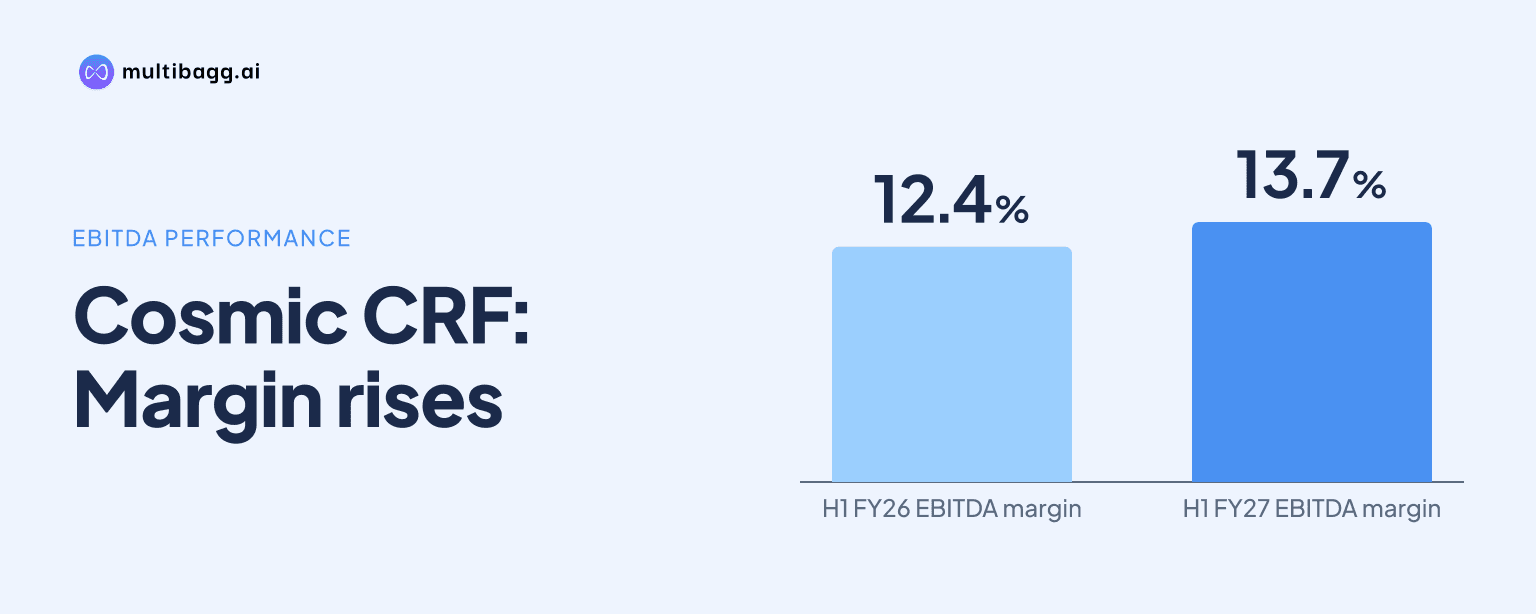
Cosmic CRF Limited reported a consolidated EBITDA margin of 13.7% in H1 FY27, up 124 basis points from H1 FY26, as EBITDA rose 14.9% to Rs 43.5 crore while revenue from operations increased 4.5% to Rs 318.3 crore. Total expenditure grew 3.1% to Rs 274.8 crore, below revenue growth.
Know Cosmic CRF inside out
Results, valuation, peers and who's buying, in one view.
How did Cosmic CRF expand EBITDA margin in H1 FY27?
Cosmic CRF expanded its H1 FY27 EBITDA margin because revenue from operations grew by Rs 13.8 crore year on year while total expenditure increased by Rs 8.2 crore. EBITDA, or earnings before interest, tax, depreciation and amortisation, consequently rose by Rs 5.7 crore to Rs 43.5 crore, a 14.9% increase against revenue growth of 4.5%.
The margin also improved against the immediately preceding half-year. H1 FY27 EBITDA margin was 13.7%, compared with 9.9% in H2 FY26, an increase of 381 basis points, where one basis point equals one-hundredth of a percentage point. Revenue declined 22.8% half on half from Rs 412.1 crore in H2 FY26, but expenditure fell 26.0% to Rs 274.8 crore, a faster decline than sales.
The reported figures show that the spread between revenue and expenditure widened in H1 FY27 despite modest sales growth. Management attributed the half-year outcome to disciplined execution and a diversified product portfolio in a challenging industry environment, but the presentation does not quantify the respective effects of product mix, pricing or operating efficiencies on the 124-basis-point year-on-year margin increase.
Why did Cosmic CRF’s net profit rise slower than EBITDA?
Cosmic CRF’s reported profit after tax, or PAT, rose 6.9% to Rs 26.2 crore in H1 FY27, slower than the 14.9% EBITDA increase, because depreciation and interest costs were higher following capacity added through FY26. Depreciation increased 62.3% year on year to Rs 7.0 crore, while interest rose 29.6% to Rs 6.6 crore.
Profit before interest and tax, or PBIT, rose 11.0% to Rs 40.2 crore from Rs 36.3 crore. Profit before tax after exceptional items increased 7.9% to Rs 33.6 crore, and tax increased 11.6% to Rs 7.4 crore. These movements left reported PAT at Rs 26.2 crore, compared with Rs 24.5 crore in H1 FY26.
PAT margin nevertheless reached 8.2% in H1 FY27, compared with 8.0% in H1 FY26 and 6.3% in H2 FY26. Reported earnings per share were Rs 28.31, down 5.3% year on year from Rs 29.89 despite higher PAT; the presentation reports those figures but does not explain the difference between profit growth and per-share earnings.
Got a follow-up? Ask IRIS
What capacity supports Cosmic CRF’s next growth phase?
Cosmic CRF says installed capacity stands at 133,600 metric tonnes per annum, more than 11 times the 12,000 metric tonnes cited for FY23. The capacity is spread across Singur at 55,000 metric tonnes per annum, NS Engineering Projects at 65,000 metric tonnes per annum and CSEL at 13,600 metric tonnes per annum, including springs and fabrication.
Management said H1 FY27 production was 45,384 metric tonnes, up 125% year on year, at 80% capacity utilisation, and it is targeting utilisation of about 85% over the next two years. It said the focus has shifted to filling expanded capacity after additions through FY26, which management also identified as the reason for higher depreciation and interest costs.
The presentation contains another production disclosure that it does not explain. Its capacity-and-production page lists H1 FY27 installed capacity of 133,600 metric tonnes and actual production of 106,370 metric tonnes, compared with 69,000 metric tonnes and 55,941 metric tonnes in H1 FY26. That page also describes utilisation as about 80%, while the 106,370-metric-tonne figure differs from management’s 45,384-metric-tonne H1 FY27 production disclosure.
What demand visibility and product plans does Cosmic CRF disclose?
Cosmic CRF reported an H1 FY27 order book of Rs 612 crore, up 39% year on year, with infrastructure accounting for 78% and railways for 22%. The disclosed backlog is therefore weighted towards infrastructure, although management continues to identify railways as an important market.
Management said fungible production lines allow switches between wagon and infrastructure products and described NS Engineering as having about a 22% share of the indigenous organised sheet-pile market. The company also said its in-house galvanising bath can add up to 2.5% to margins and that its springs division is established, although it did not disclose segment revenue or profitability for either activity.
The next stated forward-integration project is an 11,000-metric-tonne forging unit planned from FY28. Management also said research and development teams are developing defence-sector products. Separately, it cited a Railways plan for a 100,000-wagon tender worth about Rs 40,000 crore in May 2026 and Rs 2.93 lakh crore of Railways capital outlay in the Union Budget 2026-27 as part of its demand backdrop.
Conclusion
Cosmic CRF’s H1 FY27 figures indicate that cost growth lagged revenue growth, allowing operating profit to increase faster than sales. However, depreciation of Rs 7.0 crore and interest of Rs 6.6 crore following FY26 capacity additions limited the flow-through to reported PAT, which increased 6.9% to Rs 26.2 crore.
The key disclosed operating objective is utilisation of around 85% over the next two years, compared with management’s stated 80% in H1 FY27. The next items to watch are clarification of the differing 45,384-metric-tonne and 106,370-metric-tonne H1 FY27 production disclosures, execution of the 11,000-metric-tonne forging unit planned from FY28, and conversion of the Rs 612 crore order book.