










Cosmo First plans 26,000 tonnes of H2 FY27 specialty capacity
Key highlights
- Cosmo First plans 16,000 tonnes of high-end chemical coated-film capacity in H2 FY27.
- Cosmo First plans a 10,000-tonne annual nine-layer barrier-sheet line in H2 FY27.
- Specialty and semi-specialty films accounted for close to 60% of volume, while specialty volume grew 20% in H1 FY27.
- Cosmo First reported net debt of Rs. 1,057 crore at September 2026 and targets a Rs. 300 crore to Rs. 500 crore reduction over two years.
powered by IRIS
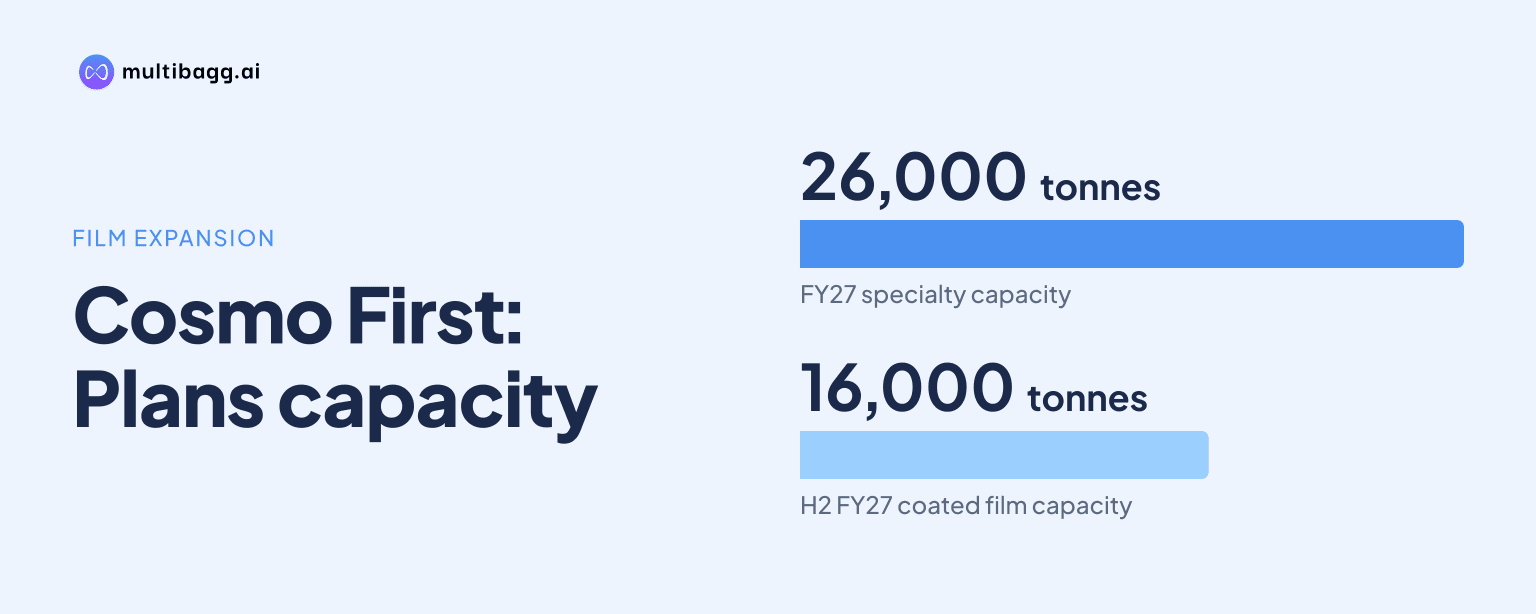
Cosmo First Limited plans to add 16,000 tonnes of high-end chemical coated-film capacity and a 10,000-tonne nine-layer barrier-sheet line in H2 FY27, taking its specialty-led expansion into films and rigid packaging as specialty and semi-specialty films accounted for close to 60% of volume and specialty volume rose 20% in H1 FY27.
Know Cosmo First inside out
Results, valuation, peers and who's buying, in one view.
What capacity is Cosmo First adding in H2 FY27?
Cosmo First is adding 16,000 tonnes of high-end chemical coated-film capacity and a nine-layer barrier-sheet line with annual capacity of 10,000 tonnes in H2 FY27. Management said the coated-film addition supports its plan to direct growth capital expenditure, or CAPEX, towards specialty products with better margins, differentiation and capital efficiency.
The two projects serve separate operations within the group. The coated-film line is part of Cosmo First's films strategy, while the barrier-sheet line will expand specialty rigid-packaging products at Cosmo Plastech. Management described the barrier-sheet project as requiring relatively modest CAPEX and said it would enable higher and improved specialty products.
Cosmo First is making these additions after commissioning a new coating line for specialty films and after a broader investment cycle of roughly Rs. 1,250 crore to Rs. 1,300 crore over the past three years. Management said the company is now positioned to leverage investments already made and does not plan major CAPEX in the short term beyond maintenance and selected specialty projects.
Why is Cosmo First prioritising specialty-film capacity?
Cosmo First is prioritising specialty capacity because specialty and semi-specialty films together represent close to 60% of total volume and specialty-film margin was close to Rs. 62 per kg in Q2 FY27. Management said the combined category had grown at about a 10% compound annual growth rate, or CAGR, during the previous six years, while specialty growth accelerated to 20% in H1 FY27.
Management expects specialty and semi-specialty products to remain at roughly 60% of the larger volume base in FY27, then reach 65% to 70% in FY28 and approach 80% over the medium term. These are management targets, rather than reported results, and the new coated-film capacity is part of the plan to increase the share.
The Q2 FY27 margin comparison illustrates the difference between product categories. Biaxially oriented polypropylene, or BOPP, gross margin was Rs. 29 per kg, down from Rs. 30 per kg in Q1 FY27 but up from Rs. 22 per kg in Q2 FY26. Biaxially oriented polyester, or BOPET, gross margin was Rs. 12 per kg, compared with Rs. 9 per kg in Q1 FY27 and Rs. 6 per kg a year earlier; management said BOPET capacity is about 10% of BOPP capacity.
How does rigid packaging support Cosmo First's strategy?
Cosmo Plastech supports Cosmo First's specialty strategy through the planned 10,000-tonne barrier-sheet line and its growing rigid-packaging sales. The business reported its second consecutive profitable quarter in Q2 FY27, with revenue of Rs. 39 crore, up 90% year on year, and an earnings before interest, tax, depreciation and amortisation, or EBITDA, margin of 8%.
The sales mix at Cosmo Plastech also changed during the year, with brand sales reaching 67% in Q2 FY27 from 50% a year earlier. H1 FY27 revenue increased 73% to Rs. 75 crore, indicating that the barrier-sheet project is being added while the business is expanding its existing specialty rigid-packaging offering.
Specialty chemicals provide another route for Cosmo First to build products beyond its core film operations. H1 FY27 revenue in specialty chemicals grew 59% to about Rs. 155 crore across coating chemicals, masterbatches and adhesives, while Q2 FY27 topline growth exceeded 80% and volume rose 60% year on year.
Management said the specialty-chemicals subsidiary recorded a 23% EBITDA margin in Q2 FY27, and third-party sales accounted for close to 17% of its sales during the quarter. Management sees the business reaching close to Rs. 500 crore in medium-term revenue with return on capital employed above 20%, which is an aspiration rather than a reported outcome.
Got a follow-up? Ask IRIS
How will Cosmo First fund the new capacity?
Cosmo First said its H2 FY27 projects fit within a smaller near-term CAPEX programme, with FY27 spending expected at about Rs. 100 crore to Rs. 110 crore after approximately Rs. 90 crore in the first half. Management said FY28 CAPEX is not finalised but could be in the Rs. 50 crore to Rs. 70 crore range, largely for maintenance and possible specialty growth.
Net debt was Rs. 1,057 crore at September 2026, down from Rs. 1,159 crore at March 2026, despite a Rs. 148 crore increase in net working capital linked to higher raw-material prices following the West Asia war. Net debt was 1.9 times EBITDA at September 2026, and management expects a reduction of roughly Rs. 300 crore to Rs. 500 crore over the next two years.
The September 2026 quarter produced higher reported operating profit, although it included two non-recurring items. Consolidated sales rose 51% year on year to Rs. 1,388 crore on 15% volume growth, while EBITDA increased 38% to Rs. 177 crore from Rs. 128 crore in September 2025.
A customs-duty refund write-back of about Rs. 24.8 crore in the US subsidiary and an inventory loss of Rs. 7 crore added about Rs. 18 crore on a net basis to Q2 FY27 EBITDA. Excluding both items, EBITDA was Rs. 159 crore, representing 24% year-on-year growth, while the reported EBITDA margin was 12.8% compared with 14.0% a year earlier.
What operating factors could affect the capacity ramp-up?
Cosmo First has some room to increase film volumes before the new lines are considered, with management putting current utilisation at roughly 90% and potential additional volume at 8% to 10%. The US film business grew 35% in volume in the latest quarter, which management cited alongside its specialty and export focus.
Management said new BOPP lines planned by industry participants could be commissioned over the next two years, although some projects may be deferred. Cosmo First's stated approach is to increase specialty products and exports rather than depend only on base-film demand, while retaining a focus on customer satisfaction and return on capital employed.
Renewable power is also part of management's operating-cost plan. By next year, management expects renewable sources to account for about two-thirds of Cosmo First's power requirements and estimates annual power-cost savings of approximately Rs. 25 crore to Rs. 30 crore, subject to completion of the planned renewable-power increase.
Conclusion
Cosmo First is combining a 16,000-tonne coated-film addition with a 10,000-tonne barrier-sheet line to extend its specialty strategy across films and rigid packaging. The plan follows close to 60% specialty and semi-specialty volume, a specialty-film margin near Rs. 62 per kg in Q2 FY27, and H1 FY27 revenue growth of 59% in specialty chemicals and 73% at Cosmo Plastech.
The next milestones are the H2 FY27 commissioning and ramp-up of both lines, progress towards management's FY28 specialty-mix target of 65% to 70%, and net-debt reduction of Rs. 300 crore to Rs. 500 crore over two years. Management's planned increase in renewable power, expected by next year, is another disclosed item to watch because it underpins estimated annual savings of Rs. 25 crore to Rs. 30 crore.