








Dalmia Bharat Approves ₹700 Crore Open-Market Buyback Plan
Max Plan at ₹4,999/yr₹8,999

Find your next multibaggerBe a Pro Investor
Research stocks and track your picks on the go. Download the app.
Key highlights
- Dalmia Bharat approved an open-market buyback of up to ₹700 crore on November 23, 2026.
- The buyback has a maximum purchase price of ₹1,850 per equity share.
- The programme may cover up to 37.84 lakh shares, or 2.02% of Dalmia Bharat’s equity.
- Promoters and promoter group members are excluded from the buyback.
powered by IRIS
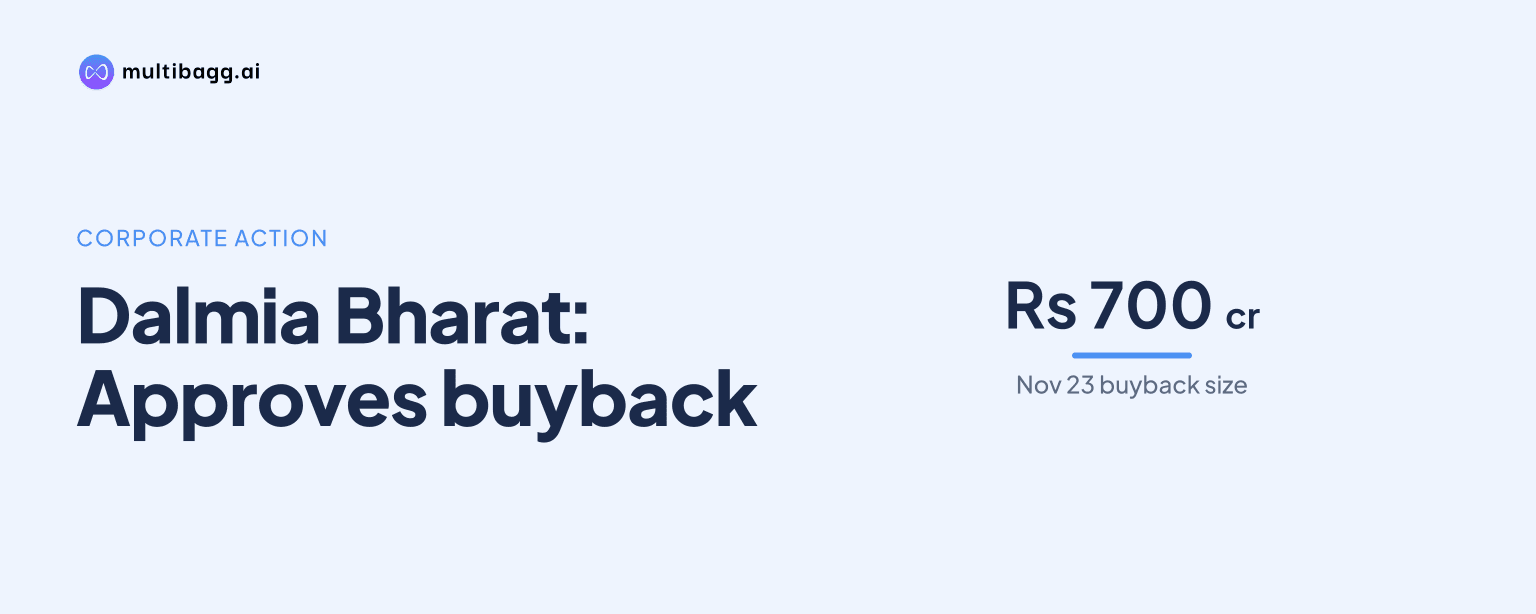
Dalmia Bharat approved an open-market share buyback of up to ₹700 crore on November 23, 2026, at a maximum price of ₹1,850 per equity share. The programme may cover up to 37.84 lakh shares, representing up to 2.02% of the company’s equity, while promoters and promoter group members are excluded.
Know Dalmia Bharat inside out
Results, valuation, peers and who's buying, in one view.
What did Dalmia Bharat approve?
Dalmia Bharat approved the repurchase of its fully paid-up equity shares through the open-market route, subject to a maximum outlay of ₹700 crore. The board has set ₹1,850 per share as the maximum price for the programme, which defines the highest price at which the company may purchase shares under the buyback.
The company said the buyback may cover up to 37.84 lakh shares. This represents up to 2.02% of Dalmia Bharat’s total equity shares. The approval moves the proposal beyond the board-meeting stage disclosed earlier, when the company had said it would consider a share repurchase without disclosing its size, price, share count or execution route.
Promoters and members of the promoter group will not participate in the buyback. As a result, any reduction in the outstanding public share base would occur through purchases from eligible non-promoter shareholders in the market, within the approved limits.
How will the Dalmia Bharat buyback be carried out?
Dalmia Bharat will conduct the approved repurchase through the open-market route rather than a tender offer. Under this route, the company may buy shares from the stock market at prevailing prices, provided the purchase price does not exceed ₹1,850 per share and the total spending remains within ₹700 crore.
The maximum share count of 37.84 lakh is linked to the approved price ceiling and buyback size. The actual number of shares bought may be lower if the company purchases shares below the maximum price, while the aggregate amount spent cannot exceed the approved ₹700 crore limit.
The filing states that the buyback excludes promoters and promoter group members. It also places the transaction within the applicable legal framework for buybacks, including provisions of the Companies Act, 2013, and the Securities and Exchange Board of India’s buyback regulations.
Got a follow-up? Ask IRIS
Why is the approved buyback significant for investors?
The approval gives investors defined terms for the corporate action, including the maximum capital allocation, price ceiling and possible share reduction. Until the November 23 board decision, Dalmia Bharat had only disclosed that it would consider a buyback proposal, with no financial or operational parameters announced.
A buyback can reduce the number of shares outstanding when shares are repurchased and extinguished under the applicable process. The eventual financial effect will depend on the actual number of shares purchased, the prices paid in the market and the final amount deployed by Dalmia Bharat within the ₹700 crore cap.
The maximum price is a ceiling, not an assurance that shares will trade or be bought at ₹1,850. In an open-market buyback, purchases are carried out at market prices within the authorised range. Shareholders’ ability to sell shares depends on market trading conditions and the company’s purchases during the buyback period.
What is Dalmia Bharat’s earlier buyback record?
Dalmia Bharat had previously approved an open-market buyback in March 2020. That programme had a maximum size of ₹500 crore, a ceiling price of ₹700 per share and a maximum share count of 71.43 lakh shares, according to the company’s earlier disclosed programme details.
The 2020 buyback was also proposed through the stock exchanges, NSE and BSE. Its approved size was stated as 6.7% of standalone capital and reserves and 5% of consolidated capital and reserves as of March 31, 2019. The current approval is larger in absolute terms at ₹700 crore, though the current filing specifies a maximum equity coverage of 2.02%.
The two programmes should not be compared solely through their headline prices because they relate to different periods and market conditions. The current decision is best assessed on its disclosed terms: the ₹700 crore financial cap, ₹1,850 maximum price, 37.84 lakh-share limit and open-market execution method.
What does the buyback mean for Dalmia Bharat’s operations?
The buyback is a capital-allocation decision and does not disclose any change to Dalmia Bharat’s cement operations, production capacity, customer commitments or business strategy. The filing is focused on the approved share repurchase and its terms.
For the broader cement sector, the announcement is specific to Dalmia Bharat and does not establish an industry-wide trend. It provides a clear corporate-action reference point for investors, while the operational and financial effect will depend on how much of the authorised buyback is ultimately executed.
Conclusion
Dalmia Bharat’s board has approved an open-market buyback of up to ₹700 crore at a maximum price of ₹1,850 per share. The programme may cover up to 37.84 lakh shares, or 2.02% of equity, and excludes promoters and promoter group members.
Investors will now watch the company’s subsequent disclosures on the buyback timetable, stock-exchange execution and actual shares purchased. The approved limits set the outer boundary of the programme, while final deployment will depend on purchases made within those limits.

