










DCAL targets Bavla revenue above Rs 400 crore during FY28
Key highlights
- DCAL expects Bavla FY28 revenue in excess of Rs 400 crore to Rs 450 crore.
- CDMO revenue fell to Rs 388 crore in Q2 FY27 from Rs 509 crore in Q2 FY26.
- DCAL said its first two-product Bavla technology transfer remains scheduled for completion by the end of FY27.
- DCAL has guided for about Rs 200 crore of FY27 capital expenditure, including SAP implementation.
powered by IRIS
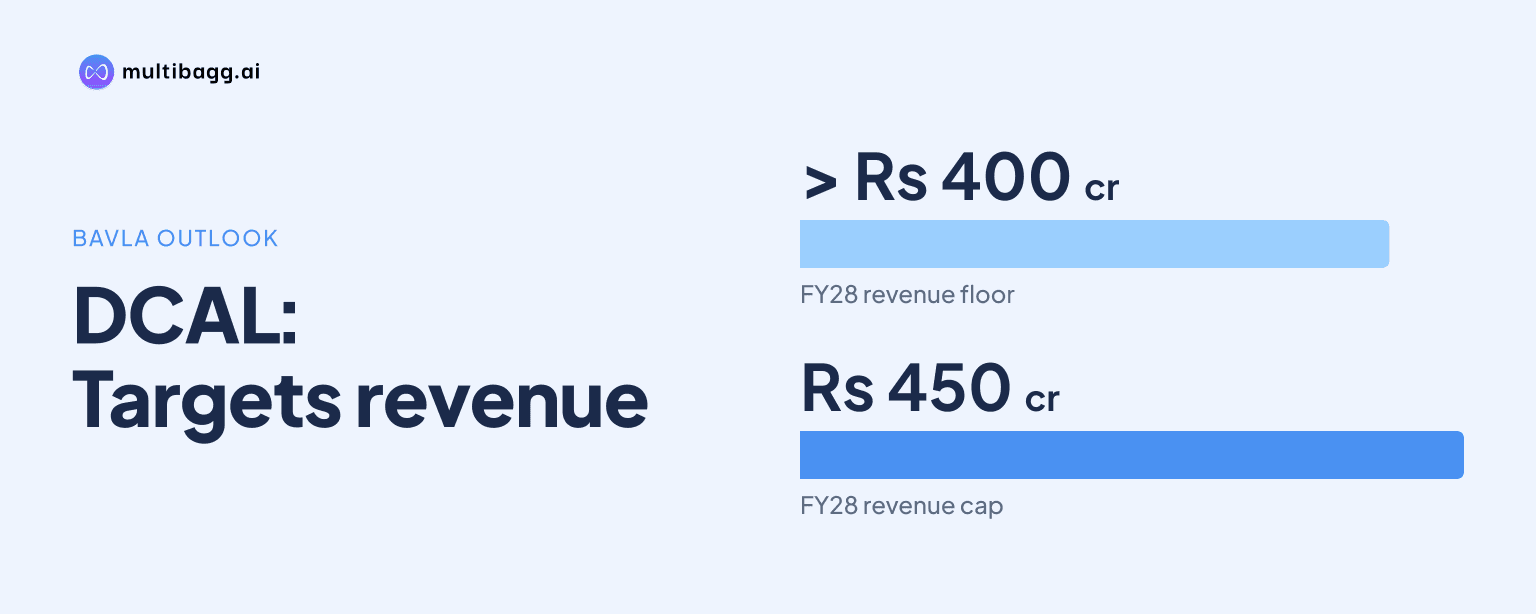
Dishman Carbogen Amcis Limited (DCAL) expects its Bavla site to generate revenue above Rs 400 crore in FY28, management said after the quarter ended September 30, 2026, contingent on completing technology transfers and customer regulatory filing changes needed to move Swiss-developed products to Indian large-scale manufacturing.
Know Dishman Carbogen Amcis inside out
Results, valuation, peers and who's buying, in one view.
What revenue does DCAL expect from Bavla in FY28?
DCAL expects Bavla’s full-year FY28 revenue to be in excess of Rs 400 crore to Rs 450 crore. Chief Financial Officer Harshil Dalal gave the indication after an analyst asked when Bavla could achieve a Rs 150 crore quarterly revenue run rate, but management did not identify the quarter in which that level could be reached.
The FY28 outlook depends on two technology transfers already under way, additional transfers in the pipeline and discussions with a large pharmaceutical company about manufacturing key starting materials and intermediates. Management called that prospective project promising, but did not disclose the customer’s name, a contract value, a production start date or Bavla revenue attributable to it.
How will DCAL transfer Swiss products to Bavla?
DCAL plans for its Swiss operations to develop niche and complex molecules while Indian sites, including Bavla, carry out larger-scale manufacturing. Management said this model is intended to improve utilisation of Indian assets after regulatory issues in India were cleared and customer confidence was rebuilt.
Two commercial technology transfers were under way in the quarter ended September 30, 2026. The first involved two legacy products and an American customer project, and DCAL said it remained on schedule for completion by the end of FY27. A second transfer was also in progress, with management indicating that it could add pipeline from two companies in the following year.
The transfer process requires operational work as well as customer-led updates to regulatory filings before manufacturing can move to India. DCAL said several other Switzerland-to-India transfers were in progress, while customer discussions held at CPHI Europe were under evaluation. Nine senior European employees were scheduled to visit India over four weeks to support technology transfers, customer engagement and alignment in project management, research and development, and sales.
What is delaying Bavla’s capacity ramp?
DCAL said Bavla’s ramp depends on the completion of technology transfers and customers updating regulatory filings with relevant agencies. Dalal said management could not offer a precise quarter for a Rs 150 crore quarterly run rate because timing also depends on the potential large-pharma starting-material and intermediate project.
The company said its contract development and manufacturing organisation, or CDMO, business is lumpy because development activity depends on molecules entering customers’ pipelines. DCAL historically targeted smaller molecules, particularly for biotechnology companies, but management said it is now seeking development work from large pharmaceutical companies, including Phase III molecules, with the aim of undertaking subsequent commercial manufacturing in India.
Some near-term demand has been deferred rather than lost, according to DCAL. Shipments expected in the first half were moved into the second half, while funding constraints at certain biotechnology companies pushed some orders into the next financial year. Management therefore said FY27 revenue might not grow, despite an earlier expectation of high-single-digit growth, while stating that the deferred orders had not been cancelled.
Got a follow-up? Ask IRIS
How did DCAL’s CDMO business perform in the first half?
DCAL’s CDMO revenue declined in both the September quarter and the first half, while Marketable Molecules revenue rose in the first half despite a lower quarterly result. Consolidated revenue was Rs 507 crore in the quarter ended September 30, 2026, down 22% from the comparable prior-year quarter, while earnings before interest, tax, depreciation and amortisation, or EBITDA, were Rs 46 crore.
CDMO revenue fell by Rs 121 crore year on year in Q2 FY27 and by Rs 191 crore in H1 FY27. Management attributed the movement to deferred shipments and biotech-company orders moving to the next financial year. CDMO margin was 12.3% in Q2 FY27 versus 25% in Q2 FY26, while the H1 margin was 8.7% versus 21%, which management linked to lower revenue against a largely fixed expense base.
Marketable Molecules revenue declined to Rs 118 crore in Q2 FY27 from Rs 143 crore a year earlier, primarily because of lower sales of vitamin D analogues, including Calcifediol and Calcitriol. Yet H1 revenue increased to Rs 256 crore from Rs 240 crore. Management expects a second-half increase in vitamin D analogue revenue and identified that business as the segment’s most profitable sub-segment.
What investment supports DCAL’s Bavla plan?
DCAL has completed its final large Bavla capital-expenditure project, a purified-water plant supplied by BWT Switzerland. Management described the facility as India’s largest by distribution network and user points, and said it is intended to serve the whole Bavla site, including the future restart of existing and new operational plants.
For FY27, DCAL has guided for total capital expenditure of about Rs 200 crore, including maintenance expenditure and digital transformation. Management identified the group-wide SAP software implementation as its largest digital project. The company also said its Naroda site secured its first commercial contract after product market approval in July 2026 for a macrocyclic peptide launched in the United States.
DCAL reported depreciation of Rs 90 crore and finance cost of Rs 40 crore in the September quarter. Management said it was completing the final stages of an external commercial borrowing drawdown and expected quarterly interest cost to fall to about Rs 20 crore to Rs 25 crore after deployment, most likely from Q4 FY27 or Q1 FY28.
Conclusion
DCAL’s Bavla outlook is a manufacturing-transition target rather than a reported revenue result. The FY28 objective of more than Rs 400 crore to Rs 450 crore relies on moving Swiss-developed products to Indian production, while CDMO revenue fell to Rs 388 crore in Q2 FY27 from Rs 509 crore a year earlier and CDMO margin declined to 12.3% from 25%.
The next indicators are completion of the first transfer by the end of FY27, progress on the second transfer and customer evaluations for further projects, and the arrival of deferred CDMO shipments in the second half. Management has not set a quarterly Bavla revenue target, but has tied its FY28 expectation to technology-transfer completion and potential large-pharma starting-material work.