










Dishman Carbogen Amcis Limited drops FY27 growth outlook
Key highlights
- Dishman Carbogen Amcis reported Q2 FY27 revenue of Rs 507 crore, down 22% year on year.
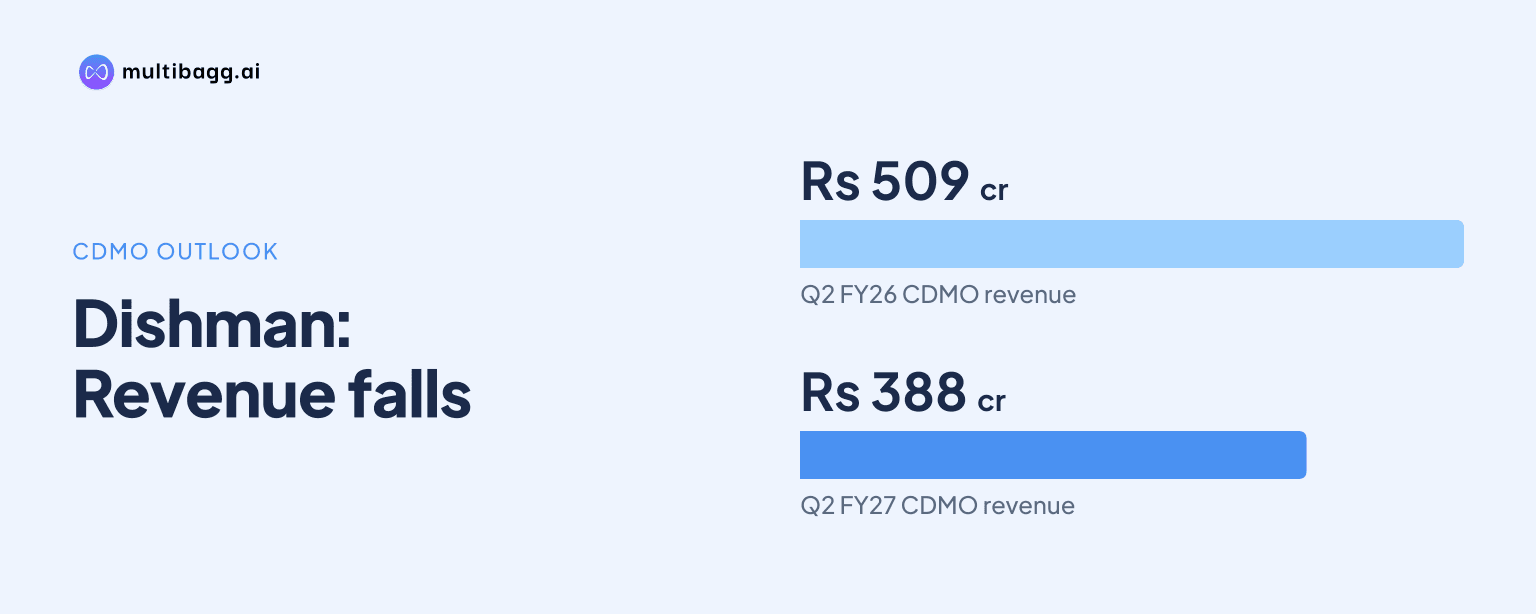
- CDMO revenue fell to Rs 388 crore in Q2 FY27 from Rs 509 crore in Q2 FY26.
- CDMO margin declined to 12.3% in Q2 FY27 from 25% a year earlier.
- Management expects Bavla revenue of more than Rs 400 crore to Rs 450 crore in the next financial year.
powered by IRIS
Dishman Carbogen Amcis Limited no longer expects revenue growth in FY27 after revenue for the quarter ended September 30, 2026 fell 22% year on year to Rs 507 crore. Management attributed the result to deferred Contract Development and Manufacturing Organization, or CDMO, shipments, delayed biotech-funded development work, and lower vitamin D analogue and drug-product sales.
Know Dishman Carbogen Amcis inside out
Results, valuation, peers and who's buying, in one view.
Why did Dishman Carbogen Amcis withdraw its FY27 revenue-growth expectation?
Dishman Carbogen Amcis said FY27 revenue may not grow because orders expected during the first half have moved into later periods. Global Chief Financial Officer Harshil Dalal said the shipment deferral from Q1 into the second half remained in place, but some orders expected to be serviced in Q2 could instead move into the next financial year. He said the orders had not been lost.
The CDMO business faced two timing pressures in the quarter ended September 30, 2026. Certain shipments were deferred into the second half, while some biotech customers postponed development orders into the next financial year because they lacked funding. Management described the business as lumpy because its historical focus has been small-molecule projects for biotech companies.
An analyst referred to a prior high-single-digit FY27 revenue-growth expectation during the call. Dalal responded that the company might not record revenue growth this year, while saying management expects at least high-single-digit or double-digit growth over the medium term. That outlook was linked to servicing deferred orders and to plans to use Indian manufacturing sites more fully, rather than to a FY27 target.
How did Dishman Carbogen Amcis perform in Q2 and H1 FY27?
Dishman Carbogen Amcis reported Q2 FY27 revenue of Rs 507 crore and earnings before interest, tax, depreciation and amortisation, or EBITDA, of Rs 46 crore. Revenue declined 22% from the comparable quarter a year earlier, while H1 FY27 EBITDA was Rs 106 crore. Management said its largely fixed expense base amplified the effect of lower revenue on EBITDA.
CDMO was the largest source of the revenue decline. Segment revenue fell to Rs 388 crore in Q2 FY27 from Rs 509 crore in Q2 FY26, while H1 revenue declined to Rs 929 crore from Rs 1,120 crore. CDMO margin declined to 12.3% in Q2 FY27 from 25% a year earlier and to 8.7% in H1 from 21%.
Marketable Molecules revenue fell in Q2 but was higher in H1. Q2 FY27 revenue was Rs 118 crore, compared with Rs 143 crore in Q2 FY26, primarily because sales of vitamin D analogues, including Calcifediol and Calcitriol, declined. H1 revenue rose to Rs 256 crore from Rs 240 crore, although management said the lower vitamin D analogue business reduced margins in both Q2 and H1.
The quarter also included lower development revenue and drug-product revenue than a year earlier. Other expenses were Rs 105 crore, down about 23% year on year, while employee expenses were Rs 321 crore. Depreciation was Rs 90 crore in Q2 and Rs 181 crore in H1, and quarterly finance cost was Rs 40 crore.
Got a follow-up? Ask IRIS
What could support Dishman Carbogen Amcis after the weak first half?
Dishman Carbogen Amcis expects a stronger second-half contribution from vitamin D analogues, which management called the most profitable Marketable Molecules sub-segment. Management did not quantify the expected uplift, but identified Calcifediol and Calcitriol as contributors to the Q2 decline. The company is also increasing its commercial team, with a focus on the US market, and said it had received new customers and orders in South America.
The main operational plan is to move larger-scale production to India after development work at Carbogen Amcis sites. Two technology transfers to Bavla are under way, including the first commercial transfer of a legacy project involving an American company. Management said the first transfer remained on schedule for completion by the end of FY27, while the second is expected to provide additional pipeline opportunities in the coming year.
Naroda secured its first commercial contract after a macrocyclic peptide received market approval in July 2026. Separately, a semiconductor customer requested a quotation for an initial volume of several hundred metric tonnes following technical work between the Switzerland and India teams. Management did not disclose a revenue value for either opportunity.
Dalal did not provide a quarter in which Bavla could reach Rs 150 crore of revenue, saying timing depends on technology transfers and customers updating regulatory filings. He said management expects Bavla revenue of more than Rs 400 crore to Rs 450 crore for the full next financial year. That expectation also depends on progress in discussions with a large pharmaceutical company on key starting materials or intermediates.
What are Dishman Carbogen Amcis spending, margin and interest-cost expectations?
Dishman Carbogen Amcis guided for FY27 capital expenditure of about Rs 200 crore, including maintenance expenditure and a group-wide SAP digital-transformation project. Management also said the final large Bavla capital-expenditure project, a purified-water system intended to support the whole site and future capacity expansion, had been completed.
Dalal said full-year EBITDA margin could be about 15% to 16%, depending on revenue over the final two quarters. The statement followed Q2 EBITDA of Rs 46 crore and H1 EBITDA of Rs 106 crore, with CDMO margin at 12.3% in Q2 and 8.7% in H1. It is management's expectation rather than a confirmed outcome.
Management said it was completing final conditions for drawing external commercial borrowing funds. Dalal said interest cost could decline from Q4 FY27, or from Q1 of the following financial year if deployment takes longer. He estimated quarterly interest cost could fall to about Rs 20 crore to Rs 25 crore from about Rs 40 crore after the borrowing is deployed.
Conclusion
Dishman Carbogen Amcis enters the second half of FY27 without an expectation of annual revenue growth after Q2 revenue declined 22% to Rs 507 crore. The shortfall was led by CDMO revenue, which fell from Rs 509 crore to Rs 388 crore, while vitamin D analogue, development and drug-product revenue also declined. Deferred shipments and delayed biotech-funded work pushed part of expected activity beyond the current reporting period.
The next measures are whether deferred CDMO shipments are serviced in the second half, whether vitamin D analogue sales improve, and whether the first Bavla technology transfer completes by the end of FY27. Management also expects Bavla revenue of more than Rs 400 crore to Rs 450 crore in the next financial year, has planned about Rs 200 crore of FY27 capital expenditure, and expects borrowing deployment to reduce quarterly interest cost from Q4 FY27 or the following Q1.