










Dishman Carbogen sees interest cost fall to Rs 20-25 crore
Key highlights
- Dishman Carbogen expects quarterly interest cost to decline to about Rs 20-25 crore from about Rs 40 crore after ECB deployment.
- Management expects the ECB benefit most likely from Q4, or Q1 of the next financial year if the drawdown is delayed.
- Quarterly CDMO revenue was about Rs 388 crore, compared with about Rs 509 crore in the prior-year quarter.
- Dishman Carbogen reported quarterly EBITDA of about Rs 46 crore and finance cost of about Rs 40 crore.
powered by IRIS
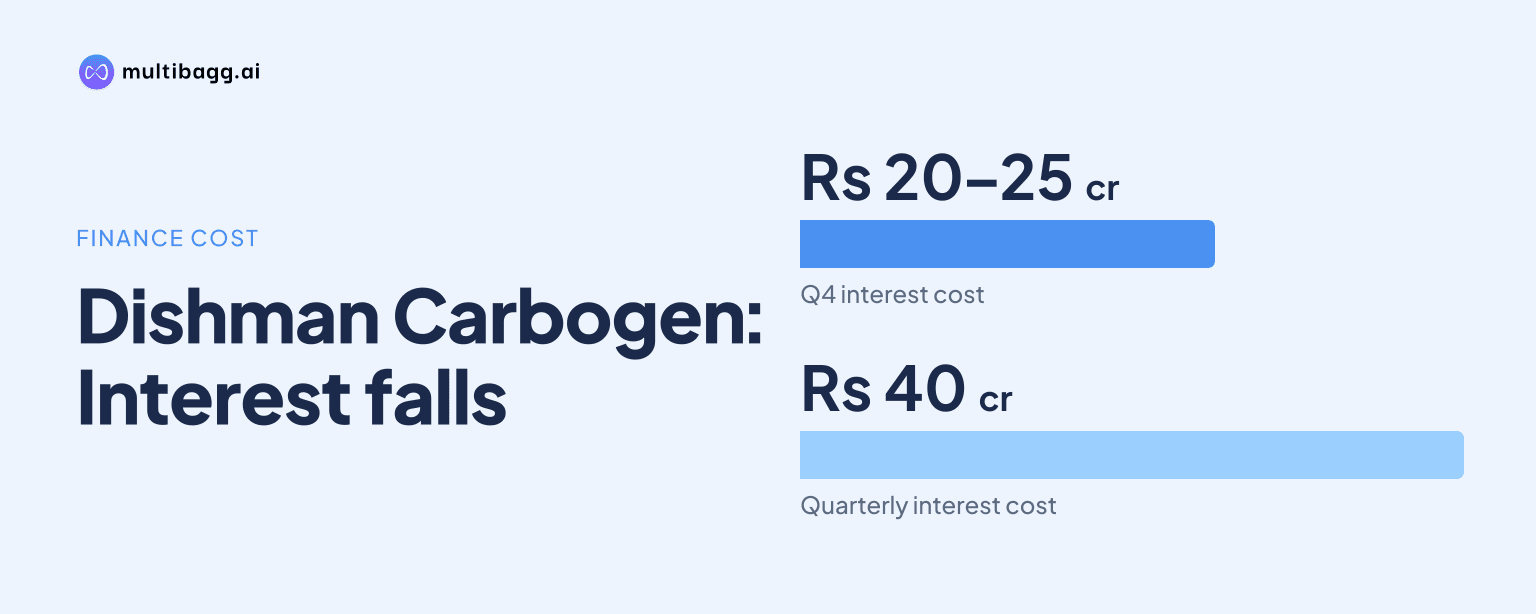
Dishman Carbogen Amcis Limited expects its pending external commercial borrowing, or ECB, deployment to reduce quarterly interest cost to about Rs 20-25 crore from about Rs 40 crore, with the benefit most likely beginning in Q4 of the current financial year or Q1 of the next financial year. Management said final drawdown conditions were being completed.
Know Dishman Carbogen Amcis inside out
Results, valuation, peers and who's buying, in one view.
How much could Dishman Carbogen’s ECB reduce interest costs?
Dishman Carbogen expects quarterly interest cost to decline by about Rs 15-20 crore after the ECB is deployed, taking the run rate from about Rs 40 crore to about Rs 20-25 crore. Management gave that range in response to a question on consolidated interest costs after completion of the refinancing process and confirmed that the projected level was about half of the current quarterly cost.
On an annualised basis, an analyst described the movement as about Rs 160 crore falling to about Rs 80-85 crore, and management agreed. The direct management guidance, however, was the quarterly Rs 20-25 crore range. The expected benefit is linked to the refinancing drawdown rather than to an assumption of higher revenue, margin expansion or lower operating expenditure.
The reduction would affect a cost item that was close to the company’s reported EBITDA, or earnings before interest, tax, depreciation and amortisation, of about Rs 46 crore in the quarter. Dishman Carbogen reported finance cost of about Rs 40 crore for that period, while first-half EBITDA stood at about Rs 106 crore and depreciation was about Rs 181 crore.
When will Dishman Carbogen’s interest cost begin declining?
Dishman Carbogen said interest costs should start declining as soon as the ECB is deployed, most likely from Q4 of the current financial year or otherwise Q1 of the next financial year. Management said it was completing the final piece of drawing down the funds and was attempting to finish the process before the Christmas holiday period.
The timing remained conditional because the company was still satisfying drawdown conditions. In a later response, management said it was working to complete at least the first tranche before the Christmas holidays, but that the process could spill into the new calendar year and would then most likely be completed in Q4 of the current financial year.
Dishman Carbogen did not disclose the ECB interest rate, maturity, final drawdown amount, security terms or the amount of cash locked under fixed-deposit liens. It also did not provide a detailed debt-maturity schedule. The Rs 20-25 crore quarterly estimate therefore remains management’s expectation after deployment rather than a reported reduction in the quarter under review.
How is Dishman Carbogen using other borrowings during the ECB process?
Dishman Carbogen said non-convertible debentures, or NCDs, raised since August were largely used to refinance existing NCDs and fund maintenance capital expenditure in India. Management said there was no other fresh fundraising planned because the ECB was in the process of being raised.
The company’s disclosed full-year capital-expenditure guidance was close to Rs 200 crore, including maintenance spending and digital transformation. Management identified the organisation-wide SAP implementation as its largest current digital project. It separately reported quarterly capital expenditure of $5.4 million and first-half capital expenditure of $10.3 million, without supplying rupee equivalents in the call.
The refinancing plan is distinct from operational recovery. Management described the quarter as soft and said that, because most expenses are fixed, a revenue decline has a significant effect on EBITDA. Lower finance costs could reduce the burden below the EBITDA line, while revenue and margin recovery depend on deferred orders, customer demand and manufacturing execution.
Got a follow-up? Ask IRIS
What operating pressures are Dishman Carbogen facing alongside refinancing?
Dishman Carbogen’s contract development and manufacturing organisation, or CDMO, revenue fell to about Rs 388 crore in the quarter from about Rs 509 crore in the comparable prior-year quarter. First-half CDMO revenue declined to about Rs 929 crore from about Rs 1,120 crore, with management citing shipments deferred to the second half and delayed orders from certain biotech companies facing funding constraints.
CDMO margin declined to about 12.3% in the quarter from 25% a year earlier, while the first-half margin fell to about 8.7% from 21%. Management said the company had historically targeted small molecules for biotech customers but was now also pursuing development work from larger pharmaceutical companies, particularly Phase III molecules, with commercial manufacturing intended to be carried out from Indian sites.
The Marketable Molecules segment recorded a different first-half trend. Quarterly revenue declined to about Rs 118 crore from about Rs 143 crore, while first-half revenue rose to about Rs 256 crore from about Rs 240 crore. Management attributed the quarterly and first-half margin pressure to lower vitamin D analogues sales and said it expected stronger revenue uplift from that sub-segment in the second half.
For the current financial year, management said revenue may not grow because orders previously expected in Q2 could be serviced in the next financial year. It said the deferred orders had not been lost and projected full-year EBITDA margin of about 15-16%, subject to the revenue outcome in the next two quarters.
What milestones could support Dishman Carbogen’s next-year recovery plan?
Dishman Carbogen expects Bavla revenue to exceed Rs 400-450 crore for the full next financial year, although management did not provide a quarter when the site could reach a Rs 150 crore quarterly run rate. It said the result depends on completing technology transfers and discussions with a large pharmaceutical customer for key starting materials or intermediates.
Management said two technology transfers were under way, with several more in the pipeline. The largest transfer was expected to move into validation campaigns in March and April, following pilot runs and transfer work with the customer. After validation batches are completed, the customer must update regulatory filings before commercial manufacturing can proceed.
Management said the order book being built for the next financial year looked better, including Phase III work, but described the conversion period as lengthy. It said early-phase projects can take five to 10 years to progress through Phase II, Phase III and commercialisation, although it cited cases where that normal period had been shortened to about two years.
Conclusion
Dishman Carbogen’s refinancing plan could reduce quarterly interest cost from about Rs 40 crore to about Rs 20-25 crore, a potential change of about Rs 15-20 crore against quarterly EBITDA of about Rs 46 crore. The projected savings would address financing costs while the company manages lower CDMO revenue, which fell by about Rs 121 crore year on year in the quarter, and a CDMO margin decline from 25% to 12.3%.
The next disclosed trigger is completion of the ECB drawdown, expected most likely in Q4 or otherwise Q1 of the next financial year. Operationally, management’s March-April validation campaign for the largest technology transfer, subsequent customer regulatory filings and its expectation of Bavla revenue above Rs 400-450 crore in the next financial year are the milestones to watch.