










Dishman Carbogen Amcis CDMO margin falls to 12.3% in Q2
Key highlights
- Dishman Carbogen Amcis’ Q2 FY27 revenue declined 22% to Rs 507 crore.
- CDMO revenue fell to Rs 388 crore in Q2 FY27 from Rs 509 crore in Q2 FY26.
- CDMO margin declined to 12.3% from 25% a year earlier.
- Dishman Carbogen Amcis has guided for FY27 capital expenditure of about Rs 200 crore.
powered by IRIS
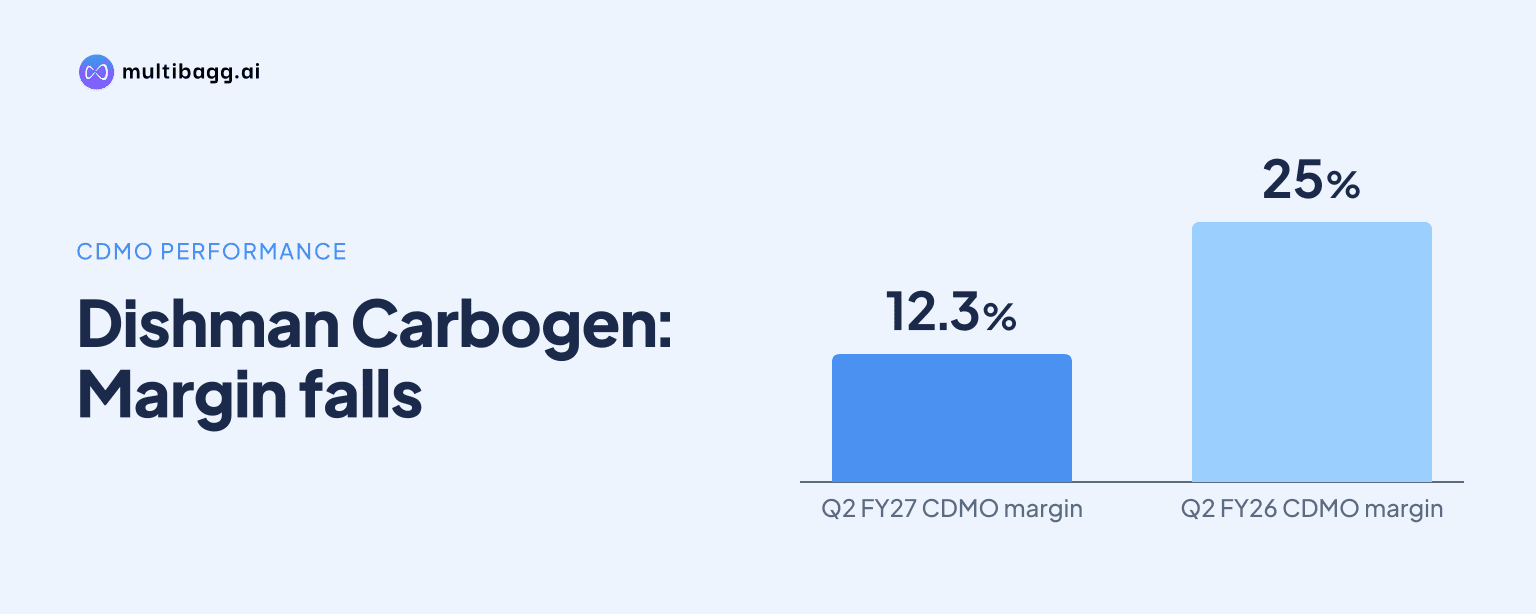
Dishman Carbogen Amcis Limited reported a 12.3% contract development and manufacturing organisation (CDMO) margin in Q2 FY27, down from 25% a year earlier, as quarterly revenue fell 22% to Rs 507 crore. Management said predominantly fixed expenses made the revenue decline consequential for earnings before interest, tax, depreciation and amortisation (EBITDA).
Know Dishman Carbogen Amcis inside out
Results, valuation, peers and who's buying, in one view.
Why did Dishman Carbogen Amcis’ CDMO margin fall in Q2 FY27?
Dishman Carbogen Amcis’ CDMO margin fell because lower revenue was absorbed against a cost base that management described as mostly fixed. CDMO revenue was Rs 388 crore in the quarter ended September 30, 2026, compared with Rs 509 crore in Q2 FY26. The resulting 12.3% segment margin was 12.7 percentage points below the 25% reported a year earlier.
The pressure extended to the first half. CDMO margin was 8.7% in H1 FY27, against 21% in H1 FY26, while revenue was Rs 929 crore versus Rs 1,120 crore. Management attributed the lower CDMO revenue partly to shipments deferred to the second half of FY27 and to some biotechnology customers postponing orders into the next financial year because of funding constraints.
Management said reduced development revenue also contributed to the group’s 22% quarterly revenue decline. The mechanism is operational leverage: employee and other costs do not decline at the same pace as revenue when production volumes, development work or shipments are delayed. The chief financial officer said a future revenue increase should have a corresponding positive EBITDA effect, but did not give a target margin.
How did lower revenue affect Dishman Carbogen Amcis’ earnings?
Dishman Carbogen Amcis reported Q2 FY27 EBITDA of Rs 46 crore and H1 FY27 EBITDA of Rs 106 crore. The group’s quarterly revenue was Rs 507 crore, with management describing the period as soft in both revenue and operating-profit terms. It specifically linked the EBITDA impact to the fixed nature of most expenses.
Cost of goods sold was about Rs 34 crore in Q2 FY27, broadly similar to the prior-year quarter and equal to about 7% of revenue. Employee expense was Rs 321 crore and other expense was Rs 105 crore, with other expense down about 23% year on year. The reduction in other expense therefore did not offset the effect of lower revenue on EBITDA.
Depreciation was about Rs 90 crore in Q2 FY27 and Rs 181 crore in H1 FY27, while finance cost was about Rs 40 crore for the quarter. The call did not disclose quarterly profit after tax or a comparable-quarter EBITDA figure. It did disclose that the cost structure and timing of revenue recognition were central to the lower operating result.
Which Dishman Carbogen Amcis businesses saw lower sales?
Dishman Carbogen Amcis recorded lower Q2 revenue in both CDMO and Marketable Molecules. CDMO revenue declined by Rs 121 crore year on year to Rs 388 crore, while Marketable Molecules revenue declined by Rs 25 crore to Rs 118 crore. Management said the CDMO reduction included deferred shipments, lower development revenue and deferrals by some biotech customers.
Marketable Molecules was affected principally by lower vitamin D analogue sales, including Calcifediol and Calcitriol. That segment’s Q2 FY27 revenue was Rs 118 crore, down from Rs 143 crore, and management said lower vitamin D analogue revenue also reduced its margins in both Q2 and H1. It expects stronger vitamin D analogue revenue in the second half of FY27.
The half-year comparison was different for Marketable Molecules. H1 FY27 revenue increased to Rs 256 crore from Rs 240 crore in H1 FY26, despite the lower Q2 result. CDMO, by contrast, reported declines in both periods, with H1 revenue down Rs 191 crore to Rs 929 crore. This contrast shows that the group’s quarterly shortfall was concentrated in CDMO timing and vitamin D analogue sales.
Got a follow-up? Ask IRIS
How is Dishman Carbogen Amcis seeking to raise Indian-site utilisation?
Dishman Carbogen Amcis is transferring selected processes and products from Carbogen Amcis operations to its Indian manufacturing sites, including Bavla and Naroda. Management said two legacy-product technology transfers to India are under way. The first commercial transfer, involving an American company, has been initiated and is scheduled for completion by the end of FY27.
Management said the intended model is for Swiss operations to focus on developing niche and complex molecules, with Indian sites handling larger-scale manufacturing. It said customer regulatory filings must be updated before manufacturing can shift, making the timing of revenue contribution uncertain. Several additional technology-transfer initiatives between Switzerland and India are also ongoing or under customer evaluation.
At Naroda, Dishman Carbogen Amcis said production supporting the US launch of a macrocyclic peptide became part of its commercial pipeline after the product received market approval in July 2026. Naroda then secured its first commercial contract for that product. Management also said a semiconductor-project customer had requested a quotation for an initial volume of several hundred metric tonnes after technical collaboration between Switzerland and India.
What has Dishman Carbogen Amcis said about FY27 and Bavla?
Dishman Carbogen Amcis no longer expects revenue growth in FY27, according to its chief financial officer. Management said shipments deferred from Q1 into H2 FY27 remain expected, but orders originally expected in Q2 may instead be serviced in the next financial year. It said those deferred orders have not been lost.
For the medium term, management said it expects at least high-single-digit or double-digit revenue growth, without providing a specific FY27 revenue or consolidated EBITDA-margin target. It also said Bavla could generate more than Rs 400 crore to Rs 450 crore of revenue in the full next financial year, depending on technology-transfer completion and progress on a potential large-pharma project for key starting materials or intermediates.
The group has guided for FY27 capital expenditure of about Rs 200 crore, including maintenance expenditure and digital transformation. The largest disclosed digital initiative is the implementation of SAP across the organisation. Management also said Bavla’s final large capital project, a purified-water plant and distribution network, has been completed to support existing operations and future capacity.
Conclusion
Dishman Carbogen Amcis’ Q2 FY27 performance reflects the effect of lower CDMO shipments and development activity on a predominantly fixed-cost base. Group revenue declined 22% to Rs 507 crore, CDMO revenue fell to Rs 388 crore from Rs 509 crore, and CDMO margin contracted to 12.3% from 25%. Marketable Molecules also declined in the quarter because of lower vitamin D analogue sales, although its H1 revenue increased year on year.
The next reported indicators will be second-half vitamin D analogue sales, delivery of deferred CDMO shipments and progress on the two technology transfers scheduled for completion by the end of FY27. Management’s stated Bavla revenue expectation of more than Rs 400 crore to Rs 450 crore in the next financial year depends on those transfers and a potential large-pharma project, while FY27 capital expenditure is guided at about Rs 200 crore.