










De Neers expanded OEM base to 68 and catalogue to 9,600
Key highlights
- De Neers increased OEM relationships from 3 in FY22 to 68 in H1FY27.
- De Neers expanded its catalogue from 3,200 SKUs in FY22 to 9,600 in H1FY27.
- De Neers increased dealers from 220 to 363 and city coverage from 180 to 329 between FY22 and H1FY27.
- De Neers reported FY26 standalone net sales of Rs 158.26 crore and a 21.3% EBITDA margin.
powered by IRIS
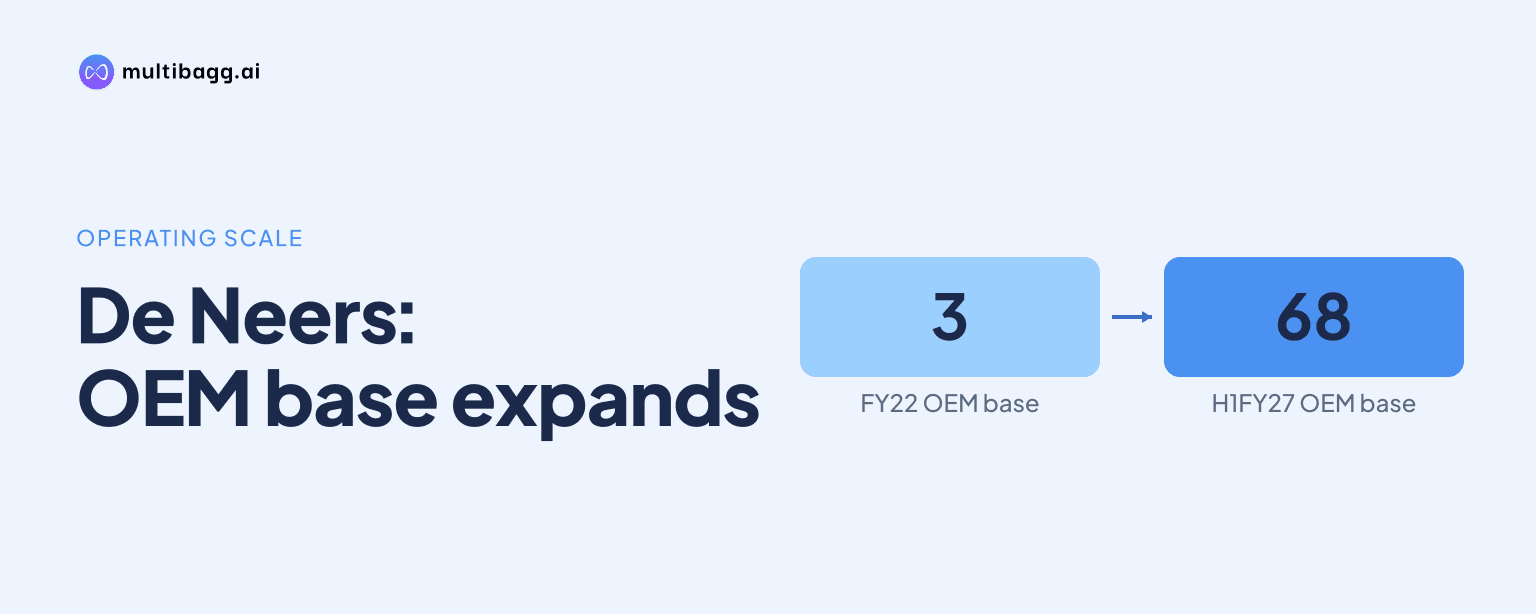
De Neers expanded its original equipment manufacturer base from 3 in FY22 to 68 in H1FY27, while its product catalogue increased from 3,200 to 9,600 stock-keeping units (SKUs). Over the same period, its dealer count rose from 220 to 363 and the number of Indian cities covered increased from 180 to 329.
Know De Neers Tools inside out
Results, valuation, peers and who's buying, in one view.
How much did De Neers expand its product catalogue?
De Neers tripled its catalogue to 9,600 SKUs in H1FY27 from 3,200 in FY22, adding 6,400 individual product listings over the period. The expansion was continuous across the reported years: the catalogue reached 3,800 SKUs in FY23, 5,500 in FY24, 7,800 in FY25 and 9,500 in FY26 before the H1FY27 total.
The pace changed materially across the series. De Neers added 600 SKUs in FY23 and 1,700 in FY24, then made its largest annual additions of 2,300 in FY25 and 1,700 in FY26; the increase from FY26 to H1FY27 was 100 SKUs. The presentation also characterises the H1FY27 catalogue as having expanded by more than 23% over the last two years.
Management says its 9,600-SKU portfolio is more than twice the portfolio of its closest competitor, although the presentation does not identify that competitor or provide its SKU count. It positions this breadth across hand-tool categories as a one-stop sourcing offer for industrial requirements, including both standard and niche needs.
How did De Neers broaden OEM, dealer and city coverage?
De Neers increased its original equipment manufacturer, or OEM, count to 68 in H1FY27 from 3 in FY22, a rise of 65 OEM relationships. The OEM total rose from 3 to 6 in FY23, 15 in FY24, 57 in FY25 and 66 in FY26, so 42 of the reported additions occurred between FY24 and FY25.
Dealer coverage grew to 363 in H1FY27 from 220 in FY22, while city coverage across India reached 329 from 180. The latest half-year movement was 11 additional dealers and seven additional cities compared with FY26, whereas the OEM count increased by two from 66. These measures show that catalogue expansion was accompanied by growth in both channel points and geographical reach.
The presentation lists Renault, Maruti Suzuki, Hyundai, Polycab and Havells alongside the OEM statistics. A separate client display includes Renault and Ashok Leyland as new additions and names organisations including Mahindra, Tata Steel, IndianOil, Larsen & Toubro, Indian Railways, Honda and Hyundai. The material does not specify sales values, contract terms or the revenue contribution of any named customer.
Got a follow-up? Ask IRIS
What does the larger catalogue mean for De Neers' sales model?
De Neers says the larger catalogue is intended to let customers and dealers procure products through one supplier rather than depend on multiple suppliers. The stated mechanism is customer and dealer convenience: a broad hand-tool range can simplify procurement and, according to management, improve time and cost efficiency for buyers.
Management also identifies cross-selling as a benefit of the integrated portfolio. Its stated rationale is that complementary SKUs can be sold through the same dealer relationship, increasing average transaction value and share of wallet per dealer. The presentation does not disclose average transaction values, dealer-level sales, repeat-order rates or a measured cross-selling contribution.
The product data show that the catalogue grew faster than the dealer network over the FY22 to H1FY27 period. SKUs increased by 6,400, while dealers increased by 143 and cities by 149; this means the reported operating model now carries 9,600 SKUs across 363 dealers and 329 cities. That comparison measures the scale of assortment growth alongside physical distribution, but it does not establish sales per dealer or inventory productivity.
The scale-up has also been accompanied by a larger inventory balance. Consolidated inventories were Rs 139.48 crore at FY26 and Rs 146.59 crore at H1FY27, an increase of Rs 7.11 crore, while consolidated sundry debtors rose from Rs 51.63 crore to Rs 74.69 crore. These balance-sheet movements are reported amounts and the presentation does not assign them specifically to the SKU or distribution expansion.
How does De Neers' expansion compare with financial performance and its manufacturing plan?
De Neers reported standalone net sales of Rs 158.26 crore in FY26, compared with Rs 60.19 crore in FY22, while standalone earnings before interest, tax, depreciation and amortisation, or EBITDA, rose from Rs 6.89 crore to Rs 33.67 crore. Its standalone EBITDA margin increased from 11.4% in FY22 to 21.3% in FY26, alongside the operating expansion in SKUs, OEMs and dealers.
At the consolidated level, FY26 net sales were Rs 178.03 crore, compared with Rs 144.70 crore in FY25, and EBITDA increased to Rs 38.73 crore from Rs 25.83 crore. Consolidated EBITDA margin rose from 17.8% to 21.8%, while reported net profit increased from Rs 15.76 crore to Rs 25.29 crore and the reported net profit margin moved from 10.9% to 14.2%.
De Neers has also set out a manufacturing initiative that may affect part of the product portfolio. DNSJV Private Limited, in which De Neers holds 51%, signed a joint-venture agreement on 15 June 2026 to set up a Sonepat, Haryana facility. Management targets commercial production by the middle of FY2027-28 and says the venture provides backward integration in socket manufacturing, with plans to expand into allen keys, screwdrivers and allied products for cost optimisation and profitability improvement.
The source reports that construction at the Sonepat site is progressing, but provides no capital-expenditure amount, capacity target, production volume or financial forecast for the joint venture. It also says De Neers is evaluating entry into power tools, expanding beyond conventional hand tools, without stating a launch date, investment amount or expected revenue contribution.
Conclusion
De Neers' reported operating expansion is defined by a 6,400-SKU increase, 65 additional OEMs, 143 more dealers and coverage of 149 more cities between FY22 and H1FY27. Financially, standalone sales rose from Rs 60.19 crore in FY22 to Rs 158.26 crore in FY26, while the standalone EBITDA margin increased from 11.4% to 21.3%.
The next disclosed milestone is DNSJV's targeted commercial production by the middle of FY2027-28, following its 15 June 2026 agreement and ongoing construction in Sonepat. Investors can also watch whether the catalogue moves beyond 9,600 SKUs, whether OEM additions continue beyond 68, and whether the company proceeds from evaluating power tools to setting out a defined plan.