










De Neers targets 20-25% annual revenue and profit growth
Key highlights
- De Neers management targets 20-25% compound annual growth in revenue and profitability through 2030.
- De Neers aims for exports to contribute 10-15% of revenue by 2030.
- De Neers targets more than 10% of revenue from value-added products.
- De Neers says its platform can support 3-4 times current revenue and includes more than 9,600 SKUs.
powered by IRIS
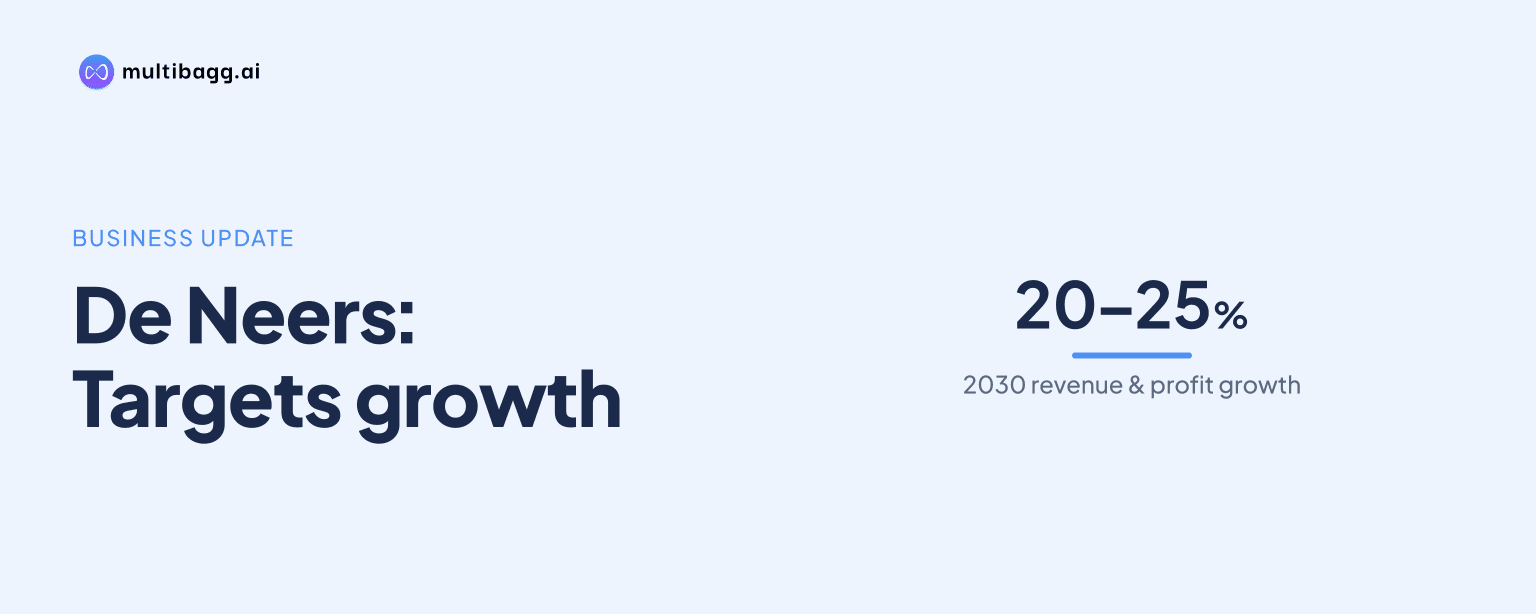
De Neers Tools Ltd said in its H1 FY27 investor presentation that it targets 20-25% compound annual growth in revenue and profitability through 2030, alongside exports contributing 10-15% of revenue and value-added products exceeding a 10% share.
Know De Neers Tools inside out
Results, valuation, peers and who's buying, in one view.
What is De Neers targeting by 2030?
De Neers management is targeting 20-25% compound annual growth in both revenue and profitability by 2030. These are management objectives disclosed in the H1 FY27 presentation, rather than reported growth figures or forecasts of a specific revenue or profit amount. The company has paired the targets, indicating that its stated plan is for profitability growth to track sales growth over the period.
The 20-25% range applies separately to revenue growth and profitability growth, making the two financial ambitions identical in percentage terms. The presentation does not provide a base-year revenue figure, a base-year profit figure or annual milestones through 2030. The framework therefore enables comparison of future reported performance with the same 20-25% annual target for both measures, but does not quantify a rupee outcome.
How will exports and value-added products change De Neers sales?
De Neers plans for exports to represent 10-15% of revenue by 2030. This makes international sales a defined component of the growth plan rather than an unspecified expansion activity. The target is expressed as a revenue share, while the presentation does not state the current export contribution, the countries involved or a separate export-revenue target.
De Neers also aims for value-added products to contribute more than 10% of revenue. Compared with the 10-15% export objective, the value-added-products goal has a 10% minimum threshold but no disclosed upper bound. The two targets cover different sales-mix measures: exports describe the destination of revenue, while value-added products describe the product category generating revenue.
The H1 FY27 presentation links both mix targets to the wider 2030 growth plan but does not say whether value-added products sold outside India would count in both categories. It also does not define which products qualify as value added. De Neers presents impact sockets as a manufactured category using high-grade alloy steel, precision forging, computer numerical control machining, heat treatment, surface finishing and 100% inspection.
Got a follow-up? Ask IRIS
What platform does De Neers cite for its 2030 plan?
De Neers says its operating platform is designed to support 3-4 times current revenue. The stated foundation includes a portfolio of more than 9,600 stock-keeping units, or SKUs, together with established inventory and a wide distribution network. This is a statement about platform capacity, not a commitment that revenue will increase by 3-4 times by a specified date.
De Neers describes its strategic positioning as an extensive product range combined with an established sourcing network, dealer relationships and original equipment manufacturer, or OEM, relationships. Relative to the 20-25% annual revenue-growth target, the 3-4 times statement addresses potential scale capacity rather than an annual expansion rate. De Neers also says it expects higher operating leverage as the business scales, without providing a target operating-margin percentage.
The impact-socket process illustrates the manufacturing mechanisms described in the presentation. It starts with high-grade alloy steel and includes forging, computer numerical control machining, heat treatment, surface finishing and a quality check before products reach the market. De Neers states that the quality check includes 100% inspection, a process feature presented alongside its infrastructure and portfolio claims.
Which execution priorities has De Neers identified?
De Neers identifies reducing the working-capital cycle as a 2030 objective. The presentation describes this as working-capital optimization and also identifies capital efficiency and backward integration as focus areas. It does not disclose the current working-capital cycle, a target number of days, required investment for backward integration or a timetable for those actions.
De Neers also aims to become an approved vendor for major automotive companies in India. This approval-oriented target is distinct from the H1 FY27 presentation's valued-clientele page, which includes Mahindra, Maruti Suzuki, Honda, Hyundai, Renault and Ashok Leyland. De Neers does not specify which automotive companies it is pursuing for approval, the status of approvals or the expected sales contribution from automotive OEM business.
The automotive approval objective sits beside a customer list spanning industrial and infrastructure names including Tata Steel, IndianOil, Larsen & Toubro, Bharat Heavy Electricals and Indian Railways. The list shows the range of sectors presented in H1 FY27, while the 2030 OEM objective remains prospective. Management's disclosed plan therefore includes seeking formal vendor status with major automotive manufacturers as well as expanding its existing operating platform.
Conclusion
De Neers has set a measurable 2030 framework of 20-25% annual growth in revenue and profitability, exports at 10-15% of revenue and value-added products above a 10% revenue share. Its stated operating base includes more than 9,600 SKUs, established inventory and distribution, and a platform management says can support 3-4 times current revenue.
The next disclosures to watch are export share, value-added-product mix, the working-capital cycle and automotive OEM approvals. These measures would show progress against the 2030 plan because the H1 FY27 presentation provides no annual milestones, current export share or current value-added-product contribution.