










ProV targets ₹1,100 crore-plus FY28 revenue, then 20–25% growth
Key highlights
- ProV targets more than ₹1,100 crore in brand revenue by FY28, roughly double its current run-rate.
- Management expects approximately 20–25% annual revenue growth for the following three to five years.
- Makhana, seeds, figs, dates and flavoured products rose to 1,700 MT in H1 from 440 MT.
- Surat is planned for more than 5 lakh pouches a day versus H1 sales of about 1.1 lakh pouches a day.
powered by IRIS
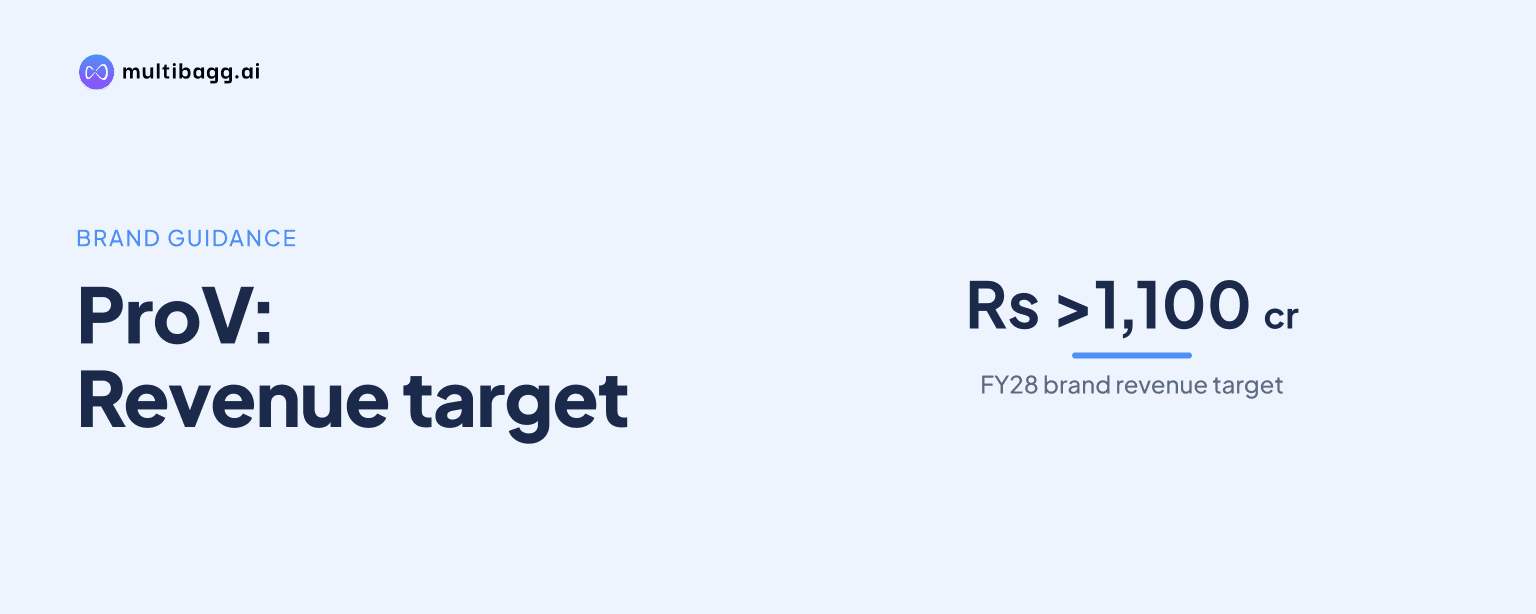
Proventus Agrocom Limited is targeting more than ₹1,100 crore of ProV brand revenue by FY28, roughly double its current run-rate, and management expects approximately 20–25% annual revenue growth for the following three to five years. The plan combines portfolio expansion, wider distribution, phased Surat capacity and greater capital productivity.
Know Proventus Agrocom inside out
Results, valuation, peers and who's buying, in one view.
What is ProV's FY28 brand-revenue target?
ProV is targeting more than ₹1,100 crore in brand revenue by FY28, a level management says is roughly double the current run-rate. The target places consumer packs at the centre of growth across ProV's wholesome-nutrition portfolio rather than setting out an annual revenue target for each intervening year.
Management describes the FY28 milestone as the next stage after investments over several years in brand building, people, distribution, product development and manufacturing infrastructure. Its stated focus is to gain greater productivity and returns from marketing expenditure, manufacturing assets, distribution investments and working capital as the business scales.
The ₹1,100 crore target is specifically for brand revenue, not white-label and bulk sales. Management reported white-label and bulk sales of ₹176.9 crore, about 28% of revenue, and says that business gives ProV dry-fruit and makhana market visibility, supplier relationships, procurement efficiencies and manufacturing utilisation.
How will ProV expand its portfolio and distribution?
ProV plans to support the FY28 target by broadening its wholesome-nutrition portfolio and deepening distribution through General Trade, Modern Trade, E-Commerce and Quick Commerce. Management says its move beyond dry fruits can serve more consumer needs, diversify the business and improve product mix, while innovation and consumer acceptance can create opportunities for margin expansion.
Makhana, seeds, figs, dates and flavoured products grew almost fourfold in H1 volume, rising to 1,700 metric tonnes, or MT, from 440 MT. Management says makhana and seeds are largely sold in smaller consumer pouches, meaning each tonne requires more pouches to be processed and packed than almonds or cashews.
Pouch volumes rose more than brand revenue in H1: management said pouch sales more than doubled while brand revenue increased 61%. It attributes part of that difference to smaller packs in seeds, makhana and similar products, which it says offer households a lower-cost first trial and create an opportunity for repeat purchases across more of the range.
The comparison between 1,700 MT in H1 and 440 MT in the earlier period shows that newer categories are changing operational needs as well as portfolio mix. Management identifies continued innovation, broader channel availability and consumer acceptance of these categories as mechanisms for building revenue toward the FY28 brand target.
Got a follow-up? Ask IRIS
How will Surat and Bihar support ProV's growth plan?
ProV plans to use Surat as an integrated processing, packaging and cold-storage hub, while its Bihar facility supports sourcing-led makhana category development. Surat Phase 1 is completed, and management expects Phases 2 and 3, including additional processing, packaging and integrated cold storage, to be completed by June 2027.
The two facilities have different roles. Management says Surat will improve raw-material preservation, inventory management and flexibility for a growing portfolio, while operational Bihar is close to the makhana sourcing ecosystem and supports supplier relationships, raw-material handling, quality control, and flavoured and other value-added makhana products.
Surat is planned to reach more than 5 lakh pouches a day, compared with H1 sales of about 1.1 lakh pouches a day. Management says the facility is being built for the scale it expects over the next two to three years, rather than for the H1 daily average alone.
Management cites four demand drivers for the capacity gap: distribution expansion, repeat buying, growth in smaller-pack categories, and seasonal demand. It says the second half is traditionally the strongest period because of festive demand, so the H1 average does not fully represent peak requirements.
Phased construction is management's stated mechanism for aligning capacity with demand through June 2027. As volumes increase, management expects better utilisation, fixed-cost absorption, procurement efficiency, and inventory and logistics management, which it says should support operating leverage, unit economics and returns on invested capital.
What growth does ProV expect after FY28?
After the more than ₹1,100 crore FY28 brand-revenue milestone, ProV says it is confident of delivering approximately 20–25% annual revenue growth for the following three to five years. Management links that outlook to a larger revenue base, continuing portfolio development, wider channel presence and efforts to turn scale into stronger earnings and healthy cash generation.
ProV has not disclosed annual revenue targets for each of the three to five years or a quantified profitability target. Instead, management says it will focus on improving the productivity of marketing expenditure, manufacturing assets, distribution investments and working capital while seeking profitable growth and capital efficiency.
The FY28 and post-FY28 statements cover different periods and measures. More than ₹1,100 crore is a brand-revenue aspiration for FY28, whereas approximately 20–25% is an annual revenue-growth aspiration for the three to five years after that milestone.
Management also says white-label and bulk sales, at ₹176.9 crore or about 28% of revenue, remain integral to the model even as ProV is prioritised as the future driver of growth and margin expansion. The bulk operation is intended to complement the brand through scale, market access and manufacturing support rather than replace the consumer-pack strategy.
Conclusion
ProV's disclosed framework combines a more than ₹1,100 crore FY28 brand-revenue target with portfolio, distribution and manufacturing actions intended to support that scale. The rise in H1 volume for makhana, seeds, figs, dates and flavoured products to 1,700 MT from 440 MT helps explain the emphasis on smaller-pack capacity, while pouch sales more than doubled against 61% brand-revenue growth.
The next disclosed execution point is June 2027, when Surat Phases 2 and 3, including cold storage, are expected to be completed. Progress toward more than 5 lakh daily Surat pouches, compared with H1 sales of about 1.1 lakh a day, and management's stated focus on asset, marketing and working-capital productivity will be the operational matters to watch.