










ProV plans over 5 lakh Surat pouches daily by June 2027
Key highlights
- ProV plans Surat capacity of more than 5 lakh pouches a day by June 2027, versus H1 FY27 sales averaging about 1.1 lakh a day.
- Combined volumes of makhana, seeds, figs, dates and other value-added products rose from 440 MT in H1 FY26 to 1,700 MT in H1 FY27.
- ProV management is targeting more than Rs 1,100 crore in brand revenue by FY28.
- Premium dry fruits and wholesome nutrition products represented 57% of H1 FY27 revenue, compared with 48% in FY25.
powered by IRIS
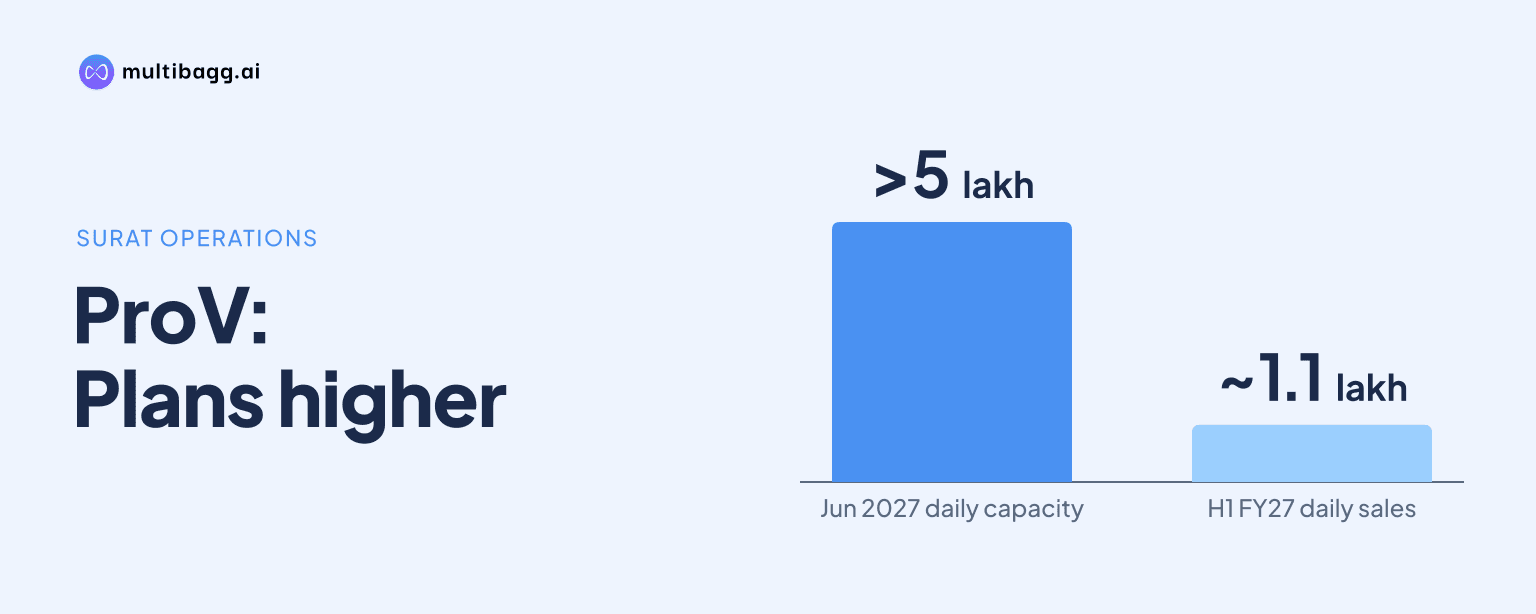
Proventus Agrocom Limited plans Surat capacity of more than 5 lakh pouches a day by June 2027, more than 4.5 times H1 FY27, or the first half of financial year 2027, average sales of about 1.1 lakh pouches a day. Management cites phased development, smaller-pack categories and festive demand as utilisation drivers.
Know Proventus Agrocom inside out
Results, valuation, peers and who's buying, in one view.
How large is ProV's Surat capacity plan versus H1 sales?
ProV's planned Surat capacity is more than 5 lakh pouches a day, compared with about 1.1 lakh daily pouch sales in H1 FY27, making the proposed capacity more than 4.5 times the reported half-year average. Management says Surat is being built for expected demand over the next two to three years rather than only current pouch volumes.
Phase 1 at Surat is completed and operational, while Phases 2 and 3 are expected by June 2027. The remaining phases include additional processing, packaging and integrated cold-storage infrastructure. ProV has not disclosed its current installed pouch capacity, an absolute H1 pouch-sales total or a specific capacity-utilisation target for Surat.
What is expected to fill ProV's additional Surat capacity?
ProV says its core consumer-pack business will be a principal demand driver, supported by management's target of more than Rs 1,100 crore in brand revenue by FY28. Management describes that target as roughly double the current run-rate and identifies wider distribution through General Trade, Modern Trade, E-Commerce and Quick Commerce, as well as repeat purchases, as the routes to growth.
New categories are the second stated source of pouch demand. Combined volumes of makhana, seeds, figs, dates and other value-added products increased from 440 metric tonnes (MT) in H1 FY26 to 1,700 MT in H1 FY27, an increase of about 286%. Management says makhana and seeds are usually sold in smaller pouches, so each tonne requires more packs than almonds or cashews.
The company reported that pouch count more than doubled in H1 FY27 while brand revenue grew 61%. Management attributes part of the difference to the rising share of smaller packs, which can cause pouch volumes to grow faster than tonnage or revenue. ProV has not provided a FY28 pouch-volume target or a forecast showing when the 5 lakh-plus daily capacity will be used.
Why does H1 sales not represent ProV's peak capacity need?
ProV says H1 FY27 average pouch sales of about 1.1 lakh a day do not capture its peak requirement because the second half is traditionally the stronger period, led by festive demand. Management's case is that adequate processing and packing capacity should protect product availability when seasonal volumes rise.
The source does not quantify the festive sales uplift, the number of peak trading days or second-half pouch volumes. It does report that ProV had on-ground sales personnel in more than 205 cities during H1 FY27, while employee strength rose by about 50% year on year across marketing, General Trade, Quick Commerce, manufacturing facilities, operations and other functions.
Employee benefit expenses increased from Rs 4.12 crore in H1 FY26 to Rs 8.84 crore in H1 FY27. Management says part of that increase reflects on-ground sales staff being moved from contractual arrangements to the company payroll from April 2026, rather than solely additional hiring. The wider sales footprint is part of management's stated basis for expecting greater capacity use.
Got a follow-up? Ask IRIS
How do ProV's Surat and Bihar facilities serve different needs?
Surat is intended to be ProV's integrated manufacturing and storage hub, while its Bihar makhana manufacturing facility is already operational and is linked to the sourcing ecosystem. Surat's remaining phases will add processing, packaging and cold storage by June 2027, whereas Bihar is intended to support raw-material handling, quality control and supplier relationships for makhana.
Management says Bihar also provides a platform for flavoured and other value-added makhana products. This focus aligns with the rise in the broader newer-category group to 1,700 MT in H1 FY27 from 440 MT a year earlier. Surat, by contrast, is designed to serve the wider portfolio through integrated processing, pouch packing and storage.
ProV says the two sites address distinct needs: Surat adds manufacturing automation and storage, while Bihar supports sourcing-led category development. The company has not disclosed capital expenditure, production capacity in MT, utilisation rates or projected cost savings for either facility, so their financial impact is not quantified in the presentation.
What operating benefits does management expect from the expansion?
Management expects Surat's larger scale to improve fixed-cost absorption, procurement efficiency, inventory management and logistics as volumes rise. These are expected benefits rather than reported outcomes: ProV has not set out a post-June 2027 margin target, a timetable for operating leverage or a percentage utilisation threshold.
The phased approach is management's stated mechanism for aligning investment with growth. Processing and packaging automation, together with integrated cold storage, are expected to improve raw-material preservation, procurement planning and inventory management. Management says these capabilities should support product quality and supply-chain efficiency as the portfolio expands.
Portfolio mix has already changed before the final Surat phases are completed. Premium dry fruits and wholesome nutrition products represented 57% of revenue in H1 FY27, compared with 48% in FY25, while gross margin rose to 23.0% from 19.7%. Management attributes this movement to portfolio evolution, scale and earlier investments, and identifies manufacturing and procurement efficiencies as future levers.
Conclusion
ProV's more than 5 lakh-pouch daily Surat plan is substantially above its H1 FY27 average of about 1.1 lakh pouches a day. Management's utilisation case combines a more than Rs 1,100 crore FY28 brand-revenue target, the increase in newer-category volumes to 1,700 MT, a smaller-pack mix that lifts pouch counts, and seasonal second-half demand.
The next disclosed milestone is completion of Surat Phases 2 and 3, including cold storage, by June 2027. Investors can watch whether pouch volumes, consumer-pack sales and distribution across more than 205 cities advance in line with management's FY28 target, because ProV has not disclosed a capacity-utilisation target or quantified savings from the expansion.