










ProV says 55% volume growth drove H1 FY27 revenue expansion
Key highlights
- ProV's consolidated revenue increased 63% year on year to Rs 634 crore in H1 FY27.
- ProV's sales volume rose 55% to 6,363 metric tonnes and pouch sales rose 101% to 2.07 crore in H1 FY27.
- ProV's September 2026 brand revenue exceeded Rs 100 crore for the first time.
- ProV reported brand gross margin of 23.0% in H1 FY27, compared with 19.7% in FY25.
powered by IRIS
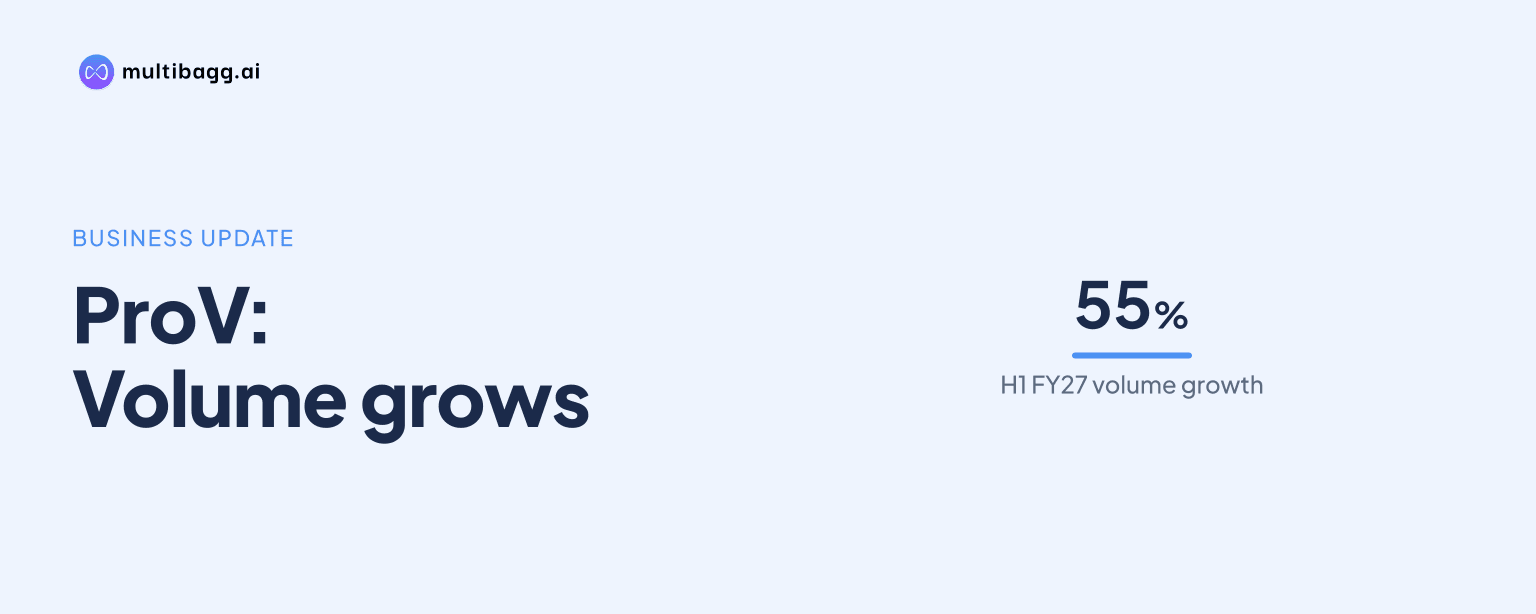
Proventus Agrocom Limited said H1 FY27 expansion was chiefly volume-led: sales volume rose 55% year on year to 6,363 metric tonnes while consolidated revenue increased 63% to Rs 634 crore, and monthly brand revenue exceeded Rs 100 crore for the first time in September 2026.
Know Proventus Agrocom inside out
Results, valuation, peers and who's buying, in one view.
How much of ProV's H1 FY27 growth came from volume?
ProV says physical volume expansion was the primary contributor to H1 FY27 growth, with volume increasing 55% year on year to 6,363 metric tonnes. Consolidated revenue rose 63% to Rs 634 crore, while brand revenue increased 61% to Rs 456 crore. Management said the difference beyond volume growth reflected improved product mix, a greater contribution from newer categories and price increases to a much smaller extent.
The brand business recorded average monthly revenue of Rs 76 crore in H1 FY27, up from Rs 47 crore a year earlier. September 2026 then became the first month in which brand revenue crossed Rs 100 crore. That monthly milestone was above the H1 average, while the reported half-year figures show brand revenue growing slightly more slowly than total consolidated revenue.
ProV also reported 2.07 crore pouches sold in H1 FY27, a 101% year-on-year increase that outpaced both tonnage growth and brand-revenue growth. Management attributed the faster pouch increase partly to makhana, seeds and similar products being sold in smaller packs, meaning each tonne produces more consumer pouches than almonds or cashews.
What changed in ProV's product mix and profitability?
ProV reported brand gross margin of 23.0% in H1 FY27, up 90 basis points year on year and compared with 19.7% in FY25. A basis point is one-hundredth of a percentage point. Earnings before interest, tax, depreciation and amortisation, or EBITDA, rose 80% year on year to Rs 16.6 crore, while profit after tax increased 77% to Rs 11.8 crore.
Management linked the gross-margin movement to a product-mix shift: premium dry fruits and wholesome nutrition products accounted for 57% of revenue in H1 FY27, compared with 48% in FY25. It identified premium dry fruits and value-added nutrition categories as future mix levers, alongside manufacturing, procurement and fixed-cost absorption as volumes rise.
Newer-category volume provides a measure of that shift. Combined sales of makhana, seeds, figs, dates and other value-added products rose from 440 metric tonnes in H1 FY26 to 1,700 metric tonnes in H1 FY27, growth of about 286%. Management said those categories were gaining traction and could support a more diversified and higher-margin revenue mix, rather than stating a specific future margin outcome.
Got a follow-up? Ask IRIS
How is ProV spending to support wider distribution?
ProV spent Rs 49.6 crore on brand building in H1 FY27, a 54% year-on-year increase, while that expenditure represented about 10.9% of brand revenue compared with 11.4% in H1 FY26. Management said spending includes product sampling, in-store demonstrations, introductory promotions, retail visibility and consumer engagement across general trade, modern trade, e-commerce and quick commerce.
For FY27, management expects brand-building expenditure to moderate to about 10% to 10.5% of brand revenue. That expectation is based on improving investment productivity as scale increases, rather than a commitment to reduce absolute brand spending. The company reported more than 600 on-ground sales personnel and distribution activity across general trade, modern trade, e-commerce and quick commerce.
Employee benefit expense rose from Rs 4.12 crore in H1 FY26 to Rs 8.84 crore in H1 FY27, an increase of about 115%. Management said employee strength increased about 50% year on year, with personnel deployed in marketing, general trade, quick commerce, manufacturing and operations across more than 205 cities. It also said part of the expense increase was a reclassification after some contractual on-ground personnel moved to the payroll from April 2026.
What manufacturing plan supports ProV's next growth phase?
ProV's Surat Phase 1 has been completed with Rs 14 crore of capital expenditure, while Phases 2 and 3, including cold storage, are targeted for completion by June 2027. On completion of all phases, the Surat site is planned to have daily pouch capacity above 5 lakh. The company reported H1 sales at about 1.1 lakh pouches a day, so the planned site capacity is intended for anticipated growth beyond current daily volumes.
Management said development is phased to align capacity additions with growth in consumer packs, newer categories and seasonal demand. It cited a FY28 brand-revenue target of Rs 1,100 crore, roughly double the current run-rate according to management. Makhana, seeds, figs, dates and flavoured products increased from 440 metric tonnes to 1,700 metric tonnes in H1, categories that management says require disproportionately more pouch-processing capacity.
The Bihar makhana factory is operational with capacity of 2,500 metric tonnes. Management said Surat is intended to provide integrated processing, packaging and storage, whereas Bihar is positioned near the sourcing ecosystem to support raw-material handling, supplier relationships, quality control and value-added makhana offerings. The stated operating mechanisms are improved procurement, inventory management, logistics and fixed-cost absorption as volume grows.
Conclusion
ProV's H1 FY27 figures indicate that its 63% consolidated-revenue increase to Rs 634 crore was led primarily by a 55% increase in physical volume, rather than pricing. The 101% rise in pouch sales, the shift of premium dry fruits and wholesome nutrition products from 48% to 57% of revenue, and the 23.0% gross margin show how channel expansion and product mix are accompanying the higher sales base.
The next disclosed checkpoints are management's FY27 expectation for brand-building expenditure of about 10% to 10.5% of brand revenue, the FY28 brand-revenue target of Rs 1,100 crore, and completion of Surat Phases 2 and 3 by June 2027. Progress on capacity utilisation, sales-personnel productivity and the procurement and inventory benefits expected from Surat and Bihar will determine whether the planned infrastructure supports management's stated growth path.