










EnFuse BAU reaches positive 4.5% EBITDA margin in H1 FY26-27
Key highlights
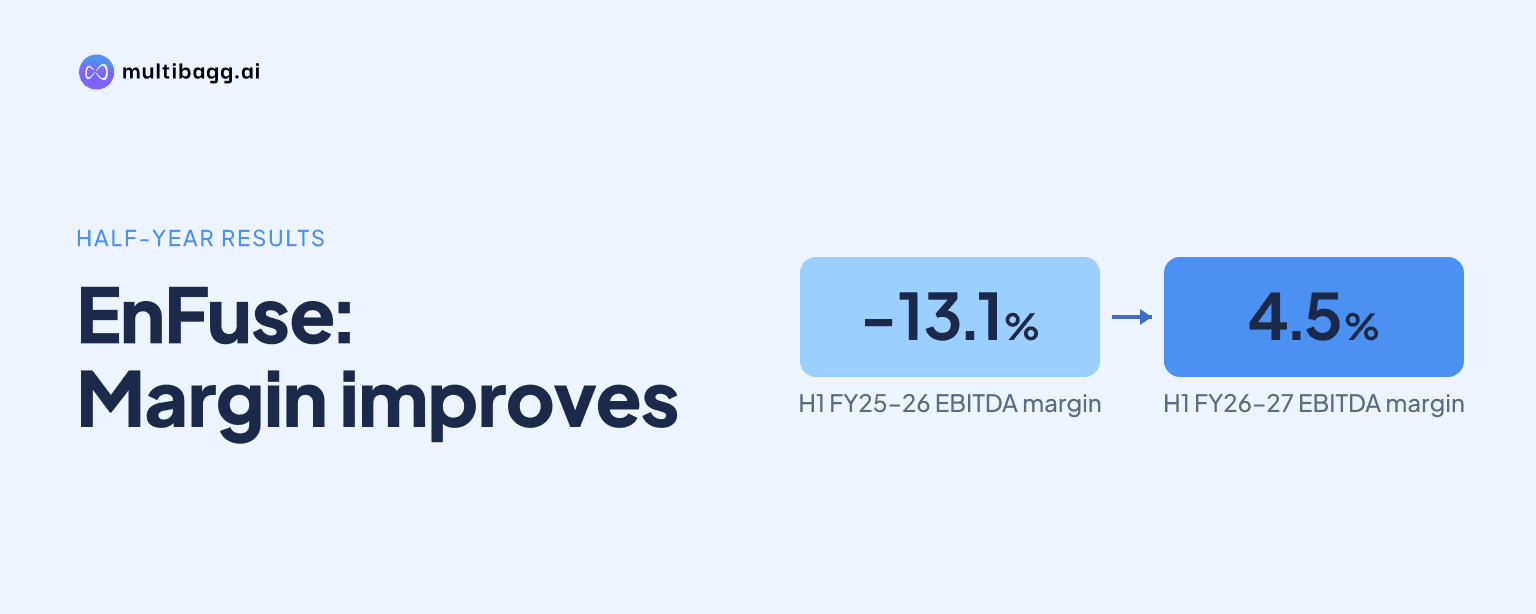
- EnFuse BAU EBITDA margin turned positive at 4.5% in H1 FY26-27 from negative 13.1% in H1 FY25-26.
- EnFuse BAU revenue rose 6.5% year on year to Rs 16.464 crore in H1 FY26-27.
- EnFuse B2G revenue fell to Rs 6.742 crore in H1 FY26-27 from Rs 15.830 crore a year earlier.
- EnFuse consolidated loss after minority interest narrowed to Rs 3.1491 crore from Rs 8.5198 crore year on year.
powered by IRIS
EnFuse Solutions Limited reported a 4.5% earnings before interest, tax, depreciation and amortisation (EBITDA) margin for its business-as-usual, business-to-business (BAU or B2B) operation in H1 FY26-27, with EBITDA of Rs 74.5 lakh on Rs 16.464 crore of revenue. The unaudited management metric followed losses in the prior two half-years as its business-to-government (B2G) programme tapered.
Know Enfuse Solutions inside out
Results, valuation, peers and who's buying, in one view.
How did EnFuse BAU return to positive EBITDA?
EnFuse returned BAU to positive EBITDA by increasing revenue while reducing its cost base. BAU revenue rose 6.5% year on year to Rs 16.464 crore in H1 FY26-27 from Rs 15.453 crore in H1 FY25-26, while management said the BAU cost base declined 9.5%. EBITDA moved to a Rs 74.5 lakh profit from losses of Rs 202.1 lakh in H1 FY25-26 and Rs 301.8 lakh in H2 FY25-26.
The EBITDA margin changed from negative 13.1% in H1 FY25-26 to negative 23.1% in H2 FY25-26 and then positive 4.5% in H1 FY26-27. Management attributed the change to a reset cost base, sharper delivery and tighter financial discipline. It identified expansion with existing clients, new logos and the conversion of proofs of concept into longer-term work across artificial intelligence data services, analytics, digital commerce and EdTech as BAU growth mechanisms.
EnFuse provides six service lines covering 24 capabilities, including enterprise data management, data analytics, machine learning and artificial intelligence, eCommerce, and EdTech. The company said 81% of BAU revenue came from exports to seven markets including the USA, Ireland and the Netherlands, supported by two delivery centres in Thane and Mumbai.
What changed as EnFuse B2G programme neared completion?
EnFuse B2G revenue declined as its digitisation programme moved through data collection and handover towards completion. B2G revenue fell from Rs 15.830 crore in H1 FY25-26 to Rs 11.420 crore in H2 FY25-26, before declining to Rs 6.742 crore in H1 FY26-27. Management expects B2G’s contribution to taper further as the programme closes.
B2G nevertheless generated positive EBITDA of Rs 18.7 lakh in H1 FY26-27, equal to a 2.8% margin. This followed an EBITDA loss of Rs 199.6 lakh and a negative 17.5% margin in H2 FY25-26, while H1 FY25-26 had EBITDA profit of Rs 273.1 lakh and a 17.3% margin. The BAU and B2G figures are unaudited standalone management information system metrics, and EBITDA includes other income and is before provisions.
The revenue mix shifted materially over the three half-years. B2G revenue of Rs 15.830 crore was slightly above BAU revenue of Rs 15.453 crore in H1 FY25-26, whereas BAU revenue of Rs 16.464 crore was more than twice B2G revenue of Rs 6.742 crore in H1 FY26-27. Management said it would pursue future public-sector opportunities selectively where they fit EnFuse’s capabilities.
How far did EnFuse reported losses narrow?
EnFuse’s consolidated loss after minority interest narrowed to Rs 3.1491 crore in H1 FY26-27 from Rs 8.5198 crore in H1 FY25-26. The presentation also records a Rs 6.8915 crore loss in H2 FY25-26, making H1 FY26-27 the third consecutive half-year of lower loss after minority interest. EnFuse remained loss-making on a reported consolidated basis at 30 September 2026.
Standalone loss after tax narrowed to Rs 3.2277 crore in H1 FY26-27 from Rs 8.5198 crore a year earlier, while the standalone loss before tax narrowed to Rs 3.3387 crore from Rs 8.7145 crore. Standalone revenue from operations declined 25.8% year on year to Rs 23.2057 crore, which management linked to the B2G programme nearing completion while BAU revenue grew 6.5%.
The standalone income statement shows lower costs in several categories. Employee benefits expense fell to Rs 14.6659 crore in H1 FY26-27 from Rs 19.6551 crore in H1 FY25-26, deferred cost declined to Rs 2.1433 crore from Rs 7.1963 crore, and other expenses decreased to Rs 5.6086 crore from Rs 8.8831 crore. Finance costs rose to Rs 1.6035 crore from Rs 1.4442 crore, remaining an expense below the management EBITDA measure.
Got a follow-up? Ask IRIS
What operating indicators support EnFuse BAU plan?
EnFuse added three international client logos in H1 FY26-27 across artificial intelligence and machine learning, competitive intelligence and analytics. Management said a fourth new client in artificial intelligence data services was expected to join in H2. The company also completed seven proofs of concept, including an eCommerce proof of concept approved by clients during the half-year.
EnFuse reported nine accounts committed for FY26-27, comprising eight client accounts and the B2G programme across EdTech, artificial intelligence and machine learning, eCommerce, analytics and software services. The company said committed accounts represented more than 93% of H1 B2B revenue. The presentation does not disclose the revenue value or duration of individual customer commitments.
The operating pipeline included demonstrations of a digital proctoring platform and artificial intelligence-assisted data annotation with human quality review. EnFuse also held internal demonstrations of a digital identity verification solution to prepare its business-development team for market discussions. Its EdTech services include live proctoring, artificial intelligence proctoring, human review and examination technology support.
What balance-sheet matters should EnFuse monitor?
EnFuse reported standalone short-term borrowings of Rs 21.8108 crore at 30 September 2026, compared with Rs 22.319 crore at 31 March 2026. Trade receivables rose to Rs 11.54 crore from Rs 6.0048 crore, while cash and bank balances declined to Rs 5.1687 crore from Rs 5.2917 crore. Management expects short-term borrowings to reduce over the next 12 months as B2G receivables are collected and related bank guarantees are released.
Standalone shareholders’ funds declined to Rs 16.3883 crore at 30 September 2026 from Rs 19.6161 crore at 31 March 2026. Total current liabilities increased to Rs 28.9442 crore from Rs 28.5015 crore, while total assets declined to Rs 50.6706 crore from Rs 54.7714 crore. These movements make B2G collections and guarantee releases part of management’s disclosed working-capital plan alongside BAU growth.
Conclusion
EnFuse’s H1 FY26-27 presentation shows that BAU became the larger operating business as B2G revenue contracted. BAU produced Rs 74.5 lakh of EBITDA at a 4.5% margin on Rs 16.464 crore of revenue, while B2G produced Rs 18.7 lakh of EBITDA on Rs 6.742 crore of revenue. The segment improvement coincided with a narrower consolidated loss after minority interest of Rs 3.1491 crore, but not reported net profitability.
Management expects EnFuse to close FY26-27 in the black and said the full benefit of cost measures is expected in H2. The next disclosures to watch are whether the expected fourth artificial intelligence data-services client, the seven completed proofs of concept, and collection of B2G receivables with related bank-guarantee releases support that target as B2G contribution tapers.