










DUCOL has 65-90% spare capacity across key product lines
Key highlights
- DUCOL's masterbatch utilisation is about 10-15%, implying roughly 85-90% spare capacity.
- Bitumag has capacity of 10 million square metres per annum and operates at about 25-35% utilisation.
- Xchem has capacity of about 20,000 MTPA and operates at about 30-35% utilisation.
- DUCOL reported consolidated H1 FY27 revenue of Rs 112.26 crore and profit after tax of Rs 6.47 crore.
powered by IRIS
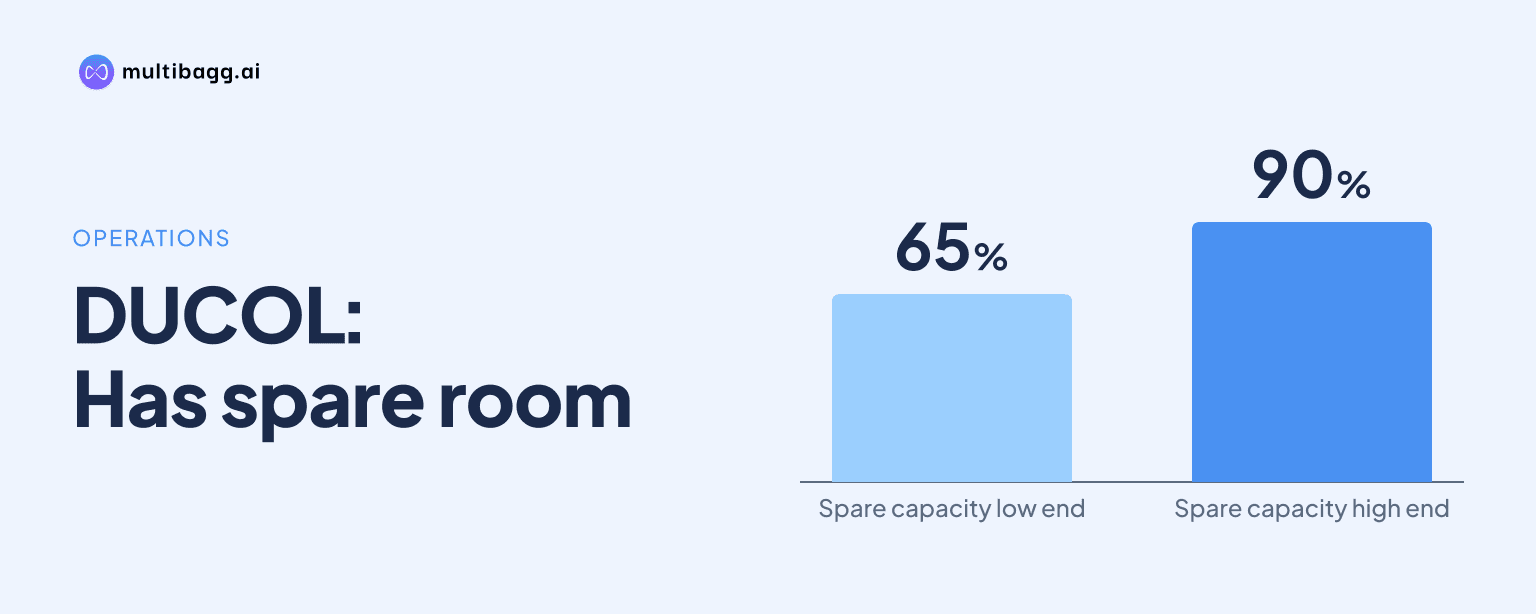
DUCOL ORGANICS & COLOURS LTD. (DUCOL) has disclosed large unused capacity across masterbatches, waterproofing and construction chemicals, with masterbatch utilisation at about 10-15%, Bitumag at about 25-35% and Xchem at about 30-35%. These levels imply 65-90% capacity headroom in those operations, subject to DUCOL converting demand into production.
Know Ducol Organics & Colours inside out
Results, valuation, peers and who's buying, in one view.
How much spare pigment-dispersion capacity does DUCOL have?
DUCOL has its widest disclosed pigment-dispersion headroom in masterbatches, where utilisation is about 10-15% and implied unused capacity is about 85-90%. Wet dispersion utilisation is about 55%, implying about 45% available capacity, while dry dispersion utilisation of about 70-75% leaves a smaller implied 25-30% gap. The presentation does not disclose installed capacity volumes for any of these three pigment-dispersion lines.
DUCOL operates four pigment-dispersion manufacturing facilities, including two units at Taloja and two at Mahad, with plant area exceeding 1,50,000 square feet. The facilities are ISO 9001:2015 certified, and the company describes ongoing modernisation using high-end machinery for wet dispersions, dry dispersions and masterbatches. Without tonnage capacity, production volume or line-wise sales data, the presentation does not quantify potential revenue from this spare capacity.
The difference between the 10-15% masterbatch utilisation level and the 70-75% dry-dispersion level shows that capacity availability is not even across DUCOL's pigment portfolio. Masterbatches have more implied room for output growth before additional manufacturing capacity may be needed, while dry dispersions have the least disclosed flexibility. Actual utilisation will depend on demand, product specifications and operating requirements, none of which are quantified in the presentation.
What capacity is available at Bitumag and Xchem?
Bitumag Industries has capacity of 10 million square metres per annum and disclosed utilisation of about 25-35%, implying about 65-75% unused capacity. DUCOL presents Bitumag as a waterproofing business supplying membranes and elastomeric compounds, with products that have field performance of more than 14 years. The presentation does not disclose actual square metres produced, capacity by product type or revenue per square metre.
Xchem Polymers has capacity of about 20,000 metric tonnes per annum, abbreviated as MTPA, and utilisation of about 30-35%. This implies available capacity of about 65-70%, slightly below Bitumag's highest implied headroom but well above the 25-30% available on dry dispersions. DUCOL describes Xchem as providing adhesives, sealants and construction additives for original equipment manufacturers, key projects and customised applications.
The financial data supplied for these businesses show different changes across FY25 and FY26. Bitumag revenue increased to Rs 52.10 crore in FY26 from Rs 41.20 crore in FY25, while profit after tax fell to Rs 3.20 crore from Rs 3.60 crore. Xchem revenue increased to Rs 72.20 crore from Rs 60.30 crore, and profit after tax rose to Rs 6.90 crore from Rs 3.40 crore. These figures provide business context but do not establish a direct relationship between revenue growth and utilisation.
Got a follow-up? Ask IRIS
Can DUCOL's cross-selling plan fill unused capacity?
DUCOL's stated mechanism for expanding sales is to cross-sell waterproofing and construction chemicals to an existing client base of more than 200 customers that buys pigment dispersions. The presentation names Asian Paints, Berger, ITC, Unilever, JSW Paints and Birla Opus among these customers. DUCOL says it can offer Bitumag membranes and elastomeric compounds alongside Xchem adhesives, sealants and construction additives.
DUCOL says multiple product lines can raise wallet share and that existing client trust eliminates costly new-customer acquisition. Management also states that cross-selling converts at significantly higher rates, but the presentation provides no conversion rate, order pipeline, customer-level sales figure or target date for lifting the 25-35% Bitumag or 30-35% Xchem utilisation levels. The proposed connection between cross-selling and capacity absorption is therefore qualitative rather than a quantified forecast.
The presentation also lists customers across Southeast Asia, the subcontinent, the Middle East and Africa, including Toyo Ink, Nippon Paint, Hempel, Bostik, Brenntag and Chryso. However, it does not identify which named customers purchase pigment dispersions, waterproofing or construction chemicals, nor does it disclose adoption of Bitumag or Xchem products by individual accounts. A customer list alone does not show the timing or volume of potential capacity use.
DUCOL's non-pigment facilities are positioned as a single-window offering for construction chemicals and waterproofing products, while Xchem emphasises customised solutions for construction-chemical and waterproofing applications. This product approach could support cross-selling where requirements overlap, but the source gives no segment-wise order book, sales volume or pricing data. Those omissions leave the pace of conversion of the implied 65-75% Bitumag and 65-70% Xchem spare capacity unresolved.
How does unused capacity relate to DUCOL's financial performance?
DUCOL reported consolidated revenue from operations of Rs 112.26 crore and profit after tax of Rs 6.47 crore in H1 FY27. Consolidated revenue was Rs 136.07 crore in FY26 and Rs 77.35 crore in FY25, while profit after tax was Rs 7.25 crore and Rs 4.62 crore, respectively. Since H1 FY27 covers only six months, it cannot on its own establish a full-year revenue or profit outcome.
On a standalone basis, H1 FY27 revenue rose 18.29% to Rs 48.71 crore from Rs 41.18 crore in standalone H1 FY26. Standalone earnings before interest, tax, depreciation and amortisation, or EBITDA, increased to Rs 6.70 crore from Rs 3.77 crore, and EBITDA margin rose by 460 basis points to 13.76% from 9.16%. These standalone results should be distinguished from capacity disclosures that include Bitumag and Xchem operations.
DUCOL says it incurred additional finance costs of Rs 1.79 crore in H1 FY27 from acquisition-related borrowings. Standalone finance costs included Rs 1.15 crore for the Bitumag acquisition and Rs 0.64 crore for the Xchem acquisition. Management says margins are expected to improve as debt is repaid, separating a stated financing consideration from the operational task of increasing utilisation.
Conclusion
DUCOL's disclosed manufacturing network has the greatest implied headroom in masterbatches at about 85-90%, followed by Bitumag at about 65-75% and Xchem at about 65-70%. Dry dispersions, at about 70-75% utilisation, have less available capacity than the other disclosed lines. The FY25, FY26 and H1 FY27 financial figures show revenue growth in several operations, but the presentation does not map those results to line-by-line utilisation changes.
The next point to watch is execution of DUCOL's plan to cross-sell Bitumag and Xchem products to more than 200 existing customers, alongside the ongoing modernisation of pigment-dispersion facilities. Management also expects margins to improve as acquisition-related debt is repaid after the Rs 1.79 crore additional finance cost in H1 FY27. The presentation provides no repayment schedule, utilisation target or date for absorbing spare capacity.