










Pushpa Jewellers reports 80% FY26 gold volume from repeats
Key highlights
- Existing customers contributed 284 kg of Pushpa Jewellers’ 343 kg FY26 gold volume, or about 80%.
- Pushpa Jewellers added 2,222 new designs in FY26, compared with 1,070 in FY25.
- Designs introduced in FY26 generated 125 kg, or 36%, of annual gold volume versus 17% in FY25.
- Pushpa Jewellers recorded 1,638 existing designs reordered in FY26, up from 1,519 in FY25.
powered by IRIS
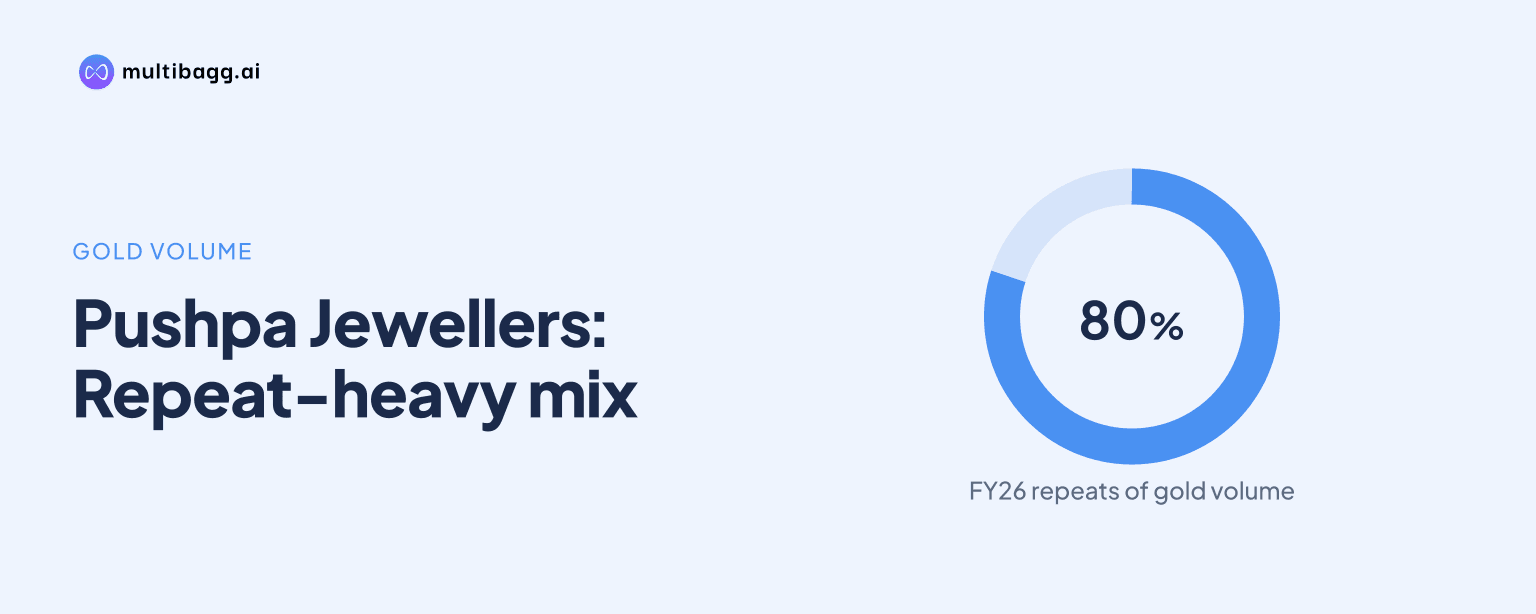
Pushpa Jewellers Limited reported that existing customers accounted for 284 kg of its 343 kg FY26 gold volume, or about 80%, while 2,222 new designs generated 125 kg, or 36%. The company links reorders to design codes, exhibitions and customised production for more than 550 jeweller clients.
Know Pushpa Jewellers inside out
Results, valuation, peers and who's buying, in one view.
How much FY26 gold volume came from existing Pushpa Jewellers customers?
Pushpa Jewellers reported that existing customers contributed 284 kg of 343 kg of FY26 gold volume, which the presentation describes as about 80%. The measure is based on kilograms rather than revenue, and it identifies sales to existing customers rather than a formal customer-retention rate or the number of repeat invoices.
Pushpa Jewellers served more than 550 jewellers in over 20 states and Union Territories in FY26. Its revenue remained concentrated in southern markets, with Telangana contributing 33.4%, Karnataka 33.2%, Andhra Pradesh 13.3%, Tamil Nadu 8.9% and Kerala 2.8%; the presentation states that five southern states represented 92% of FY26 revenue, up from 89% in FY25.
The top-10 client share fell to 24.1% of FY26 revenue from 30.0% in FY25 and 37.6% in FY24. That reduction occurred alongside the reported 284 kg from existing customers, showing that repeat-customer volume was not limited, on the disclosed figures, to a rising share from the company’s 10 largest accounts.
Did Pushpa Jewellers’ new designs generate more FY26 volume?
Yes. Pushpa Jewellers added 2,222 designs in FY26, compared with 1,070 in FY25, and designs introduced during FY26 generated 125 kg, or 36%, of the year’s gold volume. The corresponding FY25 figures were 62 kg and 17%, so current-year designs contributed 19 percentage points more of volume despite a lower total volume base.
Management said 1,956 of the 2,222 designs added in FY26 found buyers, compared with 963 of 1,070 additions in FY25. That places buyer adoption in management’s stated 88% to 90% range in both years, while the count of new designs with buyers increased by 993.
The table measures design vintage, which differs from the 284 kg attributed to existing customers. In FY26, 61 kg came from designs more than two years old, indicating continued ordering of older catalogue items even as designs added during the year increased to 125 kg from 62 kg.
How do design codes support Pushpa Jewellers reorders?
Pushpa Jewellers recorded reorders for 1,638 existing designs in FY26, up 7.8% from 1,519 in FY25 and from 1,445 in FY24. This is a count of existing designs ordered again, rather than a disclosed count of customers that reordered or the frequency and value of their orders.
The company assigns a unique code to every item and says jewellers can reorder by design number. Its process uses computer-aided design and computer-aided manufacturing, or CAD/CAM, prototypes before sampling, while customer relationship management, or CRM, systems capture orders and client requirements; each sale and design code is recorded after delivery.
Pushpa Jewellers also says it uses sales-data analysis, trend research and client sketching to refresh its catalogue and co-create designs with jewellers. The catalogue contains more than 3,500 designs, and necklaces accounted for 74.0% of FY26 revenue, up from 71.1% in FY25, while earrings declined to 12.9% from 17.0%.
Got a follow-up? Ask IRIS
What role do exhibitions and fulfilment play in Pushpa Jewellers’ repeat model?
Exhibitions booked 24.3% of Pushpa Jewellers’ FY26 orders, down from 27.6% in FY25, while other channels including repeat business accounted for 75.7%, up from 72.4%. The other-channel figure cannot be treated solely as repeat orders because the presentation says it includes, rather than consists entirely of, repeat business.
Pushpa Jewellers describes exhibitions as a means of showcasing its range, booking orders and opening accounts. It then captures the client brief, coordinates production with independent karigars, delivers and invoices the order, and records sales data and design codes for future catalogue decisions.
Production is outsourced to independent, predominantly Kolkata-based karigars on a per-job basis, with Pushpa Jewellers providing designs and specifications and approving samples before bulk production. The assurance and shipping stage includes two to three quality checks, Bureau of Indian Standards, or BIS, hallmarking and dispatch; the company states that 100% of dispatches are BIS-hallmarked.
Management also disclosed a four-to-six-month implementation period for Microsoft Dynamics 365 enterprise resource planning, or ERP, workflows. The presentation says the system is intended to integrate processes and strengthen financial controls as volumes grow, but it does not provide an implementation start date or a quantified benefit.
Conclusion
Pushpa Jewellers’ FY26 disclosures show a business model combining existing-customer volume with catalogue renewal: existing customers supplied 284 kg of 343 kg sold, while 2,222 new designs generated 125 kg. Reorders of 1,638 existing designs, buyer adoption for 1,956 new designs and 61 kg from designs older than two years provide further evidence of ongoing demand for coded catalogue items.
The next disclosed development to watch is the Microsoft Dynamics 365 ERP rollout, which management says has a four-to-six-month implementation period. Future disclosures could show whether existing-customer volume remains near 80%, whether new-design buyer adoption stays within the stated 88% to 90% range, and whether exhibition bookings continue below the FY25 share of 27.6%.