










Q-Line’s Unit 4 adds 93.6 million annual strip capacity
Key highlights
- Q-Line’s Lucknow Unit 4 commenced in February 2026.
- Unit 4 has annual capacity for 75.5 million rapid-ELISA kits and 93.6 million glucometer strips.
- Unit 4 also has annual capacity for 1.5 million clinical chemistry reagents and 31,200 glucometer devices.
- Management plans to ramp Unit 4 toward full-scale operations in H2 FY27 using 36 product licences.
powered by IRIS
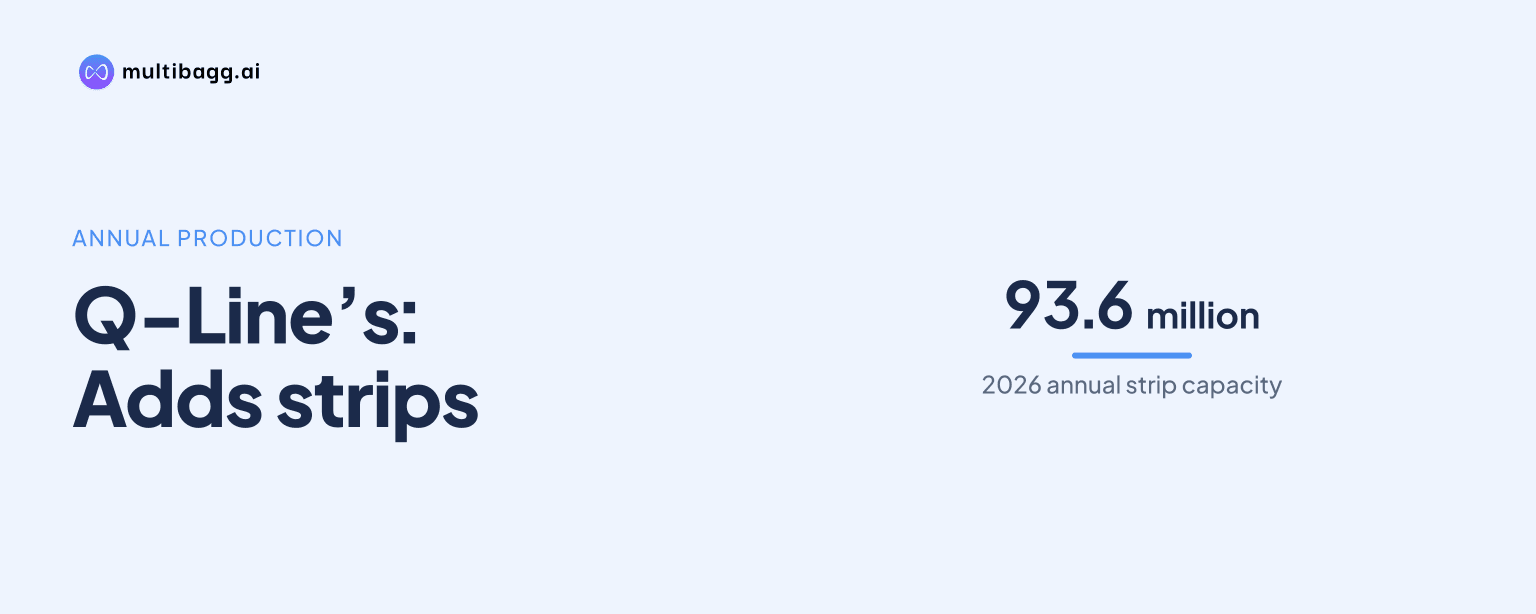
Q-Line Biotech’s fourth factory in Lucknow, commissioned in February 2026, has annual installed capacity for 93.6 million glucometer strips and 75.5 million rapid-ELISA kits. The unit adds clinical, rapid and point-of-care manufacturing to Q-Line’s four-site network, which management plans to ramp toward full-scale operations in H2 FY27.
Know Q-Line Biotech inside out
Results, valuation, peers and who's buying, in one view.
What capacity does Q-Line’s Unit 4 add?
Q-Line’s Unit 4 has annual installed capacity of 75.5 million rapid-ELISA kits, 93.6 million glucometer strips, 1.5 million clinical chemistry reagents and 31,200 glucometer devices. The Lucknow facility manufactures clinical, rapid and point-of-care, or POC, reagents as well as POC devices, giving it a broader stated product range than the three older facilities.
The largest stated capacity at Unit 4 is 93.6 million annual glucometer strips, followed by 75.5 million rapid-ELISA kits. The strip and device lines introduce glucose-testing products, while the rapid-ELISA and clinical chemistry reagent lines extend Q-Line’s diagnostic reagent manufacturing categories.
Unit 4 commenced in February 2026, while Units 2 and 3 both commenced in December 2023 and Unit 1 commenced in May 2016. All four sites are located in Delhi or Lucknow, with the February 2026 commissioning making Unit 4 the latest addition to Q-Line’s manufacturing base.
How does Unit 4 compare with Q-Line’s existing plants?
Q-Line’s Unit 4 is the only facility listed with four separate capacity lines: rapid-ELISA kits, glucometer strips, clinical chemistry reagents and glucometer devices. By comparison, Delhi-based Unit 1 has capacity for 1.27 million kits and manufactures clinical chemistry, molecular reagents and rapid-ELISA kits.
The two other Lucknow facilities have narrower stated roles. Unit 2 manufactures hematology reagents with capacity for 96,000 kits, while Unit 3 manufactures clinical chemistry instruments with capacity for 1,200 analyzers. Unit 4 therefore adds high-volume reagent and strip capacity alongside a finished-device line of 31,200 glucometer devices annually.
The facility mix has changed since the December 2023 additions. Units 2 and 3 created separate operations for hematology reagents and clinical chemistry instruments, whereas the February 2026 unit combines clinical, rapid and POC categories at one location. The presentation does not disclose capacity utilisation, production volumes or revenue by facility.
Which products can Q-Line make at Unit 4?
Q-Line identifies clinical reagents, rapid reagents, POC reagents and POC devices as Unit 4’s manufactured products. Its annual capacity for 1.5 million clinical chemistry reagents connects the new facility to Q-Line’s clinical chemistry platform, which includes the Selectra Pro M analyzer that has been scaled up for commercial production.
The 75.5 million rapid-ELISA-kit line expands a category already manufactured at Unit 1, alongside molecular reagents. The presentation does not state whether Unit 4 will make the same rapid-ELISA products as Unit 1, but it separately identifies the new site’s annual kit capacity.
For POC products, Unit 4 has annual capacity for 93.6 million glucometer strips and 31,200 glucometer devices. Elsewhere, Q-Line lists an HB Meter, or haemoglobin meter, as under development in its POC-device pipeline, but the presentation does not identify Unit 4 as its manufacturing location.
Got a follow-up? Ask IRIS
How does Unit 4 fit Q-Line’s manufacturing platform?
Q-Line describes its platform as spanning reagent development, instrument manufacturing and consumables, supported by 19 scientists and engineers in research and development. It says research and development spending is maintained at about 1% of revenue for reverse engineering, new formulation development and instrument innovation.
Q-Line reported diagnostic-instrument revenue of Rs 83 crore in FY26, down from Rs 115 crore in FY25. Manufactured instruments declined to Rs 45 crore from Rs 60 crore, while traded instruments fell to Rs 38 crore from Rs 55 crore, showing lower revenue in both parts of the instrument business.
Consumables revenue increased to Rs 17 crore in FY26 from Rs 14 crore in FY25, while services revenue fell to Rs 3 crore from Rs 8 crore. The presentation does not allocate these segment revenues to individual facilities, so it does not quantify Unit 4’s revenue contribution from reagents, strips or devices.
What is Q-Line planning after Unit 4 starts operations?
Management plans to ramp Unit 4 toward full-scale operations in H2 FY27, using 36 product licences to strengthen in-house manufacturing of diagnostic reagents and kits. Management presents the plan as supporting Q-Line’s core business and its contract manufacturing organization and contract development and manufacturing organization, or CMO/CDMO, activities.
Q-Line says it is positioning itself as a full-service CMO/CDMO for in-vitro diagnostics, or IVD, and reports serving three CDMO clients. The presentation does not identify these clients, disclose contract terms or state how much of Unit 4’s installed capacity is assigned to CDMO production.
Q-Line’s distribution presence covers 26 states and two Union Territories, although North India generated 84% of FY26 zonal revenue. East accounted for 8%, South for 4%, West for 3%, Central Zone for 2% and exports for 0.3%; management says it plans to expand domestic distribution, build export markets and strengthen corporate-laboratory and institutional relationships.
Conclusion
Unit 4 broadens Q-Line’s stated manufacturing range with annual capacity for 75.5 million rapid-ELISA kits, 93.6 million glucometer strips, 1.5 million clinical chemistry reagents and 31,200 glucometer devices. The facility supplements the Delhi kit operation, the Lucknow hematology-reagent plant and the Lucknow clinical-chemistry-instrument plant with clinical, rapid and POC production at one site.
The next disclosed milestone is management’s planned ramp of Unit 4 toward full-scale operations in H2 FY27 using 36 product licences. Management also plans to consolidate group operations through the proposed acquisition of a 70% stake in Heidelco Medicore, while pursuing domestic distribution, export and CDMO opportunities.