










Q-Line manufactured reagents reach Rs 185 crore in FY26
Key highlights
- Q-Line reported manufactured reagent revenue of Rs 185 crore in FY26, up from Rs 64 crore in FY24.
- Q-Line’s traded reagent revenue declined from Rs 72 crore in FY24 to Rs 54 crore in FY26.
- Q-Line’s total reagent revenue increased from Rs 136 crore in FY24 to Rs 238 crore in FY26.
- Reagents represented 69.8% of Q-Line’s FY26 revenue contribution.
powered by IRIS
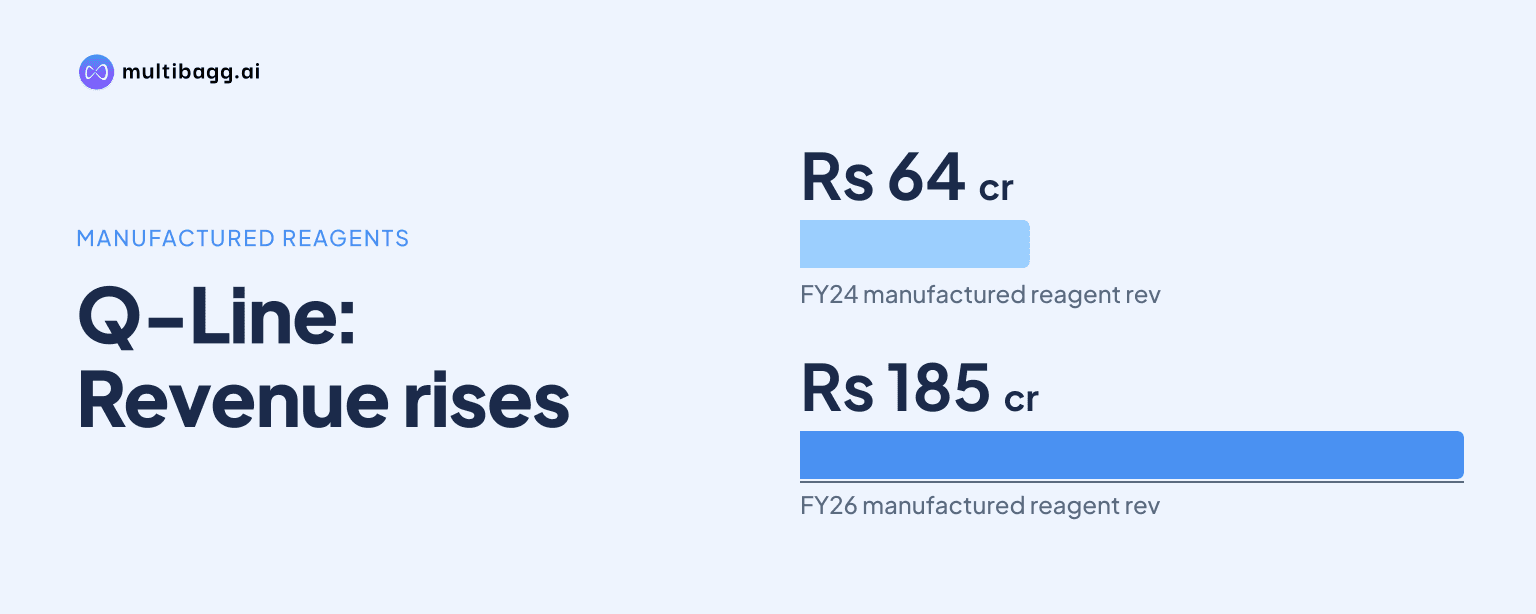
Q-line Biotech reported Rs 185 crore of manufactured reagent revenue in FY26, up from Rs 64 crore in FY24. Over the same period, traded reagent revenue declined from Rs 72 crore to Rs 54 crore. The shift occurred in Q-Line’s reagents line, its largest FY26 business segment at 69.8% of revenue contribution.
Know Q-Line Biotech inside out
Results, valuation, peers and who's buying, in one view.
How did Q-Line’s reagent revenue mix change?
Q-Line’s reported manufactured reagent revenue increased by Rs 121 crore between FY24 and FY26, while traded reagent revenue decreased by Rs 18 crore. Total reagent revenue rose from Rs 136 crore in FY24 to Rs 238 crore in FY26, an increase of Rs 102 crore.
Manufactured reagent revenue rose by Rs 45 crore in FY25 and by a further Rs 76 crore in FY26. Traded reagent revenue moved lower in both years, falling from Rs 72 crore in FY24 to Rs 67 crore in FY25 and Rs 54 crore in FY26. The displayed manufactured and traded figures may not sum precisely to reported totals because the presentation shows rounded crore values.
The presentation reports Rs 74 crore of manufactured reagent revenue and Rs 35 crore of traded reagent revenue in H1FY27, producing total reagent revenue of Rs 109 crore for the half year. Its FY23 data show Rs 131 crore of total reagent revenue and Rs 81 crore of traded revenue, but do not provide a manufactured-reagent figure for FY23.
What does the shift mean for Q-Line’s largest business line?
Q-Line generated more reagent revenue from manufactured products than traded products from FY25, when the reported figures were Rs 109 crore and Rs 67 crore, respectively. The difference widened to Rs 131 crore in FY26, based on Rs 185 crore of manufactured revenue and Rs 54 crore of traded revenue.
Reagents were Q-Line’s core revenue driver, contributing 69.8% of FY26 business-line revenue. The presentation describes the line as serving recurring consumable demand from laboratories, hospitals and diagnostic centres across 26 states and Union Territories, but does not disclose reagent volumes, pricing, gross margin or recurring revenue by manufactured and traded category.
Q-Line defines reagents as consumables used in in vitro diagnostics, or IVD, of human samples. The segment includes reagent kits, rapid cards, consumables and point-of-care, or POC, strips, across clinical chemistry, haematology, immunodiagnostics, molecular diagnostics and other testing areas.
The company lists four manufacturing units, 19 research and development scientists and engineers, and technology-transfer agreements with global diagnostic companies. These disclosed capabilities provide context for the FY26 manufactured-reagent figure, although the presentation does not identify the facilities, test categories or agreements responsible for the Rs 185 crore revenue.
Got a follow-up? Ask IRIS
How does Q-Line’s reagent business compare with other lines?
Q-Line’s Rs 238 crore reagent business in FY26 exceeded diagnostic instruments at Rs 83 crore, consumables at Rs 17 crore and services at Rs 3 crore. This comparison shows why the reagent mix movement is significant to Q-Line’s reported revenue composition.
Diagnostic instruments recorded a different FY26 pattern. Manufactured instrument revenue declined from Rs 60 crore in FY25 to Rs 45 crore in FY26, while traded instrument revenue declined from Rs 55 crore to Rs 38 crore, reducing total instrument revenue from Rs 115 crore to Rs 83 crore.
Q-Line says its Selectra Pro M clinical chemistry analyser has been scaled up for commercial production through a technical collaboration with a European company. It also identifies Mircolab 300, Q-Count 3, Q-Count 5, the InnoLyte electrolyte analyser and an automated slide stainer as commercialised products.
What do H1FY27 results show alongside the reagent mix change?
Q-Line reported consolidated net revenue from operations of Rs 152 crore in H1FY27, compared with Rs 144 crore in H1FY26. Gross profit increased from Rs 83 crore to Rs 95 crore, and gross profit margin rose from 57.7% to 62.6%; the presentation does not assign that movement to manufactured reagents or another product line.
Earnings before interest, tax, depreciation and amortisation, or EBITDA, increased from Rs 36 crore in H1FY26 to Rs 40 crore in H1FY27, with margin rising from 25.0% to 26.0%. Profit after tax declined from Rs 21 crore to Rs 20 crore as depreciation increased from Rs 4 crore to Rs 8 crore and finance cost rose from Rs 8 crore to Rs 10 crore.
At September 2026, Q-Line reported Rs 186 crore of cash and bank balance, compared with Rs 76 crore at March 2026. Net cash from operations was negative Rs 9 crore, investing cash flow was negative Rs 110 crore and financing cash flow was positive Rs 112 crore; no segment-level cash flow is disclosed for reagents.
Conclusion
Q-Line’s reported figures show a material change within its largest business line. Manufactured reagent revenue rose from Rs 64 crore in FY24 to Rs 185 crore in FY26 as traded reagent revenue declined from Rs 72 crore to Rs 54 crore, while total reagent revenue reached Rs 238 crore and represented 69.8% of FY26 revenue contribution.
The next disclosed measure to watch is whether H1FY27 manufactured reagent revenue of Rs 74 crore and traded revenue of Rs 35 crore continue the FY26 mix pattern through the full year. Q-Line also lists Selectra Pro XL, Medonic M20, KC1Del and an HB Meter as under development, but gives no commercialisation dates or revenue targets for those products.