










Pushpa Jewellers FY26 profit rose but operating cash outflow widened
Key highlights
- Pushpa Jewellers reported a negative Rs 51.29 crore cash flow from operating activities in FY26, versus negative Rs 4.10 crore in FY25.
- Pushpa Jewellers' inventory increased to Rs 91.06 crore at 31 March 2026 from Rs 35.49 crore a year earlier.
- Pushpa Jewellers' trade receivables rose to Rs 35.51 crore and receivable turnover declined to 15.17 times in FY26.
- Pushpa Jewellers reported FY26 PAT of Rs 25.89 crore on total income of Rs 419.55 crore.
powered by IRIS
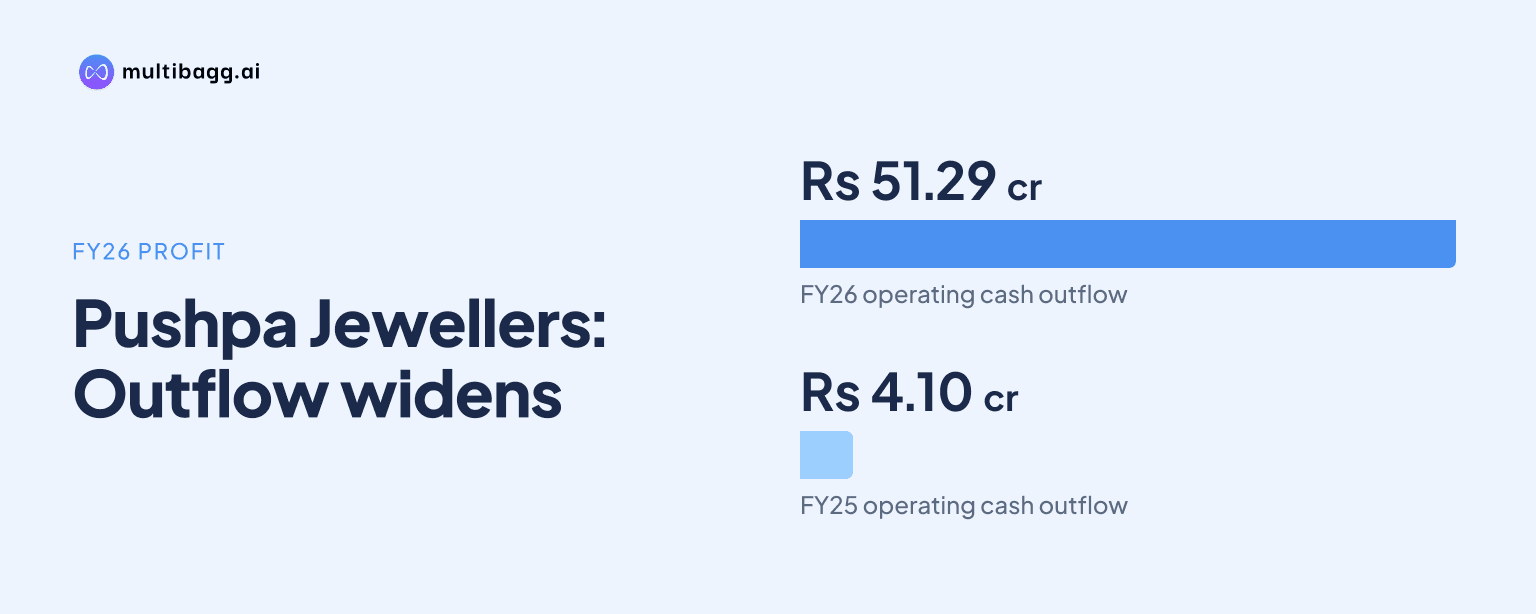
Pushpa Jewellers Limited reported a Rs 51.29 crore cash outflow from operating activities in FY26 despite profit after tax of Rs 25.89 crore, while inventory reached Rs 91.06 crore and trade receivables reached Rs 35.51 crore at 31 March 2026. The reported figures show that FY26 profit growth did not translate into positive operating cash flow.
Know Pushpa Jewellers inside out
Results, valuation, peers and who's buying, in one view.
Why did Pushpa Jewellers report an FY26 operating cash outflow?
Pushpa Jewellers reported cash flow from operating activities of negative Rs 51.29 crore in FY26, compared with negative Rs 4.10 crore in FY25 and positive Rs 8.79 crore in FY24. The investor presentation does not provide a line-by-line operating-cash-flow reconciliation, so it does not explicitly assign the FY26 outflow to individual working-capital components. It does, however, report sharply higher inventory and receivable balances alongside the outflow.
The cash-flow result contrasted with the income statement. Revenue increased to Rs 418.39 crore in FY26 from Rs 281.06 crore in FY25, while total income rose to Rs 419.55 crore from Rs 281.27 crore. Yet operating cash flow moved Rs 47.19 crore further into deficit year on year, even as profit after tax increased by Rs 3.60 crore to Rs 25.89 crore.
How much did Pushpa Jewellers' inventory and receivables increase in FY26?
Pushpa Jewellers' inventory rose to Rs 91.06 crore at 31 March 2026 from Rs 35.49 crore a year earlier, while trade receivables increased to Rs 35.51 crore from Rs 19.66 crore. These two balance-sheet lines together stood at Rs 126.57 crore at FY26 end, compared with Rs 55.15 crore at FY25 end. Inventory was the larger item, accounting for Rs 91.06 crore of the reported balance.
The presentation also records a lower receivable-turnover ratio. This ratio, expressed in times, declined to 15.17 in FY26 from 22.72 in FY25 and 47.27 in FY24. A lower turnover figure means the reported revenue base turned through receivables fewer times during the year; the presentation supplies the ratio but does not disclose customer-level collection periods or an ageing schedule.
The inventory build occurred as revenue per kilogram sold increased. Gold jewellery sold declined to 343 kilograms in FY26 from 356 kilograms in FY25 and 423 kilograms in FY24, whereas revenue per kilogram rose to Rs 122.0 lakh from Rs 78.9 lakh in FY25. The presentation attributes the Rs 43 lakh increase in FY26 revenue per kilogram versus FY25 to higher gold prices, while reporting a 19% volume decline against FY24.
Got a follow-up? Ask IRIS
Did Pushpa Jewellers' FY26 profit growth convert into operating cash?
No, Pushpa Jewellers' FY26 profit growth did not coincide with positive operating cash flow. Profit after tax, or PAT, rose to Rs 25.89 crore from Rs 22.29 crore in FY25, while earnings before interest, tax, depreciation and amortisation, or EBITDA, increased to Rs 39.39 crore from Rs 32.05 crore. In contrast, cash flow from operating activities was negative Rs 51.29 crore, rather than negative Rs 4.10 crore a year earlier.
Margins moved differently from absolute profit. EBITDA margin declined to 9.39% in FY26 from 11.39% in FY25, though it remained above FY24's 7.87%; PAT margin fell to 6.17% from 7.92%, but was above 5.19% in FY24. Raw-material expense was Rs 366.94 crore in FY26, up from Rs 241.01 crore, while total expenditure rose to Rs 380.16 crore from Rs 249.22 crore.
Cash at year-end nevertheless increased because financing cash flow exceeded the operating and investing outflows. Cash and cash equivalents increased by Rs 3.03 crore during FY26 to Rs 6.89 crore at 31 March 2026, following Rs 64.62 crore of financing inflow and Rs 10.30 crore of investing outflow. The presentation reports the aggregate financing amount but does not break it down in the supplied material.
What do Pushpa Jewellers' FY26 ratios show about working capital and funding?
Pushpa Jewellers' reported current ratio increased to 22.69 times in FY26 from 4.11 times in FY25, alongside current assets of Rs 147.70 crore and current liabilities comprising Rs 2.54 crore of short-term borrowings and Rs 3.97 crore of other liabilities and provisions. The ratio is a balance-sheet measure at year-end, whereas the negative Rs 51.29 crore operating-cash-flow figure measures cash movement over FY26. The two measures therefore describe different parts of the financial statements.
Funding and return ratios also changed in FY26. Debt to equity declined to 0.10 times from 0.19 times in FY25, while net worth rose to Rs 154.44 crore from Rs 58.14 crore. Return on equity fell to 24.35% from 47.31%, and return on capital employed fell to 21.72% from 45.14%; book value per share increased to Rs 63.76 from Rs 30.84.
Management's FY30 plan directly identifies faster receivables collection and better inventory turnover as ways to strengthen the cash conversion cycle. The plan also calls for data analysis and trend research to align buying, design and production with demand, plus enterprise resource planning, or ERP, implementation for visibility, controls and accountability. These are forward-looking management plans rather than reported FY26 outcomes.
Conclusion
Pushpa Jewellers' FY26 accounts show a contrast between reported earnings and operating cash generation. Total income rose to Rs 419.55 crore and PAT reached Rs 25.89 crore, but operating cash flow was negative Rs 51.29 crore as inventory, receivables and other current assets increased to a combined Rs 140.80 crore at 31 March 2026. The decline in receivable turnover to 15.17 times provides another reported indicator of the larger working-capital commitment.
The next disclosed point to watch is execution of management's FY30 cash-conversion plan, particularly faster collections, inventory turnover and data-led inventory planning. In H1 FY27, management said it had strategically built inventory for the festive and wedding season, while its B2B Trade Fulfilment Centre in Mumbai opened on 4 August 2026. Future statements will indicate whether those actions are accompanied by a change from FY26's negative operating cash flow.