










Pushpa Jewellers FY26 revenue per kg doubles as volume falls
Key highlights
- Pushpa Jewellers sold 343 kg of gold jewellery in FY26, down 19% from 423 kg in FY24.
- Pushpa Jewellers’ derived revenue per kg rose to ₹122 lakh in FY26 from ₹60.4 lakh in FY24.
- Pushpa Jewellers reported FY26 domestic sales of ₹414.9 crore, representing 99.2% of its sales mix.
- Pushpa Jewellers’ FY26 EBITDA margin was 9.39%, compared with 11.39% in FY25.
powered by IRIS
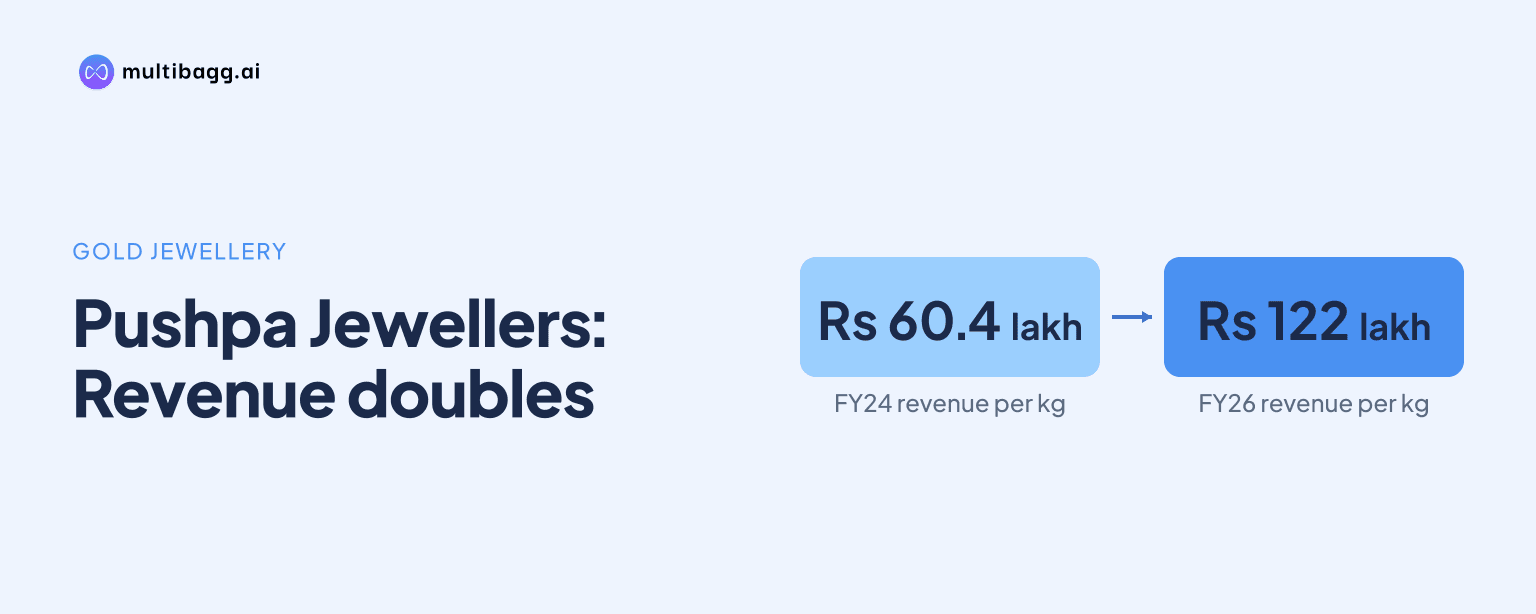
Pushpa Jewellers Limited sold 343 kilograms (kg) of gold jewellery in financial year 2026 (FY26), 19% below FY24’s 423 kg, while its derived revenue per kilogram increased 102% to ₹122 lakh from ₹60.4 lakh. Pushpa Jewellers’ FY26 sales mix therefore shows revenue growth alongside lower physical volume, with the presentation linking the higher value per kg to rising gold prices.
Know Pushpa Jewellers inside out
Results, valuation, peers and who's buying, in one view.
Why did Pushpa Jewellers sell fewer kilograms in FY26?
Pushpa Jewellers sold 343 kg of gold jewellery in FY26, down 80 kg, or 19%, from 423 kg in FY24. Volume also declined by 13 kg from FY25’s 356 kg, which the presentation describes as a 3.7% year-on-year reduction. The company’s reported metric is net weight of gold jewellery sold, rather than the number of jewellery units or transactions.
The decline occurred over two consecutive annual comparisons. FY25 volume of 356 kg was 67 kg below FY24, and FY26 volume was a further 13 kg lower than FY25. The presentation does not provide a segment-wise volume split, unit count, or a stated operational reason for the lower kilograms, so it cannot establish whether customer demand, product design, pricing, or another factor drove the fall.
Pushpa Jewellers’ management described its H1 FY27 product offering as lightweight, Bureau of Indian Standards (BIS)-hallmarked 22K and 18K gold jewellery. That commentary is consistent with a business emphasis on jewellery designs and price points rather than a disclosed target for kilograms sold, but management did not provide an annual FY26 product-category volume breakdown.
How much did Pushpa Jewellers’ revenue per kg increase?
Pushpa Jewellers’ derived revenue per kg sold rose to ₹122 lakh in FY26, compared with ₹78.9 lakh in FY25 and ₹60.4 lakh in FY24. The presentation highlights a ₹43 lakh increase from FY25 as gold prices rose. The FY26 figure was slightly more than twice the FY24 level, a 102% increase based on the presentation’s annual data.
The move was progressive across the three reported years: revenue per kg increased by ₹18.5 lakh in FY25 from FY24, then by ₹43 lakh in FY26 from FY25, according to the presentation. In contrast, gold jewellery volume fell in each of those years. This comparison shows that the value realised per kilogram increased faster than the decline in net weight, allowing reported revenue to rise despite fewer kilograms sold.
The ₹122 lakh metric is labelled “derived” in the investor presentation. It should consequently be read as a revenue-to-net-weight calculation supplied by Pushpa Jewellers, rather than a separately reported product selling price. It also does not separate the effect of gold prices from jewellery mix, including the lightweight 22K and 18K products management highlighted for H1 FY27.
Got a follow-up? Ask IRIS
How did Pushpa Jewellers’ sales mix change in FY26?
Pushpa Jewellers generated ₹414.9 crore of FY26 domestic sales, representing 99.2% of the sales mix, while export sales were ₹3.2 crore, or 0.8%. Domestic sales increased 51% year on year, according to the presentation, whereas exports declined from ₹6.13 crore in FY25. The reported sales base was therefore overwhelmingly domestic in FY26.
The mix data indicates a greater domestic contribution at the same time that export revenue fell by ₹2.93 crore from FY25. Pushpa Jewellers does not disclose export destinations, the export volume in kilograms, or reasons for the decline. The available figures therefore show the direction and relative scale of the mix change, but do not identify whether the export movement reflected pricing, customer demand, product availability, or timing.
Management’s H1 FY27 commentary said it was deepening relationships with wholesale and retail partners across India. It also said the business-to-business Trade Fulfilment Centre in Mumbai, launched on 4 August 2026, would extend wholesale reach in a key trading hub and bring the company closer to regional retail and corporate clients. Those statements relate to distribution plans after FY26, not to a disclosed FY26 domestic-volume measure.
Did higher revenue per kg lift Pushpa Jewellers’ profit margins?
Pushpa Jewellers’ total income rose to ₹419.55 crore in FY26 from ₹255.49 crore in FY24, while profit after tax rose to ₹25.89 crore from ₹13.26 crore. However, the earnings before interest, tax, depreciation and amortisation (EBITDA) margin was 9.39% in FY26, below 11.39% in FY25, and the profit-after-tax margin was 6.17%, below 7.92% a year earlier. Higher income therefore coincided with higher absolute profit but lower margins than FY25.
FY26 revenue was ₹418.39 crore, compared with ₹281.06 crore in FY25 and ₹255.34 crore in FY24. Raw-material expense increased to ₹366.94 crore in FY26 from ₹241.01 crore in FY25, while employee cost rose to ₹6.22 crore from ₹3.97 crore. The presentation reports these line items but does not attribute the 200-basis-point EBITDA-margin change to any individual cost or pricing factor.
Working-capital figures also changed during FY26. Inventory was ₹91.06 crore as at 31 March FY26, compared with ₹35.49 crore at 31 March FY25, and trade receivables increased to ₹35.51 crore from ₹19.66 crore. Cash flow from operating activities was negative ₹51.29 crore in FY26, versus negative ₹4.10 crore in FY25; the presentation provides the reported cash-flow values without assigning a cause to the movement.
Conclusion
Pushpa Jewellers’ FY26 numbers show a clear divergence between physical volume and value: gold jewellery sold fell from 423 kg in FY24 to 343 kg, while derived revenue per kg climbed from ₹60.4 lakh to ₹122 lakh. That shift accompanied total income of ₹419.55 crore and profit after tax of ₹25.89 crore, but EBITDA margin remained below the FY25 level at 9.39%.
The next disclosed items to watch are management’s execution on wider distribution, fresh lightweight designs and operational efficiencies, following the 4 August 2026 Mumbai Trade Fulfilment Centre launch. Management also said it had built inventory for the festive and wedding season, after FY26 inventory reached ₹91.06 crore; future disclosures can show whether that inventory supports sales while receivables and operating cash flow develop from the FY26 levels.