










Pushpa Jewellers Limited cuts bridal gold use by two-thirds
Key highlights
- Pushpa Jewellers’ three examples reduce gold weight by 17.7 g to 35.5 g per bridal piece.
- The stated lower capital per piece ranges from Rs 2.3 lakh to Rs 4.6 lakh at Rs 13,046 per gram of 22-karat gold.
- Necklaces accounted for 74.0% of Pushpa Jewellers’ FY26 revenue.
- Pushpa Jewellers added 2,222 designs in FY26, compared with 1,070 in FY25.
powered by IRIS
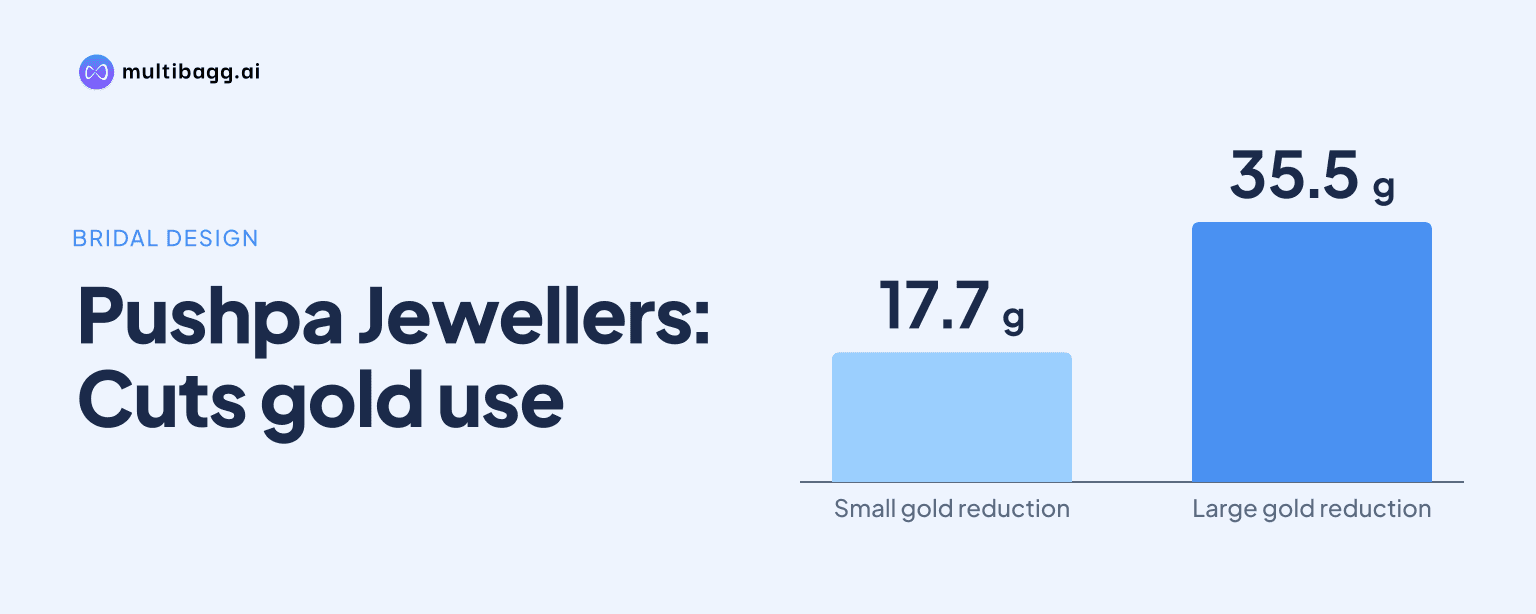
Pushpa Jewellers says its design room can retain a full bridal look while using about two-thirds less gold, with three examples reducing conventional weights from 27 g, 54 g and 30 g to 9.3 g, 18.5 g and 10.5 g. The presentation calculates lower capital per piece of Rs 2.3 lakh to Rs 4.6 lakh.
Know Pushpa Jewellers inside out
Results, valuation, peers and who's buying, in one view.
How does Pushpa Jewellers reduce gold in bridal designs?
Pushpa Jewellers reduces gold use by redesigning bridal pieces so that roughly two-thirds of the gold can be engineered out while retaining what it describes as a full bridal look. The stated mechanism is the design room’s work rather than a shift away from bridal jewellery. Its three illustrations start at conventional weights ranging from 27 g to 54 g and end at weights between 9.3 g and 18.5 g.
For jewellers buying these pieces, Pushpa Jewellers frames the outcome as lower capital per piece. The company calculates this as gold saved multiplied by a 22-karat gold rate of Rs 13,046 per gram. The three examples show savings of 17.7 g, 35.5 g and 19.5 g, with the stated reduction in capital per piece ranging from Rs 2.3 lakh to Rs 4.6 lakh.
The reduction is illustrated across different original weights. Design 1 cuts gold by 17.7 g from a conventional 27 g, Design 2 cuts 35.5 g from 54 g, and Design 3 cuts 19.5 g from 30 g. This is a product-design proposition for individual bridal items, rather than a reported change in Pushpa Jewellers’ total gold sold or inventory investment.
What do Pushpa Jewellers’ three lightweight designs save?
Pushpa Jewellers presents Design 2 as the largest absolute saving, cutting 35.5 g of gold and Rs 4.6 lakh of capital per piece. Design 1 saves 17.7 g and Rs 2.3 lakh, while Design 3 saves 19.5 g and Rs 2.5 lakh. The monetary amounts use the presentation’s 22-karat reference rate of Rs 13,046 per gram.
The examples show that the heaviest conventional piece also produces the largest stated capital reduction. Design 2 begins at twice Design 1’s 27 g conventional weight and finishes at 18.5 g, compared with 9.3 g for Design 1. Pushpa Jewellers presents both as designs that retain a full bridal look despite the lower gold content.
The Rs 2.3 lakh to Rs 4.6 lakh figures are design-level calculations, not company-wide inventory disclosures. Pushpa Jewellers provides the formula and gold rate used, but does not disclose the units sold for the three illustrated designs, their share of sales, or aggregate inventory capital released. The evidence therefore quantifies potential capital reduction per piece in these examples.
Got a follow-up? Ask IRIS
How important are necklaces to Pushpa Jewellers’ product mix?
Pushpa Jewellers is necklace-led, with necklaces accounting for 74.0% of FY26 revenue, compared with 12.9% for earrings and 13.1% for mala and others. The company lists necklaces at Rs 70,000 to Rs 2.9 lakh per piece, above the Rs 1.8 lakh upper end for both earrings and malas.
The FY26 necklace contribution rose 2.9 percentage points from 71.1% in FY25, although it remained just below the 74.1% reported in FY24. Earrings moved in the opposite direction, falling from 17.0% in FY25 to 12.9% in FY26. Mala and others increased from 11.9% to 13.1% over the same period.
Pushpa Jewellers lists more than 3,500 designs in its catalogue and a latest average price per piece of Rs 97,000. The range includes plain and studded 22-karat and 18-karat gold, Kundan and antique temple work, as well as emerald, jade, pearl and Meena. The catalogue also covers earrings, malas, bangles, mangalsutras, kadas and rings.
How does design activity support Pushpa Jewellers’ repeat orders?
Pushpa Jewellers added 2,222 new designs in FY26, 2.1 times the 1,070 added in FY25, while 1,638 existing designs were reordered in FY26. The presentation says jewellers reorder by design number, linking catalogue design activity to repeat purchases rather than relying only on exhibition bookings.
New designs accounted for 125 kg sold in FY26, up from 62 kg in FY25, while designs added during the year supplied 36% of FY26 kilograms, compared with 17% in FY25. Existing designs supplied 218 kg in FY26, down from 294 kg in FY25. Total kilograms from these two design-vintage categories declined from 356 kg in FY25 to 343 kg in FY26.
Pushpa Jewellers reports that 1,956 of 2,222 new FY26 designs found buyers, or about 88%, compared with 963 of 1,070, or about 90%, in FY25. It also says 284 kg of its 343 kg sold in FY26 came from existing customers, or about 80%. Exhibitions booked 24.3% of FY26 orders, down from 27.6% in FY25, while other channels including repeat orders represented 75.7%.
Pushpa Jewellers uses an outsourced karigar model in which independent artisans make products to company designs and specifications, with samples approved before bulk production. Design coding and computer-aided design and computer-aided manufacturing, or CAD/CAM, prototypes support the process. The presentation says 100% of dispatches are Bureau of Indian Standards, or BIS, hallmarked, following two to three quality checks.
Conclusion
Pushpa Jewellers’ three illustrations quantify a design objective of reducing the gold tied up in a bridal item while retaining a full bridal look. The stated saving ranges from 17.7 g to 35.5 g, or Rs 2.3 lakh to Rs 4.6 lakh per piece at the disclosed 22-karat gold rate, within a product mix in which necklaces supplied 74.0% of FY26 revenue.
What to watch next is whether the increase to 2,222 new designs in FY26 translates into sustained orders and kilograms sold. Pushpa Jewellers reports that new designs supplied 36% of FY26 kilograms and that 1,638 existing designs were reordered. It also discloses an enterprise resource planning implementation period of four to six months to strengthen workflows and controls as volumes grow.