










Pushpa Jewellers H1 income rose 83% as EBITDA margin fell
Key highlights
- Pushpa Jewellers' H1 FY27 total income increased 82.85% to ₹314.16 crore.
- Pushpa Jewellers' H1 FY27 EBITDA margin declined 123 basis points to 8.50%.
- Pushpa Jewellers' H1 FY27 profit after tax rose 83.27% to ₹20.21 crore.
- Pushpa Jewellers opened its Mumbai business-to-business trade fulfilment centre on 4 August 2026.
powered by IRIS
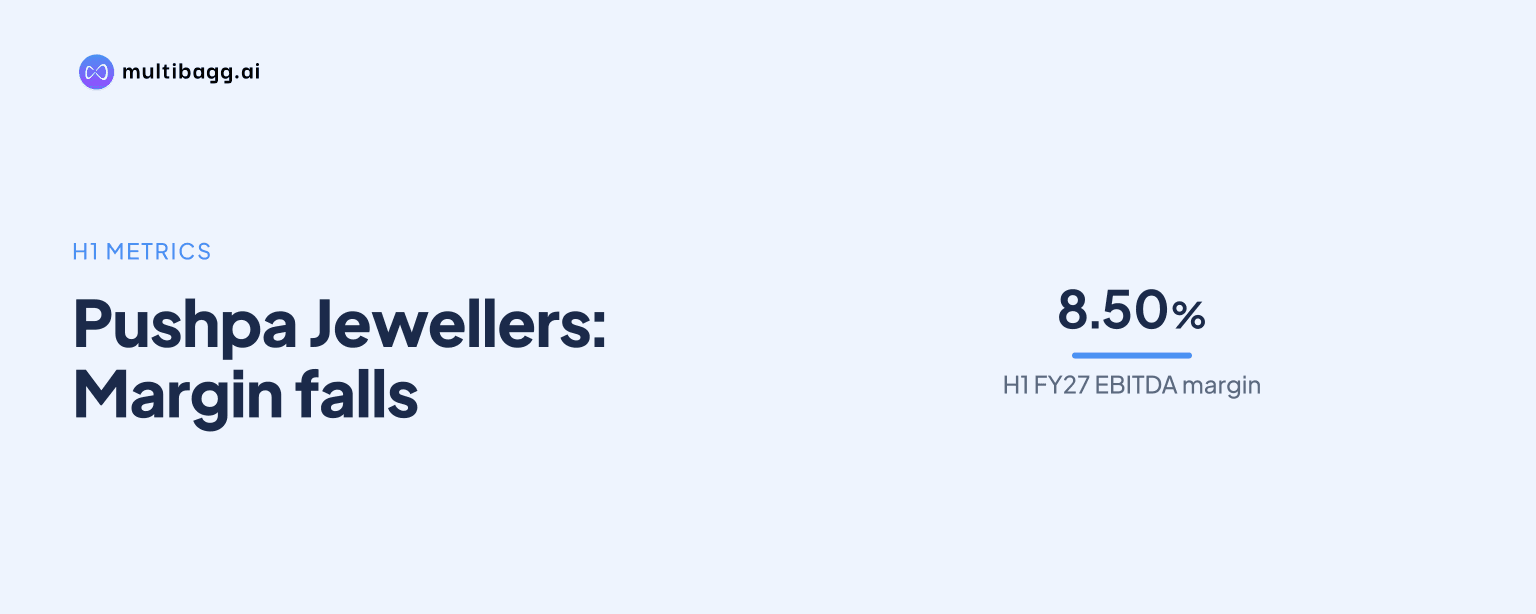
Pushpa Jewellers Limited reported H1 FY27 total income of ₹314.16 crore, up 82.85% year on year, while EBITDA margin declined 123 basis points to 8.50%. EBITDA rose 59.79% to ₹26.69 crore and profit after tax increased 83.27% to ₹20.21 crore, leaving net profit margin at 6.43%.
Know Pushpa Jewellers inside out
Results, valuation, peers and who's buying, in one view.
What drove Pushpa Jewellers' H1 FY27 income growth?
Pushpa Jewellers' total income increased by ₹142.34 crore, from ₹171.82 crore in H1 FY26 to ₹314.16 crore in H1 FY27. Revenue, excluding other income, rose by ₹143.13 crore to ₹314.11 crore, while other income fell from ₹83 lakh to ₹5 lakh. Management attributed the half-year performance to demand from retail jewellers for lightweight, Bureau of Indian Standards-hallmarked 22K and 18K gold jewellery.
Management positioned this product offering against higher gold prices and lower industry volumes. India gold-jewellery demand declined from 600 tonnes in calendar year 2022 to 431 tonnes in calendar year 2025, a reduction of 28%, according to the presentation. Over a separate period, the 24K gold price increased from ₹58,800 per 10 grams in calendar year 2023 to ₹1.43 lakh per 10 grams at the 29 June 2026 spot reading; management said lightweight designs can offer more accessible price points in that environment.
Why did Pushpa Jewellers' EBITDA margin decline in H1 FY27?
Pushpa Jewellers' earnings before interest, tax, depreciation and amortisation, or EBITDA, margin fell to 8.50% in H1 FY27 from 9.72% in H1 FY26, a decline of 123 basis points. EBITDA rose ₹9.99 crore to ₹26.69 crore, but its 59.79% growth rate was below the 82.85% increase in total income. One basis point equals one-hundredth of a percentage point.
Raw-material expenses rose by ₹128.33 crore to ₹277.11 crore, while total expenditure increased by ₹132.36 crore to ₹287.47 crore. Employee costs increased from ₹2.62 crore to ₹3.74 crore, and other expenses rose from ₹3.71 crore to ₹6.62 crore. These cost movements accompanied the margin change, although the presentation does not give a separate management explanation for the 123-basis-point decline.
The H1 movement followed a decline in annual EBITDA margin from 11.39% in FY25 to 9.39% in FY26. Over the same annual comparison, total income rose from ₹281.30 crore to ₹419.60 crore and EBITDA increased from ₹32.10 crore to ₹39.40 crore. The annual figures therefore also show income growth outpacing EBITDA growth, although they do not establish the cause of the H1 FY27 margin movement.
Got a follow-up? Ask IRIS
How did Pushpa Jewellers convert operating growth into net profit?
Pushpa Jewellers converted the H1 increase in income into profit after tax of ₹20.21 crore, compared with ₹11.03 crore a year earlier. That was an increase of ₹9.18 crore, or 83.27%, and net profit margin was 6.43%, compared with 6.42% in H1 FY26. The near-flat net profit margin contrasts with the decline in EBITDA margin during the same period.
Below EBITDA, finance costs declined by ₹38 lakh to ₹1.13 crore, while depreciation increased by ₹7 lakh to ₹56 lakh. Profit before tax rose from ₹14.71 crore to ₹25.00 crore, and tax expense increased from ₹3.68 crore to ₹4.79 crore. The presentation therefore records a ₹10.29 crore increase in profit before tax and a ₹9.18 crore increase in profit after tax.
Pushpa Jewellers' annual profit margins had also changed before H1 FY27. Profit after tax margin declined from 7.92% in FY25 to 6.17% in FY26, while profit after tax increased from ₹22.30 crore to ₹25.90 crore. This comparison shows that reported profit expanded in FY26 even as the annual margin declined, similar to the distinction between H1 FY27 profit growth and operating-margin compression.
How is Pushpa Jewellers preparing for festive and wedding demand?
Pushpa Jewellers said it had built inventory ahead of the festive and wedding season and opened a business-to-business trade fulfilment centre in Mumbai on 4 August 2026. Management said the Mumbai centre expands wholesale reach in a jewellery trading hub and brings the company closer to regional retail and corporate clients. The presentation does not disclose the inventory value, the centre's capacity or a revenue target for the facility.
Management said its next priorities are to widen distribution, introduce fresh lightweight designs and pursue operational efficiencies. It also cited computer-aided design and computer-aided manufacturing capabilities, known as CAD-CAM, and Kolkata's artisan network as mechanisms for launching collections quickly. These plans follow H1 FY27 revenue of ₹314.11 crore, but the presentation does not provide sales by geography, customer category or product category for the half year.
The lightweight focus is consistent with Pushpa Jewellers' FY26 volume and value data. Gold jewellery sold fell to 343 kilograms in FY26 from 356 kilograms in FY25 and 423 kilograms in FY24, while revenue per kilogram rose from ₹78.9 lakh in FY25 to ₹1.22 crore in FY26. Domestic sales accounted for ₹414.90 crore, or 99.2%, of FY26 revenue, whereas export sales were ₹3.20 crore, or 0.8%.
Conclusion
Pushpa Jewellers' results show that H1 FY27 sales and profit expanded materially while operating profitability as a percentage of income declined. The ₹142.34 crore increase in total income was accompanied by a ₹9.99 crore increase in EBITDA and a ₹9.18 crore rise in profit after tax. Higher raw-material, employee and other expenses coincided with EBITDA growth lagging income growth, while lower finance costs helped keep net profit margin almost unchanged.
The next disclosed matters to watch are management's use of inventory built for festive and wedding demand and execution at the Mumbai fulfilment centre opened on 4 August 2026. Management also plans to expand distribution, add lightweight designs and improve operational efficiency. It has not disclosed numerical targets for those initiatives, leaving subsequent reporting to indicate their effect on revenue, costs and the 8.50% EBITDA margin.