










De Neers shifts debt long term as working capital rises
Key highlights
- De Neers’ consolidated inventory increased from Rs 139.48 crore at FY26 to Rs 146.59 crore in H1FY27.
- De Neers’ sundry debtors rose by Rs 23.06 crore to Rs 74.69 crore in H1FY27.
- De Neers’ short-term borrowings fell from Rs 40.81 crore to Rs 9.30 crore, while long-term borrowings rose to Rs 60.17 crore.
- De Neers’ H1FY27 consolidated net sales grew 51.2% year on year to Rs 109.38 crore.
powered by IRIS
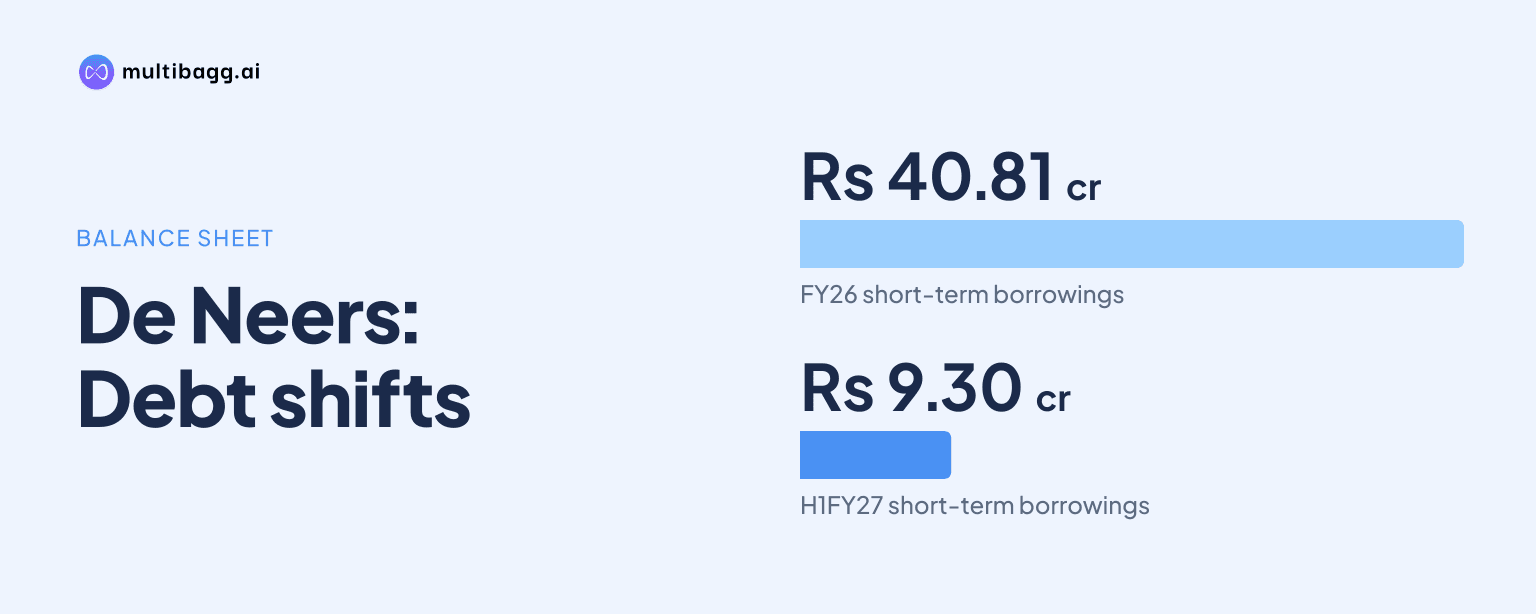
De Neers reported consolidated inventory of Rs 146.59 crore in H1FY27, while its funding mix moved toward long-term debt, with long-term borrowings rising to Rs 60.17 crore and short-term borrowings falling to Rs 9.30 crore. Sundry debtors and short-term loans and advances also rose, increasing total current assets to Rs 254.74 crore.
Know De Neers Tools inside out
Results, valuation, peers and who's buying, in one view.
What changed in De Neers’ H1FY27 balance sheet?
De Neers’ consolidated total assets increased by Rs 53.07 crore, from Rs 206.59 crore at FY26 to Rs 259.66 crore at H1FY27. Current assets made up Rs 254.74 crore of the H1FY27 total, compared with Rs 203.41 crore at FY26, while non-current assets increased from Rs 3.18 crore to Rs 4.92 crore.
The funding side changed alongside the asset increase. Total equity rose from Rs 95.34 crore at FY26 to Rs 150.70 crore in H1FY27, and total non-current liabilities increased from Rs 32.90 crore to Rs 60.54 crore. Consolidated current liabilities declined from Rs 78.35 crore to Rs 48.42 crore, although trade payables increased by Rs 4.45 crore to Rs 28.98 crore.
Reserves and surplus increased from Rs 76.70 crore to Rs 133.42 crore, while share capital was Rs 11.22 crore in H1FY27 versus Rs 18.61 crore at FY26. The H1FY27 balance sheet also reported Rs 5.95 crore received against warrants. The presentation provides the reported balances but does not explain the transactions behind the changes in these equity lines.
How much did De Neers’ inventory and receivables increase?
De Neers’ consolidated inventory rose by Rs 7.11 crore to Rs 146.59 crore in H1FY27, while sundry debtors rose by Rs 23.06 crore to Rs 74.69 crore. Together, these two operating current-asset lines increased by Rs 30.17 crore from their FY26 levels.
Receivables rose more in absolute terms than inventory during the half year, adding Rs 23.06 crore against the Rs 7.11 crore increase in stock. H1FY27 consolidated net sales were Rs 109.38 crore, up 51.2% year on year from Rs 72.34 crore, but the presentation does not disclose collection days, inventory turns, receivable ageing or a cash-flow statement.
Inventory remained the largest reported current asset at Rs 146.59 crore in H1FY27. De Neers reported 9,600 stock-keeping units, or SKUs, in H1FY27, up from 9,500 at FY26, but the presentation does not allocate inventory among product categories or individual SKUs.
Why did De Neers’ short-term loans and advances rise?
De Neers’ consolidated short-term loans and advances rose from Rs 10.21 crore at FY26 to Rs 30.12 crore in H1FY27, an increase of Rs 19.91 crore. This was the second-largest increase among the named current-asset lines after sundry debtors and contributed to the Rs 51.33 crore increase in total current assets.
The presentation does not identify the counterparties, purpose, tenure or recovery terms for the Rs 30.12 crore short-term loans and advances balance. Other current assets declined from Rs 1.18 crore at FY26 to Rs 0.12 crore in H1FY27, so they did not offset the increase in advances.
Cash and bank balances increased from Rs 0.91 crore to Rs 3.22 crore over the same period. Based on reported totals, consolidated current assets exceeded current liabilities by Rs 206.32 crore in H1FY27, compared with Rs 125.06 crore at FY26; this is a calculation from the balance sheet, not a management target.
Got a follow-up? Ask IRIS
How did De Neers change its borrowing mix?
De Neers shifted reported consolidated borrowings toward long-term debt in H1FY27. Long-term borrowings increased by Rs 27.63 crore to Rs 60.17 crore, while short-term borrowings fell by Rs 31.51 crore to Rs 9.30 crore.
Total reported borrowings therefore declined by Rs 3.88 crore, from Rs 73.35 crore at FY26 to Rs 69.47 crore in H1FY27, despite the material change in their composition. Total non-current liabilities were Rs 60.54 crore, including Rs 0.37 crore of other long-term liabilities, while current liabilities were Rs 48.42 crore.
The presentation does not disclose lenders, interest rates, repayment dates, security or the use of long-term borrowing proceeds. It reports H1FY27 finance cost of Rs 2.63 crore, compared with Rs 2.18 crore in H1FY26, while total borrowings stood at Rs 69.47 crore at the H1FY27 balance-sheet date.
What does the balance sheet show alongside H1FY27 profit growth?
De Neers’ H1FY27 consolidated sales increased 51.2% year on year to Rs 109.38 crore, and reported profit after tax increased 43.9% to Rs 12.66 crore. EBITDA, or earnings before interest, tax, depreciation and amortisation, rose from Rs 14.63 crore in H1FY26 to Rs 19.48 crore in H1FY27.
Profitability margins did not move in line with revenue growth. EBITDA margin was 17.8% in H1FY27, compared with 20.2% in H1FY26, a decline of 242 basis points, where one basis point equals one-hundredth of a percentage point. Management attributed the moderation primarily to strategic pricing adjustments for onboarding leading brands and large-volume orders in selected products.
Inventory, debtors and short-term loans and advances together stood at Rs 251.40 crore in H1FY27, versus Rs 201.32 crore at FY26. The source does not state a direct causal relationship between the Rs 50.08 crore increase in these balances, the 51.2% sales growth and the shift from Rs 40.81 crore of short-term borrowings to Rs 60.17 crore of long-term borrowings.
Conclusion
De Neers’ H1FY27 balance sheet shows that current assets increased by Rs 51.33 crore as inventory reached Rs 146.59 crore, debtors reached Rs 74.69 crore and short-term loans and advances reached Rs 30.12 crore. Total borrowings edged down to Rs 69.47 crore, but the balance moved materially from short-term toward long-term borrowings.
The next disclosed milestone is commercial production at DNSJV Private Limited’s Sonepat, Haryana manufacturing facility, which management targets by the middle of FY2027-28. Management also says it is evaluating entry into power tools, while the presentation does not provide terms or intended use for the Rs 30.12 crore of short-term loans and advances.