










Deepak Fertilisers links ammonia to mining explosives services
Key highlights
- Deepak Fertilisers reports a 40% market share for Mining Chemicals through DMSL.
- Croptek and specialty fertilisers contribute 33% of Crop Nutrition Business revenue.
- TAN business-to-consumer revenue mix rose to 16% in Q2 FY27 from 14% a year earlier.
- Deepak Fertilisers management is targeting a WHO-GMP-certified IPA facility by FY27.
powered by IRIS
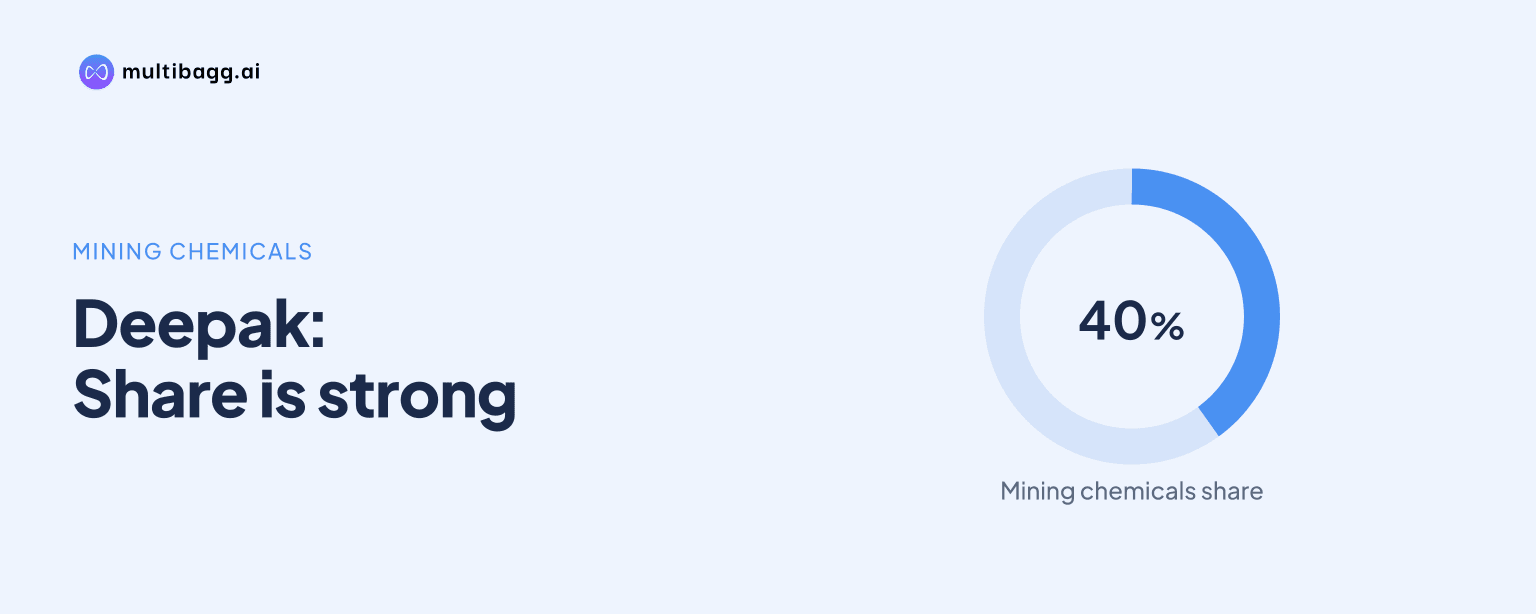
Deepak Fertilisers and Petrochemicals Corporation Limited is extending its ammonia-led chain into explosives, blasting and technical mine services while building crop-specific nutrition, with Mining Chemicals reporting a 40% market share and Croptek plus specialty fertilisers contributing 33% of Crop Nutrition Business revenue. The presentation describes a portfolio model that reaches beyond bulk chemical production.
Know Deepak Fertilisers & Petrochemicals Corp inside out
Results, valuation, peers and who's buying, in one view.
How does Deepak Fertilisers integrate its chemicals chain?
Deepak Fertilisers links sourced inputs and internal manufacturing to support availability, quality and reliability across fertilisers and industrial chemicals. Phosphoric acid is used for nitrogen-phosphorus-potassium fertiliser, sulphuric acid for ammonium nitro phosphate, and natural gas for ammonia. Ammonia is then used for nitric acid of various concentrations, ammonium nitrate melt or solids, and liquid carbon dioxide.
The company also connects propylene to isopropyl alcohol, propane, diisopropyl ether and N-propyl alcohol. This places ammonia within both Industrial Chemicals and Mining Chemicals, while phosphoric and sulphuric acid inputs support Crop Nutrition. The presentation shows an approximately 38% West India market share for an integrated position, but the displayed chart does not identify the relevant product.
Deepak Fertilisers operates across Mining Chemicals, Industrial Chemicals, Crop Nutrition and value-added real estate. Its footprint includes 8 manufacturing sites and more than 2,300 employees, with listed locations including Taloja in Maharashtra, Gopalpur in Odisha and Srikakulam in Andhra Pradesh. The presentation describes more than 40 years of experience in developing its three operating verticals.
What is Deepak Fertilisers' mining solutions strategy?
Deepak Fertilisers' mining strategy moves downstream from ammonia and ammonium nitrate into explosives, blasting technology, technical services and mine-productivity work. Deepak Mining Solutions Limited, or DMSL, is stated to have a 40% market share, plants on India’s east and west coasts, and India’s only production of high-density, low-density and medical-grade ammonium nitrate.
The stated sequence starts with a gas tie-up, then ammonia and ammonium nitrate, followed by explosives, initiating systems, blasting technology, technical services and downstream operations. The intended output is therefore not only an explosive product but safer, more consistent mine and quarry productivity, according to the presentation. Performance Chemistry Limited forms the upstream ammonia link, while Platinum Blasting Services represents the blasting-services part of the group structure.
Deepak Fertilisers reported a change in the Technical Ammonium Nitrate, or TAN, sales mix during Q2 FY27. Business-to-consumer revenue was 16% of TAN revenue, compared with 14% in the prior-year quarter, an increase of 2 percentage points.
This comparison is consistent with the presentation’s stated emphasis on customised solutions and last-mile execution in mining. However, Deepak Fertilisers does not separately disclose revenue from blasting services, technical services or downstream mine operations. Their individual financial contribution cannot therefore be established from the presentation.
How does Deepak Fertilisers position Industrial Chemicals?
Deepak Fertilisers positions Industrial Chemicals around nitric-acid grades, solvents and application-specific products rather than one bulk outlet. It describes itself as a nitric-acid category leader across South-East Asia, with a 60% concentrated nitric acid, or CNA, share and a 24% diluted nitric acid, or DNA, share. The two grades serve sectors including pharmaceuticals, agrochemicals, steel, solar, electronics, defence and explosives.
The solvents portfolio includes benzene-free isopropyl alcohol, or IPA, pharma solvents, diisopropyl ether and propane. It also includes food-grade liquid carbon dioxide, steel pickling solution, disinfectants and solar-grade nitric acid. The presentation identifies product grade and application requirements as routes into adjacent customer sectors such as cosmetics, inks, healthcare and food and beverages.
Management is targeting India’s first World Health Organization Good Manufacturing Practices-certified IPA facility by FY27. This is a management target rather than a reported certification. Deepak Fertilisers also lists semiconductor-grade IPA as in process, but the presentation provides neither a capacity figure nor a commissioning date for that product.
Got a follow-up? Ask IRIS
How is Deepak Fertilisers changing Crop Nutrition?
Deepak Fertilisers is changing Crop Nutrition by combining generic bulk fertilisers with crop-specific and specialty products. Croptek and specialty fertilisers contribute 33% of Crop Nutrition Business, or CNB, revenue, according to the presentation. The range includes Croptek C8, C9 and C11, water-soluble fertilisers, Solutek, bentonite sulphur, thiosulphate, bioliquid, PDM and Organik.
The company describes three stages in the transformation: plain-grade bulk fertilisers, higher-efficiency differentiated grades under Smartek, and Croptek crop-specific solutions supported by technical tie-ups and research and development. It also states that it is India’s only producer of crop nutrient solutions combining nitrogen, phosphorus and potassium with micronutrients and Nutrient Unlock Technology, or NUT.
A separate Q2 FY27 disclosure puts specialty products plus Croptek at 28% of Crop Nutrition revenue, unchanged from 28% in the prior-year quarter. This differs from the 33% CNB revenue figure on the Crop Nutrition portfolio page. Deepak Fertilisers does not reconcile the two measures or specify whether they reflect different periods or product classifications.
Generic products listed by Deepak Fertilisers include NP 24:24:00 and Smartek grades, while diammonium phosphate, muriate of potash and ammonium sulphate are marked as trading-only products. The Mahadhan brand is stated to be present in Maharashtra, Karnataka and Gujarat. The company also identifies itself as India’s largest bentonite sulphur manufacturer and the only manufacturer of prilled NP 24:24:0 fertiliser.
What capacity supports Deepak Fertilisers' integrated strategy?
Deepak Fertilisers' Taloja site combines fertiliser, ammonia, nitric acid, TAN, IPA and liquid carbon dioxide capacities, placing several links of the chain at one Maharashtra location. Listed capacities include 544 thousand metric tonnes per annum, or KMTPA, of TAN, 703 KMTPA of DNA, 139 KMTPA of CNA, 70 KMTPA of IPA and 800 KMTPA of nitrogen-phosphorus-potassium fertiliser.
The company’s Gopalpur facility on the east coast has 376 KMTPA of TAN capacity, while Srikakulam has 43 KMTPA of TAN and 34 KMTPA of weak nitric acid capacity. The presentation says these facilities are closer to their customer base and regional explosives manufacturers. At Dahej, listed capacity includes 300 KMTPA of DNA and 150 KMTPA of CNA, with proximity to Gujarat customers in nitroaromatics and nitrocellulose.
Conclusion
Deepak Fertilisers is using upstream integration to support two forms of downstream specialisation: explosives and productivity services for mining, and crop-specific or specialty formulations for agriculture. Its stated 40% Mining Chemicals market share, 16% Q2 FY27 TAN business-to-consumer mix and 33% CNB Croptek-specialty contribution show the strategic shift that consolidated profit figures alone do not separate.
What to watch next is management’s FY27 target for a World Health Organization Good Manufacturing Practices-certified IPA facility, the in-process semiconductor-grade IPA product and strategic capital expenditure expected to contribute in Q4. The presentation also leaves unresolved how the 33% CNB Croptek-specialty contribution relates to the separately reported 28% Q2 FY27 measure.