










Deepak Fertilisers: Industrial Gains Offset Crop Revenue Fall
Key highlights
- Industrial chemicals revenue increased 24% year-on-year to Rs 592 crore in Q2 FY27.
- Mining chemicals revenue rose 25% to Rs 734 crore despite an 8% decline in volume to 126 KMT.
- Crop nutrition revenue fell 13% year-on-year to Rs 1,494 crore but increased 9% from Q1 FY27.
- Q2 FY27 operating EBITDA increased 62% year-on-year to Rs 750 crore and margin reached 22.5%.
powered by IRIS
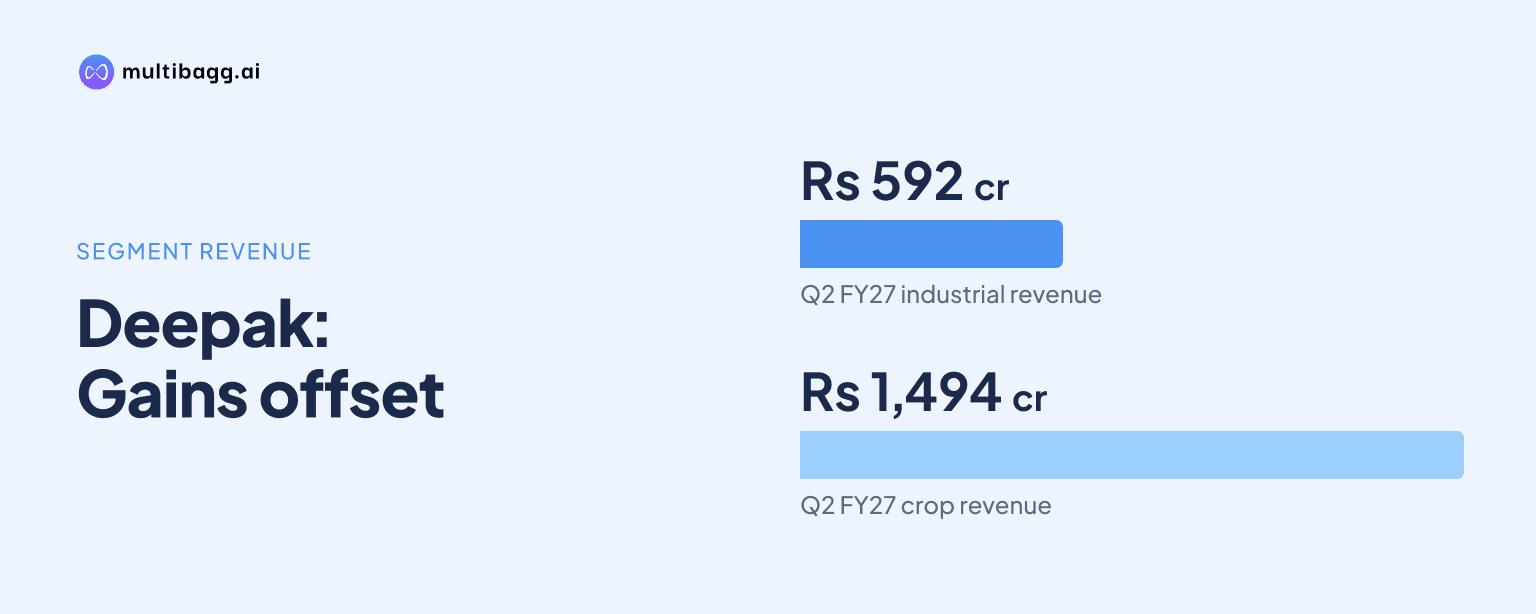
Deepak Fertilisers and Petrochemicals Corporation Limited reported Q2 FY27 industrial chemicals revenue of Rs 592 crore, up 24% year-on-year, while crop nutrition revenue fell 13% to Rs 1,494 crore; mining chemicals revenue rose 25% to Rs 734 crore, helping consolidated operating EBITDA increase 62% to Rs 750 crore.
Know Deepak Fertilisers & Petrochemicals Corp inside out
Results, valuation, peers and who's buying, in one view.
How did Deepak Fertilisers’ segments compare in Q2 FY27?
Deepak Fertilisers recorded year-on-year revenue growth in industrial chemicals and mining chemicals in Q2 FY27, while crop nutrition declined from the prior-year quarter. Crop nutrition remained the largest of the three disclosed businesses at Rs 1,494 crore, compared with Rs 734 crore for mining chemicals and Rs 592 crore for industrial chemicals.
The comparison shows that industrial chemicals also delivered the clearest sequential revenue improvement, rising 21% from Rs 490 crore in Q1 FY27. Mining chemicals revenue declined 19% sequentially from Rs 904 crore, while crop nutrition revenue increased 9% from Rs 1,367 crore despite lower volumes in several product categories.
Why did Deepak Fertilisers’ industrial chemicals revenue rise?
Deepak Fertilisers’ industrial chemicals revenue rose 24% year-on-year to Rs 592 crore because of better IPA realisations and higher nitric acid volume, according to the presentation. The Rs 592 crore result was also 21% above Q1 FY27 revenue of Rs 490 crore, which management attributed to better IPA realisations.
Total nitric acid volume reached 80 KMT, or thousand metric tonnes, in Q2 FY27, up 14% from a year earlier and 9% from Q1 FY27. The presentation’s CNA+SNA category reported 53 KMT, versus 46 KMT in Q2 FY26 and 48 KMT in Q1 FY27, while its DNA category reached 27 KMT, compared with 24 KMT and 26 KMT, respectively.
IPA sales volume was 17 KMT in Q2 FY27, up 2% year-on-year and 303% from 4 KMT in Q1 FY27 following restoration of supplies. Deepak Fertilisers reported capacity utilisation of 111% for DNA, 81% for CNA and 95% for IPA, and said IPA prices remained supported by supply tightness even as supplies remained constrained.
How did Deepak Fertilisers’ mining chemicals business perform?
Deepak Fertilisers’ mining chemicals revenue increased 25% year-on-year to Rs 734 crore in Q2 FY27 despite an 8% decline in sales volume to 126 KMT. The presentation attributed the revenue gain to elevated prices and attributed the volume decline to monsoon-related moderation and an export ban.
Revenue was nevertheless 19% below Rs 904 crore in Q1 FY27 because of a moderation in pricing during Q2 FY27. Business-to-business volume was 108 KMT, unchanged sequentially but down from 115 KMT in Q2 FY26, while business-to-consumer volume was 18 KMT, compared with 21 KMT in Q1 FY27 and 17 KMT a year earlier.
Business-to-consumer revenue rose 40% year-on-year and accounted for 16% of mining chemicals revenue in Q2 FY27, up from 14% in Q2 FY26. Export volume was 0.2 KMT, against 5 KMT a year earlier, while capacity utilisation stood at 93%; management expects mining and infrastructure activity to recover after the monsoon.
Got a follow-up? Ask IRIS
Why did Deepak Fertilisers’ crop nutrition revenue fall?
Deepak Fertilisers’ crop nutrition revenue fell 13% year-on-year to Rs 1,494 crore in Q2 FY27 because volume losses followed deficient rains in core geographies and a phosphoric acid shortage. Revenue still rose 9% from Rs 1,367 crore in Q1 FY27, as improved pricing partly offset the volume impact.
ANP+Smartek sales volume was 134 KMT, up 5% from 128 KMT in Q1 FY27 but down 38% from 215 KMT in Q2 FY26. Croptek volume declined to 40 KMT from 57 KMT a year earlier and 67 KMT sequentially, declines of 29% and 40%, respectively, as stated in the presentation.
Specialty fertiliser volume was 8 KMT in Q2 FY27, compared with 17 KMT in Q2 FY26 and 31 KMT in Q1 FY27. Deepak Fertilisers said elevated raw-material costs and the Maharashtra state specialty ban affected that business; ANP capacity utilisation was 60% and NPK capacity utilisation was 35% during the quarter.
Phosphoric acid bulk cost and freight pricing was $1,700 per metric tonne in Q2 FY27, up from $1,258 in Q2 FY26 and $1,360 in Q1 FY27. Ammonia bulk free-on-board Middle East pricing was $621 per metric tonne, compared with $340 a year earlier but below $762 in Q1 FY27; management said sharper market focus and activation were aimed at addressing weather conditions and elevated inventory.
What did segment performance mean for Deepak Fertilisers’ earnings?
Deepak Fertilisers reported consolidated operating revenue of Rs 3,334 crore in Q2 FY27, up 11% from Rs 3,006 crore in Q2 FY26 and 2% from Rs 3,256 crore in Q1 FY27. Revenue growth in industrial and mining chemicals occurred alongside the 13% year-on-year decline in crop nutrition, the largest disclosed segment.
Operating EBITDA, or earnings before interest, tax, depreciation and amortisation, rose 62% year-on-year to Rs 750 crore and the operating EBITDA margin rose to 22.5% from 15.4%. Operating EBITDA was 11% below Rs 845 crore in Q1 FY27, while net profit was Rs 394 crore, up 84% year-on-year but down 20% sequentially from Rs 490 crore.
For the first half of FY27, operating revenue was Rs 6,590 crore, 16% higher than Rs 5,665 crore in the first half of FY26. Operating EBITDA increased 63% to Rs 1,595 crore, net profit increased 93% to Rs 884 crore, and the presentation cited global supply tightness and Equinor gas as factors that helped sustain margins.
Conclusion
Q2 FY27 showed that Deepak Fertilisers’ industrial chemicals and mining chemicals businesses generated year-on-year revenue gains of 24% and 25%, respectively, even as crop nutrition revenue declined 13%. The segment mix, alongside higher consolidated operating EBITDA of Rs 750 crore, indicates that chemicals pricing and nitric acid volumes offset part of the crop business’s weather, input and inventory pressures.
The next disclosed event is the expected Q4 FY27 commercial operation of two projects, both reported as 98% complete. The Gopalpur TAN project has planned capacity of 376 KTPA and capex of Rs 2,675 crore, while the Dahej nitric acid project has planned capacity of 300 KTPA and 150 KTPA across its two listed products, with capex of Rs 1,983 crore and 65% of CNA capacity tied to a 20-year contract.